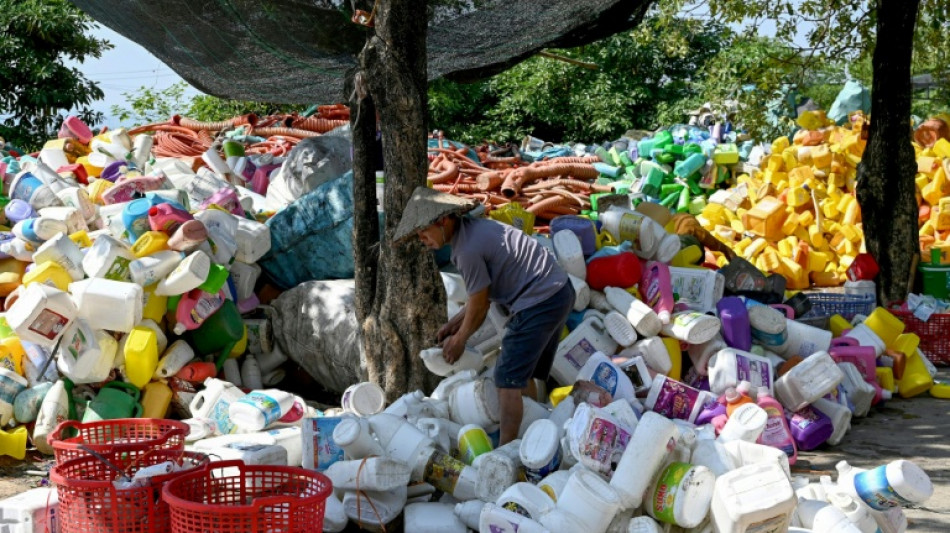
'Waiting to die': the dirty business of recycling in Vietnam / Photo: Nhac NGUYEN - AFP

 Amaze Holdings (NYSE: AMZE) Executes Binding LOI to Acquire BullionFX | Alchemy, a Decentralized Gold-Backed Financial Ecosystem for Valued at US$155 Million

 Clashes between French teens, police as school blockades intensify
 Stocks move sideways despite oil moving lower

 African leaders to gather in Egypt for business summit
 UK decides against charging foreign visitors for museums

 Dallaglio to sell England World Cup winners' medal

 Brazil come from behind to beat Australia 4-2 in friendly

 Ruthless An retains Asian Games badminton crown as Kunlavut triumphs

 Alonso to stay with F1 team Aston Martin in 2027
 China badminton 'still strong' despite Asian Games slump
 'Exceptional' Turner painting shown in Rome before sale

 European stocks climb as oil dips

 Spain aims to ban evictions until 2030 amid housing protests

 Kunlavut first Thai man to win Asian Games badminton singles gold

 French far right says antisemitism claims part of 'total war' to derail presidency bid

 'Gift from God': Rain brings relief from Indonesia toxic haze
 Ex-world snooker champion jailed for 7 years for child sex crimes
 French teens clash with police as school blockades intensify

 FIFA accuses UEFA of 'misinformation campaign' in bid for World Cup papers

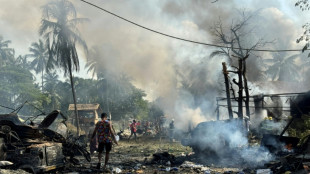 Myanmar airstrike toll hits 50 as families gather dead
 STARTRADER Raises Lloyd's of London Client Fund Insurance to USD 30 Million in Aggregate
 North Korean DMZ landmine blasts 'violation of armistice': Seoul

 Sabalenka 'fresh' for first tournament since losing No.1 spot
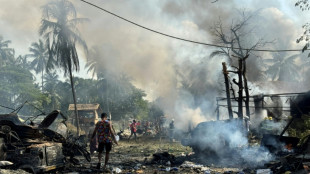 Myanmar airstrike death toll rises to 50: aid workers
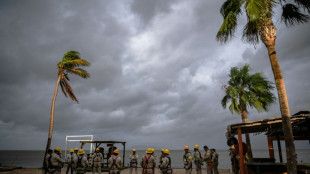
 North Korean DMZ landmine blast 'violation of armistice'

Crouched between mountains of discarded plastic, Lanh strips the labels off bottles of Coke, Evian and local Vietnamese tea drinks so they can be melted into tiny pellets for reuse.
More waste arrives daily, piling up like technicolour snowdrifts along the roads and rivers of Xa Cau, one of hundreds of "craft" recycling villages encircling Vietnam's capital Hanoi where waste is sorted, shredded and melted.
The villages present a paradox: they enable reuse of some of the 1.8 million tonnes of plastic waste Vietnam produces each year, and allow employees to earn much-needed wages.
But recycling is done with few regulations, pollutes the environment and threatens the health of those involved, both workers and experts told AFP.
"This job is extremely dirty. The environmental pollution is really severe," said Lanh, 64, who asked to be identified only by her first name for fear of losing her job.
It is a conundrum facing many fast-growing economies, where plastic use and disposal has outpaced the government's ability to collect, sort and recycle.
Even in wealthy countries, recycling rates are often abysmal because plastic products can be expensive to repurpose and sorting rates are low.
But the rudimentary methods used in Vietnam's craft villages produce dangerous emissions and expose workers to toxic chemicals, experts say.
"Air pollution control is zero in such facilities," said Hoang Thanh Vinh, an analyst at the United Nations Development Programme focused on waste recycling.
Untreated wastewater is often dumped directly into waterways, he added.
The true scale of the problem is hard to judge, with few comprehensive studies.
In one village, Minh Khai, Vinh said a sediment analysis found "very high contamination of lead and the presence of dioxins", as well as furan -- all of which have been linked to cancer.
And in 2008, the life expectancy for residents of the villages was found to be a full decade shorter than the national average, according to the environment ministry.
Local authorities and the environment ministry did not reply to AFP's requests for comment.
Lanh believes the toxic waste in Xa Cau gave her husband blood cancer, but she still spends her days sorting rubbish to pay his medical bills.
"This village is full of cancer cases, people just waiting to die," she said.
- Sickness and wealth -
No data exists on cancer rates in the villages, but AFP spoke to more than half a dozen workers in Xa Cau and Minh Khai who reported colleagues or family members with cancer.
Xuan Quach, coordinator of the Vietnam Zero Waste Alliance, said sustained exposure to the "toxic environment" made it inevitable that residents face "health risks that are of course higher".
Dat, 60, has been sorting plastic in Xa Cau for a decade and said the job "definitely affects your health".
"There's no shortage of cancer cases in this village."
But there is also no shortage of workers, keen for the economic lifeline recycling provides.
In Xa Cau, plastic piles up around multi-storey homes, some with ornate facades noting the years they were built.
"We get richer thanks to this business," said 58-year-old Nguyen Thi Tuyen, who lives in a two-storey home.
"Now all the houses are brick houses... In the past, we were just a farming village."
Most of the waste the villagers recycle is home-grown, researchers and residents say.
But even though Vietnam only recycles about a third of its own plastic waste, it also imports thousands of tons annually from Europe, the United States and Asia.
Imports soared after China stopped accepting plastic waste in 2018, though recently Vietnam has tightened regulations and announced plans to phase out imports too.
For now, US and EU trade statistics show shipments to Vietnam from the two economies reached over 200,000 tonnes last year.
In Minh Khai, the owner of a plant producing plastic pellets said domestic supply "is not enough".
"I have to import from overseas," 23-year-old Dinh, who only gave one name, explained over the whir of heavy machinery.
Most domestic waste doesn't get sorted, so it cannot easily be reused.
There have been efforts to improve the industry, including a ban on burning unrecyclable waste and building modern facilities.
But burning continues and unusable waste is often dumped in empty lots, according to Vinh.
He said the government should help recyclers move to industrial parks with better environmental safeguards, formalising a sector that handles a quarter of the country's recycling.
"The current way of recycling in recycling villages... is not good to the environment at all."
P.Smith--AT