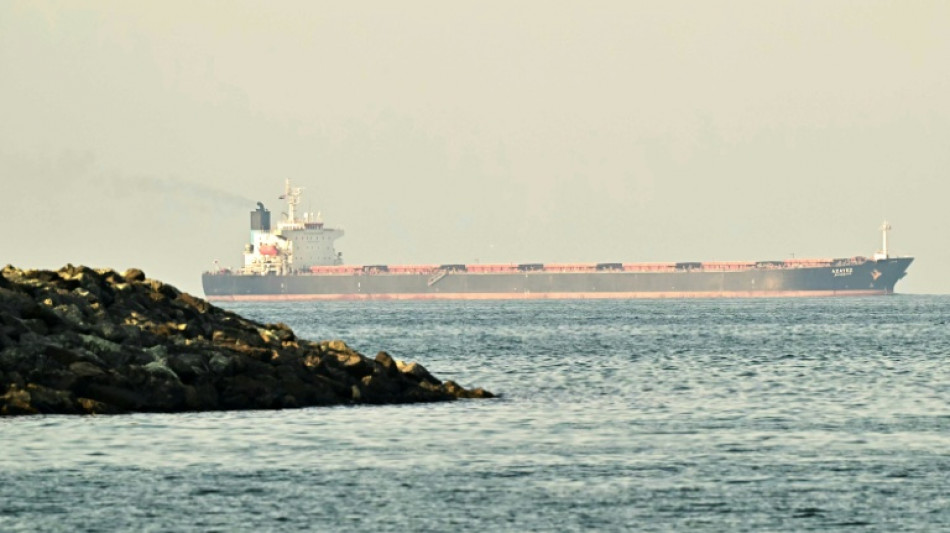
Securing the Strait of Hormuz: Tactics and threats / Photo: Giuseppe CACACE - AFP

 'I call it a bribe': Pennsylvania residents spurn $10,000 data center checks

 In a former US steel city, ordinary people struggle to get by

 'Liar,' 'clown': Lula and Bolsonaro spar in Brazil poll debate

 Record El Nino? Depends who's counting

 On the front line of ocean conservation off Portugal's Madeira

 Wembanyama targets title breakthrough as NBA season tips off

 With LeBron on board it's title or bust for Philly fans
 One year after Louvre heist, where are the missing jewels?

 Knicks face tall task in NBA championship repeat bid

 Warriors' Curry 'fine' after limping out of practice - Kerr

 Zelensky speaks to US envoys as Trump lashes out

 'Surprise package' Lazio crush Juve to keep pace with Serie A leaders Inter

 China growth expected to miss official target in third quarter

 Lazio crush Juventus to move level with Serie A leaders Inter

 Leeds draw feels like 'fresh start' for Man Utd's Carrick

 Macron denounces 'unbridled' violence as France hit by new clashes

 Hurzeler lauds 'hard worker' Gomez after Brighton goal from halfway line
 Toulouse hold off Exeter, Northampton save English Champions Cup blushes

 Arsenal snatch late win to keep pressure on Man City as Man Utd held
 Arsenal strike late to keep pressure on Man City as Man Utd held

 Four soldiers dead, dozens injured in fire at Canada military base

 Ton-up Agha helps Pakistan down Sri Lanka in tri-series opener

 Man Utd draw at Leeds keeps pressure on Carrick

 Barca defenders Garcia, Kounde injured before key games

 Lula, Bolsonaro to face off in first debate of bruising election
President Donald Trump is pressuring allies to help secure the Strait of Hormuz, a key maritime choke point that has effectively been closed by Iran in response to the US-Israeli war launched last month.
Trump highlighted the dangers in remarks on Monday, noting that a "single terrorist" could "put something in the water" or shoot a missile at ships transiting the narrow waterway bordering the Islamic republic.
Trump said a number of countries that he did not specify had committed to help, while taking aim at others that were not "enthusiastic" about doing so.
AFP examines how an escort mission could work, and the threats to vessels in the strait.
- Escorting ships -
In an escort mission, navy ships would seek to provide cover for tankers going through the Strait of Hormuz and also respond if the commercial ships were fired upon, said Jonathan Schroden, chief research officer at the Center for Naval Analyses, near Washington.
"They would try to do it in more of a convoy kind of manner... where you muster up a handful of tankers and then you have one or several navy ships escort them through," he said.
Smaller vessels such as destroyers and frigates would be best suited for the mission, which could also involve air cover from helicopters, fixed-wing aircraft, or both.
"Navy surface ships with some degree of air support would be primarily how you would do that," Schroden said.
- Mines -
The US Navy escorted tankers through the Gulf to protect them from Iranian attacks during the Iran-Iraq war in the 1980s. Mines were a threat during that operation -- dubbed Earnest Will -- and could be again.
Trump said Monday that the United States had hit all of Iran's mine-laying ships -- destroying more than 30 of them -- but that the mines could be transferred to other vessels for deployment.
Schroden also noted that Iran had "multiple means of putting (mines) into the water."
Trump added that Washington did not know if any mines had actually been placed in the Strait of Hormuz by Iran.
- Missiles, drones, boats -
Washington says Iran's navy has largely been destroyed, but Tehran has missiles, drones and small attack vessels that could also be used to threaten maritime traffic in the Strait of Hormuz.
Iran's "small boats and fast attack craft... have a variety of armaments on them that they could launch to try and... hit tankers or navy ships at a surface level," Schroden said.
They also have "a whole host of missiles that they can bring to bear. And then they have... Shahed drones and other drones that they manufacture that they could also employ," he said, referring to Iran's extensive arsenal of one-way attack drones.
"They have a wide variety of threats that they can bring to bear," Schroden added.
A.Ruiz--AT