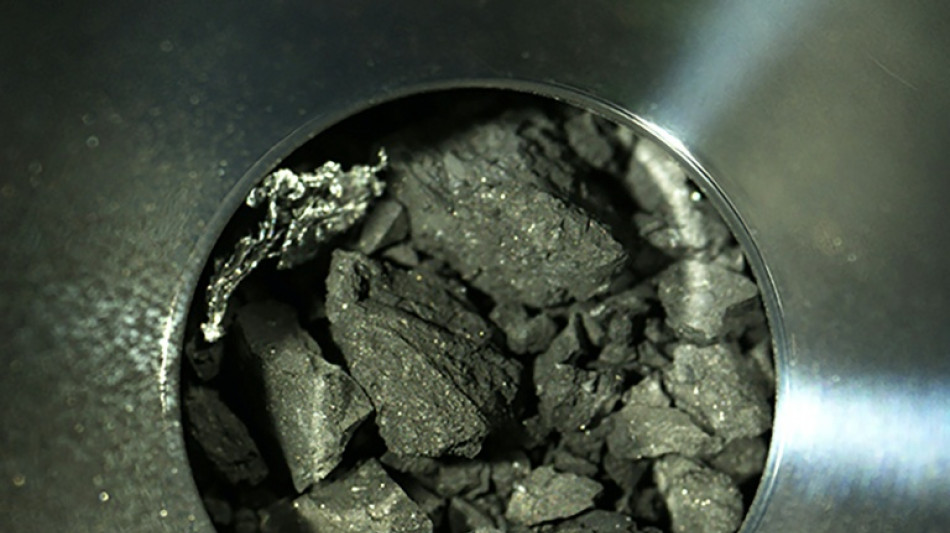
Ingredients of life discovered in Ryugu asteroid samples / Photo: Handout - JAXA/AFP/File

 Madrid mourns evicted retiree, 'icon' of Spain housing protests

 OpenAI revenue gap report rattles AI stocks

 France pledges more teachers after school students vow no let-up
 Bordeaux confirmed in sixth tier of French football

 Trump gives 'national treasure' Musk top US medal after rift

 MLB proposes shortening season, reforming playoffs

 Crew splashes down after 8-month mission on International Space Station

 Protests, clashes as S. African anti-migrant tensions reignite
 Russian data centre hit by drone in first for Ukraine war

 'Fighting for our future': France high school students vow no let-up

 Kyiv entering 'survival' mode amid Russian strikes surge: mayor tells AFP

 Verdict due in Mexico trial over murders of Australia, US surfers

 B2PRIME Welcomes Christina Barbash as Commercial Manager

 Russia forcing Kyiv into 'survival' mode before winter, mayor tells AFP

 Closing arguments begin in Maradona death trial

 UEFA president Ceferin to stand for re-election in 2027

 Nearly 300,000 Nepalis at flood risk: study

 Riyadh kindergarten hit by interception debris as Houthis say targeted airport

 Alex Bodi mizează, alături de CRIF, pe investiții transparente și pe prevenirea riguroasă a spălării banilor

 Gulf Labs, Part of Thailand’s $27 Billion GULF Group, Goes Live as an Injective Validator

 EU okay for winter despite 'historically low' gas stocks: operators

 Rwanda to host F1 Grand Prix: sources close to both sides

 EU top diplomat says bloc in favour of UN Lebanon peacekeepers' extension

 Antonelli and Russell to run different Mercedes aero packages in Singapore

 WTO hikes 2026 trade growth forecast on AI boom

All the essential ingredients to make the DNA and RNA underpinning life on Earth have been discovered in samples collected from the asteroid Ryugu, scientists said Monday.
The discovery comes after these building blocks of life were detected on another asteroid called Bennu, suggesting they are abundant throughout the Solar System.
One longstanding theory is that life first began on Earth when asteroids carrying fundamental elements crashed into our planet long ago.
The asteroids that hurtle through our Solar System give scientists a rare chance to study this possibility.
In 2014, the Japanese spacecraft Hayabusa-2 blasted off on a 300-million-kilometre (185-million-mile) mission to land on Ryugu, a 900-metre-wide (2,950-feet-wide) asteroid.
It successfully managed to collect two samples of rocks weighing 5.4 grams (under a fifth of an ounce) each and bring them back to Earth in 2020.
Research in 2023 showed that these samples contained uracil, which is one of the four bases that make up RNA.
While DNA, the famed double helix, functions as a genetic blueprint, single-strand RNA is an all-important messenger, converting the instructions contained in DNA for implementation.
On Monday, a new study by a Japanese team of researchers in Nature Astronomy demonstrated that the samples contained all the "nucleobases" for both DNA and RNA.
These included uracil as well as adenine, guanine, cytosine and thymine.
This "does not mean that life existed on Ryugu", the study's lead author, Toshiki Koga, told AFP.
"Instead, their presence indicates that primitive asteroids could produce and preserve molecules that are important for the chemistry related to the origin of life," added the biochemist from the Japan Agency for Marine-Earth Science and Technology.
The discovery also "demonstrates their widespread presence throughout the Solar System and reinforces the hypothesis that carbonaceous asteroids contributed to the prebiotic chemical inventory of early Earth," according to the study.
Cesar Menor Salvan, an astrobiologist at Spain's University of Alcala not involved in the research, emphasised that "these results do not suggest that the origin of life took place in space".
However, "with this and the results from Bennu, we have a very clear idea of which organic materials can form under prebiotic conditions anywhere in the universe," he added.
- 'Unique' ammonia finding -
Last year, the same building blocks were found in fragments brought back to Earth by NASA from the asteroid Bennu.
Scientists have also detected their presence in the meteorites Orgueil and Murchison, which were part of asteroids that fell to Earth.
For the new research, the Japanese team compared the amount of each nucleobase detected in these different space rocks, finding the quantities varied depending on their history.
They also identified a correlation between the ratios of the building blocks and the concentration of another important chemical for life: ammonia.
"Because no known formation mechanism predicts such a relationship, this finding may point to a previously unrecognised pathway for nucleobase formation in early Solar System materials," Toshiki Koga said.
Morgan Cable, a scientist at the Victoria University of Wellington in Australia not involved in the research, called this particular finding "unique".
"This discovery has important implications for how biologically important molecules may have originally formed and promoted the genesis of life on Earth," she said.
R.Garcia--AT