Will Yemen's Houthis join the Mideast war? / Photo: Mohammed HUWAIS - AFP

 Australia's new Ghost Shark submarines grow some 'teeth'
 'I call it a bribe': Pennsylvania residents spurn $10,000 data center checks

 In a former US steel city, ordinary people struggle to get by
 'Liar,' 'clown': Lula and Bolsonaro spar in Brazil poll debate

 Record El Nino? Depends who's counting
 On the front line of ocean conservation off Portugal's Madeira

 Wembanyama targets title breakthrough as NBA season tips off

 With LeBron on board it's title or bust for Philly fans
 One year after Louvre heist, where are the missing jewels?

 Knicks face tall task in NBA championship repeat bid

 Warriors' Curry 'fine' after limping out of practice - Kerr

 Zelensky speaks to US envoys as Trump lashes out

 'Surprise package' Lazio crush Juve to keep pace with Serie A leaders Inter

 China growth expected to miss official target in third quarter

 Lazio crush Juventus to move level with Serie A leaders Inter

 Leeds draw feels like 'fresh start' for Man Utd's Carrick

 Macron denounces 'unbridled' violence as France hit by new clashes

 Hurzeler lauds 'hard worker' Gomez after Brighton goal from halfway line

 Toulouse hold off Exeter, Northampton save English Champions Cup blushes

 Arsenal snatch late win to keep pressure on Man City as Man Utd held
 Arsenal strike late to keep pressure on Man City as Man Utd held

 Four soldiers dead, dozens injured in fire at Canada military base

 Ton-up Agha helps Pakistan down Sri Lanka in tri-series opener

 Man Utd draw at Leeds keeps pressure on Carrick

 Barca defenders Garcia, Kounde injured before key games

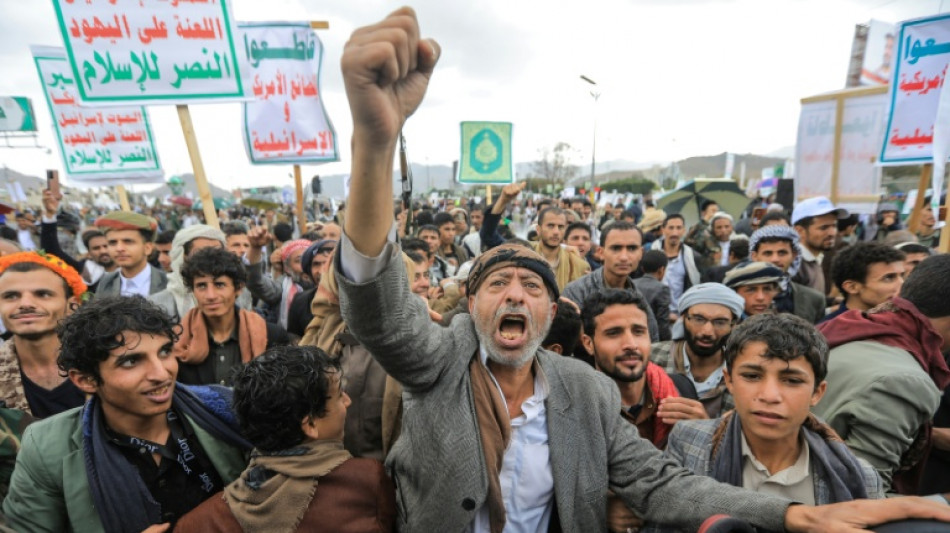
With assault rifles, daggers and posters of Iran's late Ayatollah Ali Khamenei waving in the air as tens of thousands chant "death to America, death to Israel", there's little mistaking where the loyalties of Yemen's Houthis lie.
But will the battle-hardened militia backed by the Islamic republic join the war with the United States and Israel?
Since the Middle East war erupted, the Houthis have held regular demonstrations in their capital Sanaa, where supporters have come out in full force to rally behind their brothers in arms in Iran.
The Houthis' leader has insisted the group is prepared to join the fray but has stopped short of issuing orders to join the war.
"Our fingers are on the trigger, ready to respond at any moment should developments warrant it," Abdul Malik al-Houthi told his ranks.
Following the Hamas attacks against Israel in October 2023, the Houthis slowed traffic in the Red Sea and the Suez Canal to a trickle, with occasional barrages of missiles and drones keeping insurance rates high and pushing shippers to alternative routes.
The strategy proved to be prescient, with the Houthis backers in Iran using the same blueprint to paralyse the Strait of Hormuz, a waterway that is crucial to the global transit of crude and liquefied natural gas.
From their mountainous perch overlooking the Red Sea, the Houthis effectively have a gun pointed at the temple of the Gulf economies, with any shot likely to further rattle global markets.
"The Houthis are holding in place, signalling readiness, and keeping their options open while they avoid immediate US or Israeli retaliation," Mohammed al-Basha of the US-based risk advisory Basha Report told AFP of the Houthis' current posture.
According to a map by the energy analysis firm Kpler, an armada of tankers stretching from the Strait of Malacca near Singapore to gates of the Red Sea are racing to export terminals in Saudi Arabia's Yanbu to fill their cavernous hulls.
There, a network of pipes bisecting the Arabian Peninsula connects the storage tanks, refineries and oil fields along the Gulf coast in the east to the Red Sea to the west -- supplying up to seven million barrels of oil a day to the market.
The plan however only works if the Houthis stay on the sidelines.
"At what point do the Houthis begin attacking oil infrastructure along the Red Sea at Iran’s request?" wrote Malcolm Davis, a senior analyst at the Australian Strategic Policy Institute.
- 'Exhausted' -
For ordinary Yemenis, who have already weathered over a decade of war, more violence would only bring more hardship to their lives.
"People are exhausted and worn out," a 32-year-old lawyer in Sanaa told AFP, asking not to be named.
"They can't afford clothes, or medical care, or even food and drink, and they absolutely can't bear another war."
But the Houthis' calculations remain complex.
They entered the global stage as Yemen descended into civil war more than a decade ago when the ragtag militia fighters stormed Sanaa and ousted the government from most population centres.
Since then the group has amassed an arsenal of sophisticated missiles and a variety of drones with support from Iran that are able to hit targets hundreds of kilometres (miles) from Yemen's borders.
Hailing from a different strain of the Shia faith, the Houthis are less ideologically tethered to Iran and have long enjoyed more independence from Tehran than other proxies in the Middle East.
The group was also battered by rounds of US and Israeli air strikes after starting their Red Sea campaign in October 2023.
The Houthis, however, have held an uneasy peace with the Saudi-backed military coalition in Yemen since agreeing to a truce in 2022 -- resulting in a dramatic decrease in fighting across the country.
Firing at the Red Sea would mean torching any future relationship with Saudi Arabia and the billions they could bring to the table to rebuild Yemen, along with a potential future settlement with the Riyadh-backed government in Aden.
The move would also inevitably trigger a ferocious response from the US and Israel along with Saudi Arabia and its Gulf allies.
"It's the people who pay the price for such involvement," a 40 year-old housewife from Hodeidah told AFP.
"Destruction, fear, and innocent lives lost for no reason."
R.Lee--AT