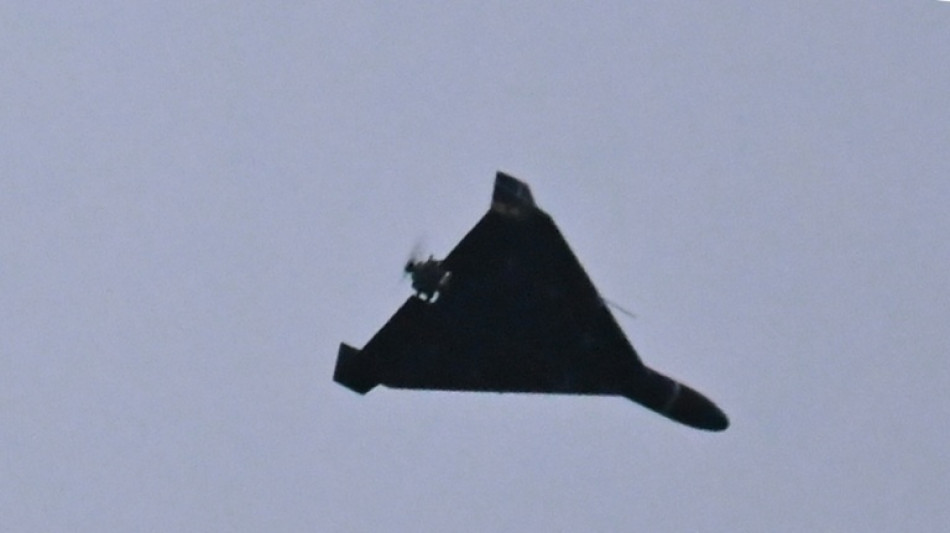
Why Iranian drones are hard to stop / Photo: Sergei SUPINSKY - AFP/File

 Mbappe hits two as Real Madrid rout Sevilla

 Browns edge Ravens for division lead, Texans beat Jags

 Lyon go top of Ligue 1 as Monaco fall to first defeat of the season

 Venezuela opposition alliance reaffirms Nobel laureate Machado as leader

 'Street Fighter' wins N. America box office, buzzy doc stuns in 2nd

 NFL: Paris game to go ahead despite protests in France

 Arteta hails Arsenal 'finishers' after Madueke fells Forest

 Trump backs ally Netanyahu ahead of Israel's tight election

 Madueke strikes late as below-par Arsenal sink Forest

 Second day of street clashes in Milan

 Dupont's Toulouse hold off Exeter as English Champions Cup woes continue

 Zelensky speaks to US envoys amid Trump spat

 Paris police in new battles with protesters and looters

 Multiple deaths, injuries at western Canada military base: minister

 Boland strikes twice for Australia in rain-hit South Africa Test

 Marseille put Angers to the sword in Ligue 1

 Albanian PM refuses to quit as violent protests enter sixth day

 Chwalinska fights back to win Wuhan Open in title breakthrough

 Kulusevski on brink of return for Spurs after 17-month absence

 Ukraine sets Saint Petersburg refinery ablaze in large-scale drone attack

 Spain's in-form Chacarra wins DP World India Championship

 Kuwait announces maintenance closures in Nuzha, Surra and Rai

 Moody’s lifts OYO parent Prism outlook to positive before planned IPO

 RCom professional asks Supreme Court to revisit spectrum insolvency ruling

 Premium products and financing drive Navratri appliance demand

Cheap and deadly, Iranian-designed Shahed drones have inflicted major damage in the Middle East war, and have anti-jamming and other capabilities that make them difficult to stop.
- Offline navigation -
Designed to explode on impact, Shahed drones connect to GPS to register their location shortly before or after takeoff, then typically turn off their receivers, said Thomas Withington, a researcher at Britain's Royal United Services Institute (RUSI).
The drones then travel long distances towards their target using gyroscopes that measure their speed, direction and position -- known as an "inertial navigation system".
"GPS is going to get jammed by whatever is protecting the target," Withington told AFP.
"If you look at a map of GPS jamming at the moment in the Middle East, you see that there's a lot of jamming... By not using the GPS, you avoid that."
The drones can then return to GPS just before impact for a more precise strike, or remain offline.
"It's not always necessarily very accurate, but it's as accurate as it needs to be," said Withington.
- Anti-jamming mechanisms -
Russia has been making Shahed-style drones to use in its war in Ukraine.
The US-based Institute for Science and International Security found in 2023 that those drones used "state-of-art antenna interference suppression" to remove enemy jamming signals while preserving the desired GPS signal.
Anti-jamming mechanisms were found in the wreckage of an Iranian-made drone that struck Cyprus in the opening days of the Middle East war, a European industry source told AFP.
"They have put (the Shahed) together using off-the-shelf parts, but it has... many of the capabilities that US military GPS equipment has," Todd Humphreys, a professor of aerospace engineering at the University of Texas at Austin, told AFP.
Defending against them now requires sophisticated electronic warfare equipment.
"The Shaheds have been upgraded," said Ukrainian air force spokesman Yuriy Ignat.
- Stealth materials -
The Shahed is built from "lightweight radar-absorbing materials", such as plastic and fibreglass, a 2023 RUSI paper said.
Their small size and low altitude allow them to slip through aerial defence systems.
- Other positioning systems? -
Some experts think Iran is using multiple positioning systems, making it easier for its drones to dodge jamming.
Serhii Beskrestnov, a technology adviser to the Ukrainian defence ministry, said Iran is using the BeiDou system, a Chinese rival to the US-developed GPS.
And the Russia-made version of Shaheds uses both BeiDou and the Russian equivalent, GLONASS, he said.
Others suspect Iran may be using LORAN, a radio navigation system developed during World War II.
LORAN, which does not require satellites, largely fell out of use when GPS emerged.
But Iran said in 2016 it was reviving the technology, which requires a network of large ground-based transmitters, though experts have not confirmed it is active today.
- Counter-strategies -
Militaries have mainly defended against Shaheds by shooting them down with cannon fire, missiles and interceptor drones, with the United States and Israel also developing lasers.
But jamming can work, as Ukraine has shown, as can "spoofing", which involves hacking into the drone's navigation system to change its destination.
Ukraine used electronic warfare to neutralise 4,652 attack drones from mid-May to mid-July 2025 -- not far off the number it shot down in the same period, 6,041, according to AFP analysis of Ukrainian military data.
Its experts insist that electronic and conventional defences are often used in tandem against the drones.
F.Wilson--AT