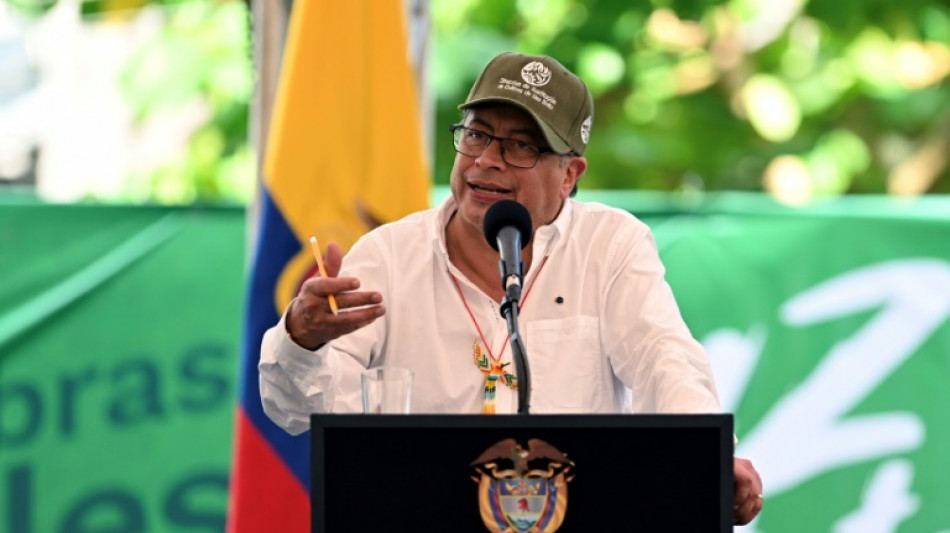
Colombia suspends truce with major rebel group in flashpoint regions / Photo: JOAQUIN SARMIENTO - AFP

 'Glad it's over': Kim powers to Games gold and military exemption

 After 11 World Cups, football finally comes home for one Indian fan
 Marc Marquez wins sprint at Japan MotoGP, Martin grabs pole
 Alcaraz fends off Arnaldi to reach Japan Open quarters
 Antonelli tops times in final practice at Bahrain GP
 Gauff digs deep to beat Osorio in China Open second round
 Fresh protests to hit Spain after housing measures defeated

 'He's here with me': Japan cycle queen dedicates gold to late brother
 Japan Olympic chief says 'lot more' athletes at Games than expected
 Asian carmakers besting US rivals at home, China poised to strike

 Widgets & Web Offers All-Inclusive Investor Relations Websites for Public Companies, IPOs and SPACs

 Adams named new US captain to 2030 World Cup

 China a better influence in Latin America than US: poll

 Judge pauses construction of border project in Texas national park

 Belgium's De Bruyne fires double to sink Turkey, France held by Italy
 US jobs data boosts stocks as oil prices dip

 US Supreme Court to hear high-stakes climate case
 Trump expected to name intel chief Clayton as AI czar: reports
 Argentina unveils passports-for-investment scheme

 Brazil election debate chaos sparks censorship row
 England's Carse charged by cricket body over nightclub incident

 Amazon vows $1 bn for data center towns, decries 'myths'

 Oil prices drop on G7 fuel release, US jobs data boosts stocks

 G7 agrees deal to ease global energy supply concerns
 Spain's government dealt blow as lawmakers reject housing bills
Colombian President Gustavo Petro on Monday suspended a truce with leftist guerrillas in four flashpoint regions following the killing of four Indigenous children by those rebels.
Petro said the bilateral ceasefire "is suspended and all offensive operations are reactivated" in the Meta, Caqueta, Guaviare and Putumayo regions.
Four children and teenagers from the Murui Indigenous community were executed in southern Colombia by dissidents of the now- disarmed Revolutionary Armed Forces of Colombia (FARC) rebels, authorities said on Sunday.
Those four regions are a stronghold of FARC dissident guerrillas who refused to join a 2016 peace accord that saw most of the rebels lay down their arms and form a communist political party.
The rebel Estado Mayor Central responded to the news with a scathing attack on the government.
"The unilateral ceasefire will unleash war and the numbers of dead, injured and prisoners will multiply," the group said in a statement sent to media.
The four Murui minors were executed on the border between the southern departments of Caqueta and Amazonas after defecting from a dissident faction of FARC called the Carolina Ramirez front, the country's human rights ombudsman said in statement on Sunday.
The front, which belongs to the Estado Mayor Central, was among the groups that adhered to a ceasefire proposed by the government several months ago and were set to begin new peace talks soon.
"Recruiting and killing children and adolescents from Indigenous communities are not exactly gestures of goodwill to achieve peace. In addition to being evident violations of international humanitarian law," the ombudsman noted.
Petro slammed the murders as "an atrocious crime, a blow to peace" and warned of "measures against these actions."
- Government under fire for negotiating -
At the end of last year, Petro announced a bilateral ceasefire with numerous armed groups.
But three of those truces have now ended following the breakdown of the peace process with the National Liberation Army guerrillas and the Gulf Clan drug traffickers.
"If the ceasefire is not effective in certain territories in protecting the lives and integrity of the population, then there is no sense in persisting with it," Petro wrote on Twitter.
Since coming to power last year, Petro has tried to negotiate peace with the country's various armed groups in a marked shift from his conservative predecessor's more bellicose approach to resolving the conflict.
This policy has triggered a hailstorm of criticism of Petro. The opposition has branded the armed forces too weak to prevent armed groups dictating the terms of peace.
In its statement, the Estado Mayor Central accused the government of failing to install the necessary mechanisms to verify that the ceasefire was being respected.
Colombia has suffered six decades of armed conflict between the state and various groups of left-wing guerrillas, right-wing paramilitaries and drug traffickers.
Petro, the first leftist president in Colombia's history, has opened talks with many of the armed groups, hoping to put an end to the violence in the world's largest cocaine producer.
Ch.P.Lewis--AT