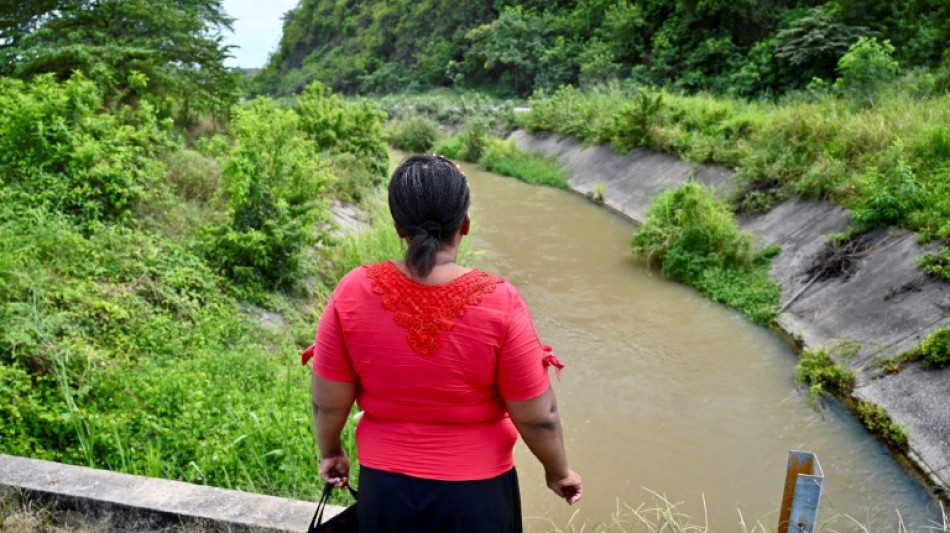
Ecuador's Death Canal: watery grave for victims of gang violence / Photo: MARCOS PIN - AFP

 Qatar Facilities Management Market to Reach $11.15bn by 2032

 Black Friday Discounts Cut Prices on Two Top-Rated Wiper Blades

 Twickenham Grounds Team Prepares Pitch for Six Matches in Three Days

 Luxembourg City Plans €13 Million Abrigado Centre for 2029

 Two A1 Crashes Create Kilometres of Rush-Hour Congestion

 South Africa Places 36 Hospitals on Standby for Possible Imported Ebola Cases

 TCC Network Linked to 200% Surge in Global School Attacks

 Beyond Black Friday: A Guide to This Week’s Holidays and Deal Days
When a person goes missing, their relatives usually contact the police, hospitals or even the morgue.
In the Ecuadoran port city of Guayaquil, a major hub in the international cocaine trade, the first instinct of many families is to search the Death Canal.
Since 2023, the police have recovered over 100 bodies from this 45-kilometer (28-mile) waterway that runs through the district of Nueva Prosperina, one of the most dangerous districts in a city soaked in narco violence.
In November, police found the bodies of nine beheaded people in a pit beside the channel.
The canal was built over a decade ago to irrigate farmland but since the Covid pandemic, when drug-related violence in Ecuador exploded, it has begun filling up with corpses.
A dirt path runs alongside the canal, dotted with trash piles, stray dogs and vultures.
There is no street lighting nor security cameras in this area, which is patrolled by armed men on motorbikes.
From a nearby hill, AFP could see houses without windows occupied by gang members.
"They point their rifles at us from down there," said a police officer who led AFP to the lookout.
"Nothing happens here without their permission."
- A murder an hour -
Ecuador has gone from being one of Latin America's safest countries to its deadliest in a few short years, with gangs linked to Mexican cartels engaging in drug trafficking, extortion, kidnapping and illegal gold mining.
Ordinary Ecuadorans have been swept up in the violence.
Georgina Bermeo's family found her body face-down in the canal in May, along with her husband's body.
The pair were robbed and shot dead, according to Bermeo's sister.
On average one person was murdered per hour in Ecuador last year, according to official statistics.
Like many people Bermeo's sister, who asked to remain anonymous, has no faith in the state to deliver justice and did not even report her sibling's death.
"The police are in the pay of the criminals," she claimed.
- 'Death visits us' -
Christian Echeverria, a police lieutenant, told AFP he had lost count of the bodies found in the canal during his three years in Guayaquil, a gateway to the United States and Europe for cocaine produced in neighboring Colombia and Peru, the world's top producers of the drug.
"They execute some of them further upstream and they are swept away by the current," he said.
Juan Ordonez, a community leader living in the area for over 40 years, said he has seen bodies stuck in the sluice gates at the end of the canal.
"We live in fear, with the doors closed, because death visits us," he said gravely.
Some of that fear is instilled by the military, which has been accused of perpetrating gross rights abuses in the name of fighting gangs.
Jonathan Villon had just finished serving breakfast to his three children when he was detained by troops in Guayaquil in 2024, his sister told AFP.
He has not been seen since.
The UN Committee on Enforced Disappearancs said in March it had received reports of at least 51 people being disappeared by state agents since 2024.
The driver of the military truck in which Villon was taken away told prosecutors that the troops left Villon alive on the banks of the canal.
Villon's sister, who also asked not to be identified, searched the waterway twice for him, in vain.
Shots were fired in her direction on one occasion.
The woman, whose partner was murdered last year and who has fled Guayaquil for her safety, voiced a widely held belief that the security forces are in cahoots with the gangs in some places.
President Daniel Noboa has assured that any foreign troops assisting in Ecuador's US-backed anti-gang crackdown will enjoy immunity from prosecution.
H.Romero--AT


