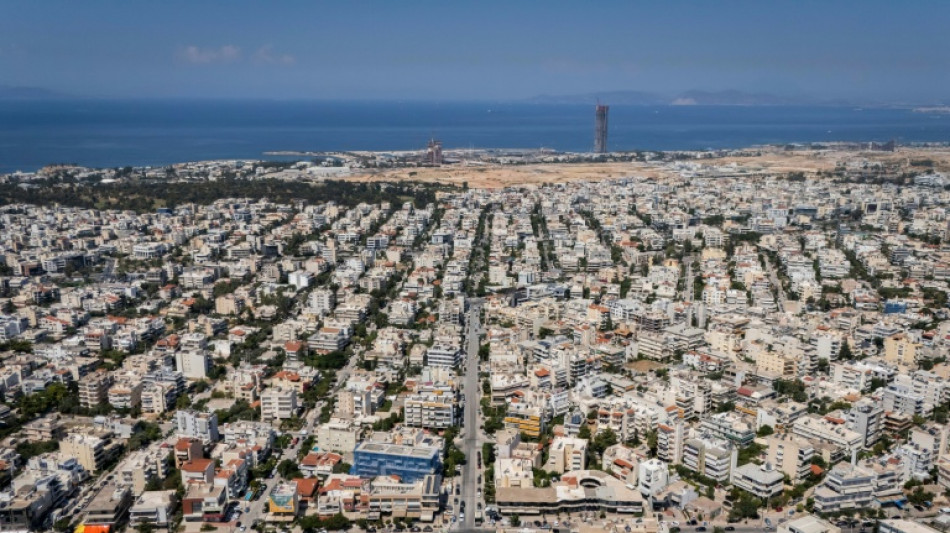
Surging real estate development divides opinion on Athens' riviera / Photo: Aris MESSINIS - AFP

 Martin wins Austrian MotoGP sprint after Acosta crash

 Japan edge Fiji to win Pacific Nations Cup
 Black smoke, flames rising near Riyadh airport: residents to AFP

 UK actor Naomi Watts honoured at Spain film festival

 Japan emperor declares Asian Games open after turbulent build-up

 Asian Games open with unity message after troubled build-up
 Denmark hails 'binding' Greenland deal with Trump
 We don't want Games host Japan losing money, says Asian Olympic official
 Ed Sheeran returns to stage after Palestinian controversy

 Asian Games to open in Japan after troubled build-up
 Drone owners rush to offload devices ahead of Beijing ban

 Trump's beef policies irk Texas ranchers, testing their loyalty

 Kennedy Center: future unclear for iconic Washington arts hub

 Trump claims 'infinite' Greenland security deal with Denmark

 Helicopters battle wildfire threatening Ecuador's capital

 Brentford batter Chelsea to undo Alonso's promising start
 Kane hits Bundesliga century as Bayern rout Union
 Trump says CNN, MS NOW, Politico banned from White House
 Hushing and hedging: US companies retreat on climate

 Springboks to face Fiji before 2027 Rugby World Cup
 Nigeria miners struggled to breathe in cell before 37 died: survivors

 McIlroy on the charge at PGA Championship as Reed withdraws
 McIlroy on the charge at PGA Championship

 Crisis-wracked Volkswagen warns of 10-bn-euro hit to profits

 Costa Rica's Grynspan tops third informal poll for UN chief: diplomat

In the southern Athens seaside suburb of Glyfada, a pensioner struggles to cross an avenue with her shopping trolley, zigzagging between cars stuck in traffic.
"I've had enough of these traffic jams," says Vassiliki Karvela as she finally reaches the local weekly market in her town of 90,000 inhabitants. "It was perfect and much calmer 20 years ago."
Some 15 kilometres (nine miles) south of the capital, Glyfada has seen its population grow and property prices rise in recent years, along with other parts of the urban sprawl along the Saronic Gulf.
And that is likely to continue.
Nearby, a new town of 6.2 square kilometres is under construction, "three times the size of Monaco", according to the site's owners, Lamda Development.
Situated on the outskirts of neighbouring Ellinikon, it promises to hold hotels, shopping centres, parks, marinas and 8,000 homes.
A luxury skyscraper some 200 metres high -– the tallest building ever constructed in Athens –- has already been built and is visible from the city centre.
Along the edge of the site, huge advertising hoardings promote the "shopping, entertainment and business destination of the future".
"This development is good for the economy," says Yorgos Christophoridis, owner of a construction company in Glyfada. "But Greeks, because of their low wages, can no longer rent or buy property here".
- Foreign buyers -
According to Stavros Giakoumakis, Glyfada’s deputy mayor responsible for the environment, nationals from Gulf states, China and Israel have settled or invested in this area.
But he cites numerous problems created by the project, ranging from damaged water and sewerage infrastructure, to a lack of parking spaces.
"Blocks of flats are being built where there used to be one- or two-storey houses," he laments.
Abandoned for years, the Ellinikon site was sold by the Greek government to the private sector during the financial crisis.
Following Greece's economic recovery, demand in the area soared rapidly, driving prices to "historic" levels, according to Premier Realty, a consultancy specialising in luxury and investment property in Greece.
A recent study by the Bank of Greece (BoG) confirms that the metropolitan area south of Athens is the most expensive in the region, with purchase prices reaching up to 7,300 euros ($8,400) per square metre.
"At first I was quite positive about the skyscraper," says Karvela, the pensioner. "But now access to the sea is restricted, and prices have been driven up. They think we’re rich!"
- 'Inequalities' -
Georgia Gemenetzi, an associate professor of urban planning at the University of Thessaly in central Greece says "there are positive and negative aspects" to this project, "which aims to boost economic growth".
But in an overcrowded capital where the lack of "green spaces is particularly acute, further intensifies population concentration," she explains.
Furthermore, it may "exacerbate inequalities by excluding certain social groups" who are pushed towards cheaper outlying areas.
With four million people -– more than a third of the country’s total population -– Athens is suffering from surging property prices.
According to the OECD, house prices in Greece rose 69 percent between 2017 and the second quarter of 2024, while 27 per cent of the population spends more than 40 per cent of their disposable income on housing, compared with 9.4 per cent of the eurozone population.
H.Romero--AT



