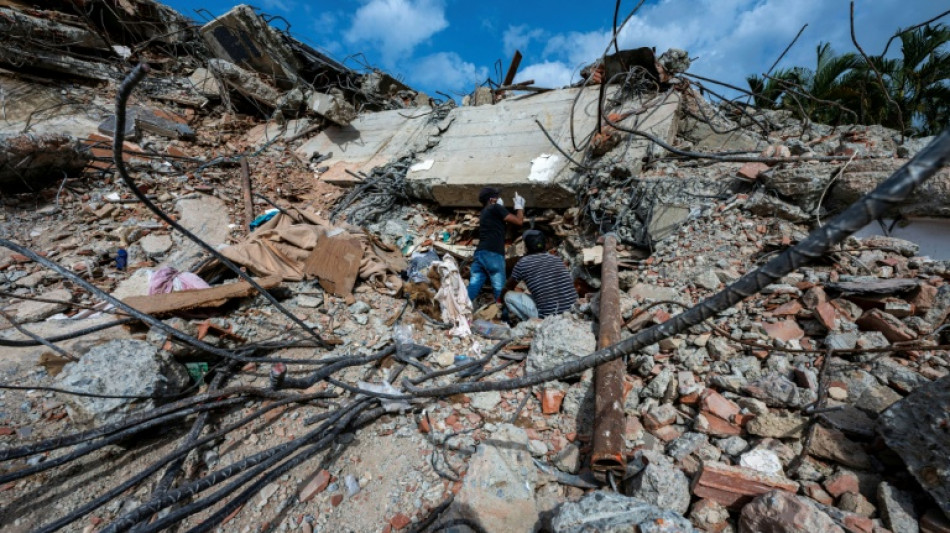
Hunt for last signs of life in Venezuela quake zone / Photo: Miguel MEDINA - POOL/AFP

 Bishop Museum Races to Save Rare Megamouth Shark Specimen

 Zach Hickerson Recounts Hayden Panettiere's Final Moments in New Interview

 Luxembourg Housing Petition Passes Threshold for Parliamentary Consideration

 Raheem Sterling Receives Suspended Sentence After Lamborghini Crash

 Audience to Choose the Set List at Luxembourg's First FAMIL Jukebox Night

 Luxembourg Pay Rise Delayed as Regional and World Headlines Develop

 Chennai Urbanist Sashna Develops 'Anniki' Card Game to Gamify Tamil Nadu History

 Transport Minister Defends Land Seizure Powers for Toronto-Quebec City High-Speed Rail

In the Venezuelan resort town of La Guaira, a group of rescuers watched as sensors that once detected life under the rubble now showed nothing, as silence gave way to resignation.
Friday -- the ninth day since the devastating double earthquakes that killed nearly 2,600 people and injured tens of thousands in the South American nation -- will be the last day in the search for survivors, some rescuers said.
After 30 hours of gruelling work with no rescue, their operation was called off. Nothing more could be done.
Chances of finding life in the rubble are highest in the first 72 hours, and diminish as each hour passes, with conditions such as temperature also playing a critical role.
The human body can survive up to seven days without water, one rescuer said.
Just hours earlier, another brigade saved a 43-year-old man in the coastal area of Catia La Mar who survived eight days under the rubble -- celebrated as a miracle after he was dug out from under a collapsed seven-story building.
Rescuers had provided him with more than ten liters of water to keep him hydrated via a hose and installed a tube to provide him with oxygen.
But in the oppressive heat of La Guaira, the team's latest assessment found no signs of life.
International aid has poured into Venezuela, with teams arriving from 27 countries.
A Mexican rescuer working in La Guaira said that their equipment could detect signs of life in another building, but they had not made contact, after digging through the rubble they found nothing.
They asked for silence. Police ordered the drivers traveling on the destroyed road to turn off their engines.
"We're rescuers, make some noise," one of them shouted, hoping to hear from survivors.
Nearby, a US brigade deployed search dogs and activated a highly sensitive sensor to detect sounds. Still nothing.
- 'There's no support' -
Marina Castillo waited for help to recover the body of her grandson, Alexandro de Guidice, a 24-year-old law student.
"It's been horrible, there's no support," Castillo, 67, said -- a common complaint among Venezuelans who decry government inaction.
"We got to his apartment, we saw all his law books, his files. It's terrible," Castillo said.
"What I want right now is for them to bring him back."
Nearly 200 buildings collapsed completely in the earthquakes that hit La Guaira and the nearby Venezuelan capital of Caracas, according to official figures.
Preliminary analysis of satellite data indicated the figure could be much higher.
Neighbors, relatives and volunteers rushed to help with picks and shovels, but their efforts were often not enough.
"Help, here's my dead mother," Mirosnel Gordon wrote in black paint on the green facade of a house.
The family placed lime on the body to slow the decomposition process while they waited for aid.
To support the search efforts, Jonathan Soto brought a backhoe from Anzoategui state, 500 kilometers (310 miles) from La Guaira.
When people pleaded for his help, he called for calm, saying, "You can't just go in there and jump in."
But desperation was widespread.
Outside the complex where Joan Manuel Lucena's mother-in-law was missing, rescuers found no signs of life.
"We're not going anywhere," Lucena said.
"We'll get them out dead or alive."
L.Adams--AT


