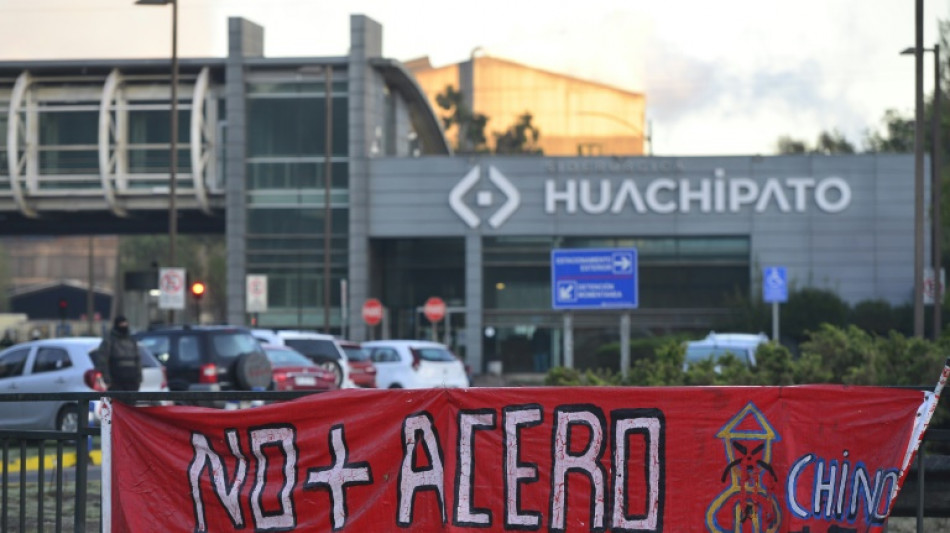
Cheap Chinese steel threatens jobs in Latin America / Photo: GUILLERMO SALGADO - AFP

 Projected 'super typhoon' heads for US Pacific islands

 UN warns of strong looming El Nino
 Hunt for last signs of life in Venezuela quake zone

 Asian markets rise as beaten-down tech stocks enjoy bounce
 David v Goliath as Cape Verde face Messi's Argentina at World Cup

 Nagelsmann quits as Germany coach after World Cup exit: reports

 All Blacks return to Christchurch 'a blessing', says Savea
 'Not a museum': Slovak UNESCO village strains under tourism

 DR Congo opposition builds against presidential third-term bid

 China sports brands score NBA stars to assist global ambitions

 Man dies after setting self ablaze outside UN in New York: police

 VAR 'taking joy' from football says Croatia coach Dalic after loss

 Afghans come home but risk exclusion without any ID
 'Coincidence of life' says Ronaldo after Jota tribute a year from death

 Japan face Italy without banned coach Jones

 Ronaldo, Portugal advance after VAR drama to set up Spain showdown

 AI romance scam impersonating Dubai prince ensnares victims
 Portugal advance in World Cup thanks to last-gasp Ramos winner

 Mission impossible? England take the World Cup high road against Mexico

 InterContinental Hotels Group PLC Announces Transaction in Own Shares - July 03

 Ukraine, Russia vow escalation as strikes on Kyiv kill 27

 Messi meeting the "game of our lives", says Cape Verde coach

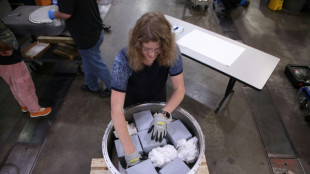 Do not open until 2276: US burying time capsule to mark July 4

 Scaloni warns Argentina that Cape Verde success 'no accident'

 Spain ease past Austria with 3-0 World Cup win

Latin American metal workers are clamoring for higher import tariffs as cheap Chinese steel floods the region, threatening hundreds of thousands of jobs linked to the industry.
Last year, the region imported a record 10 million tons of Chinese steel -- a 44 percent rise from the year before, according to data from the Latin American Steel Association (Alacero).
Two decades ago, the figure was just 85,000 tons.
"China is too present in Latin America," Alacero executive Alejandro Wagner told AFP.
"No one is against trade between countries, but it must be fair trade," he added.
As the pressure increases, steel plant bosses and workers in countries like Chile and Brazil -- the top producer in the region and number nine in the world -- are pressing governments for higher import tariffs.
If they were to do so, they would follow Mexico and the United States, which have imposed additional tariffs of 25 percent on Chinese imports amid a surge of cheap exports as a result of Beijing subsidies and excess production.
Earlier this month, US Treasury Secretary Janet Yellen expressed concern about "substantial overinvestment and excess capacity" in sectors like steel and aluminum in China, which she said had "decimated industries across the world and in the United States."
A dive in the Asian giant's construction sector has further added to an oversupply of steel for exportation.
Data from the Economic Commission for Latin America and the Caribbean in 2022 showed China leading global steel production with 54 percent, followed by India with 6.6 percent.
Latin America's top producers -- Brazil, Mexico, Argentina and Colombia -- came in at a combined 3.1 percent.
- 'Existence of dumping' -
In Latin America, some 1.4 million people work in the steel industry.
But their livelihoods have increasingly come under fire as Chinese steel now sells as much as 40 percent cheaper than it could viably be produced on home soil.
One casualty is the Huachipato steel plant, Chile's biggest, some 500 kilometers (310 miles) south of Santiago.
It has announced it is winding down operations, threatening about 2,700 direct and 20,000 indirect jobs.
"Closing Huachipato would be like an atomic bomb" hitting the region, worker Carlos Ramirez told AFP.
"What we are experiencing is very painful," the 56-year-old said, warning of a looming "social earthquake" for the port city of Talcahuano that has lived mainly from steel for 70 years.
Since 2009, Huachipato has incurred losses of more than $1 billion.
In a last-ditch effort to stay afloat, the company has asked Chile's CNDP price-distortion commission to recommend the government impose a 25 percent tariff on imported steel.
The commission in a recent ruling found "sufficient evidence to support the existence of dumping" -- the selling of Chinese steel below cost -- and recommended a levy of 15 percent.
"We are not asking for subsidies or bailouts. Huachipato can be profitable in a competitive environment," its manager, Jean Paul Saure, said in a press statement.
Huachipato specializes in key inputs for the mining industry, including steel bars and balls used in the milling of copper -- of which Chile is the world's largest producer.
During the Covid-19 pandemic, when world trade was interrupted, "it was Huachipato that kept the country's steel supply" afloat, Economy Minister Nicolas Grau told AFP.
The government, however, has its hands tied: Chile signed a free trade agreement with China in 2006 and risks punitive measures if it opts for a tariff to protect its steel industry against dumping.
In Brazil, steel imports from China rose 50 percent last year as production dropped by 6.5 percent, according to the Brazil Steel Institute.
Gerdau, one of the country's largest steel producers, has laid off 700 workers due to the "challenging scenario faced by the Brazilian market in the face of predatory import conditions of Chinese steel," the company said.
Like in Chile, the Brazilian steel industry is demanding the government increase the import tariff to 25 percent from a base that varies from product to product.
E.Hall--AT