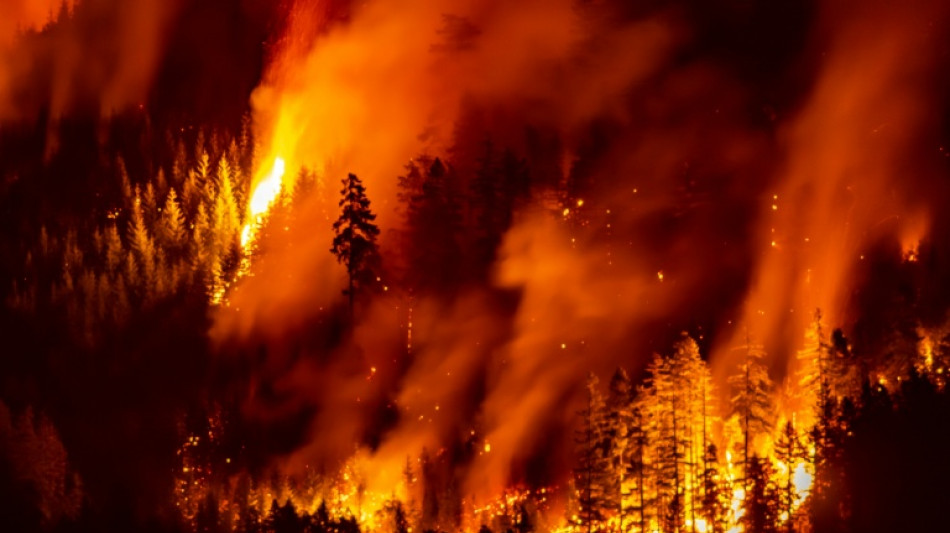
Canada tries to adapt to a future of wildfires / Photo: Colby Rex O'Neill - AFP

 Missing F-35 fighter parts 'not sensitive', says Australia minister

 Cambodia showcases scams crackdown with global conference

 Afghan cyclist who disguised herself as man wins Asian Games silver

 Typhoon Dujuan leaves four dead in Japan, 45,000 houses without power

 G7 leaders condemn Houthi strikes on Saudi Arabia

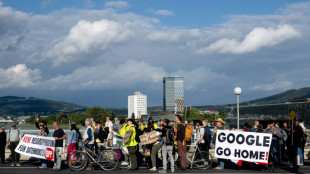 Google data centre sparks protests in Austria

 Shin Ohashi: Junk food-loving teen and Japan's next big swimming hope

 Stocks rise on AI buzz, drop in oil prices

 China's robot dancers limber up for America's Got Talent final

 Despite military might, Saudi struggles to crush the Houthis

 Trump to tout deals, defend Iran war in UN speech

 Sri Lanka to issue verdict in landmark Easter attack trial

 Coretura Selects Alloy Kore to Advance a Unique Software-Defined Vehicle Platform for Its Commercial Vehicle Customers

 Akkodis and Hamburg Public Transport Association Showcase hvv mia at InnoTrans 2026, Demonstrating the Future of AI-Powered Mobility

 Macron says talks with Trump on Red Sea, Ukraine 'constructive'

 Green policies just good politics, says UK minister

 Bardot auction in Paris fetches nearly one million euros
 No timeline on Daniels injury return, says Commanders coach

 British Columbia sues OpenAI in US court over Canada school shooting

 French star Batum retires after 18-year NBA career

 Zidane leads first France training session
 Man shot by ICE agent in Texas detained with bullet inside him: lawyer

 California declares state of emergency ahead of El Nino

 South Africa arrests three more suspects, after nine women murdered

 Carse needs time away from England, says captain Brook

Faced with another summer when wildfires have scorched millions of hectares of land and blankets of smoke have disrupted daily life nationwide, Canada is trying to limit the annual devastation.
Yet, despite procuring new water bombers and deploying forest management strategies to protect populated areas, experts caution that intense wildfires will remain a fixture of Canadian life.
"We're going to have to live with this," said Normand Lacour, who spent decades at Quebec's wildfire prevention and detection organization (SOPFEU).
Canada is home to about a quarter of Earth's boreal forest area and average annual temperatures in the country are increasing roughly twice as fast as the global average.
That makes conditions in Canada particularly "conducive to intense and very extensive forest fires," University of Ottawa geography professor Patricia DeRepentigny told AFP.
Canada's last three wildfire seasons have been among the 10 worst on record, including the devastating summer of 2023 when 18 million hectares (44.5 million acres) were torched, an area nearly as large as Syria.
This summer is not currently on track to approach that historic toll, with 4 million hectares burned so far, but the damage has been widespread.
In the western province of British Columbia, 15,000 people have been ordered to evacuate their homes, while residents of major eastern population centers like Toronto endured some of the world's worst air quality last month.
- Changing methods -
Canada's emerging response is broad-based.
The federal government has invested CAD$317 million (US$227 million) over five years "to establish a new national aerial firefighting surge capacity," Ottawa announced in May.
The money is being used to lease 10 aircraft capable of confronting wildfires, to be dispatched to provinces facing intensifying blazes.
Ottawa is also backing a CAD$150 million program that aims to clear flammable material such as vegetation from populated areas.
Provinces have also beefed up their firefighter capacity, including in Quebec where SOPFEU staffing levels are up 40 percent.
But, when it comes to protecting people from wildfires, "Canada is not in an excellent position," said Ryan Ness, the director of adaptation research at the Canadian Climate Institute.
There are "too many communities that are in areas that are exposed to wildfires that continue to develop," he told AFP.
- Fire clouds -
Canada is also extremely vulnerable to "fire clouds," or pyrocumulonimbus clouds, immense blazes that create their own wind and even lightning that can spark fresh fires.
The phenomenon, a consequence of the more frequent heat waves caused by climate change, was once rare in Canada, but that is changing.
Fire clouds were recorded 140 times in Canada in 2023, compared with once or twice a year historically, DeRepentigny said.
Fire clouds are unpredictable and can spread at staggering speeds. Battling them is a near-impossible challenge.
"There's not much we can do when this happens, apart from pulling crews out of the field and repositioning them behind the fire," said SOPFEU meteorologist Claudia Vaillancourt.
A.Moore--AT