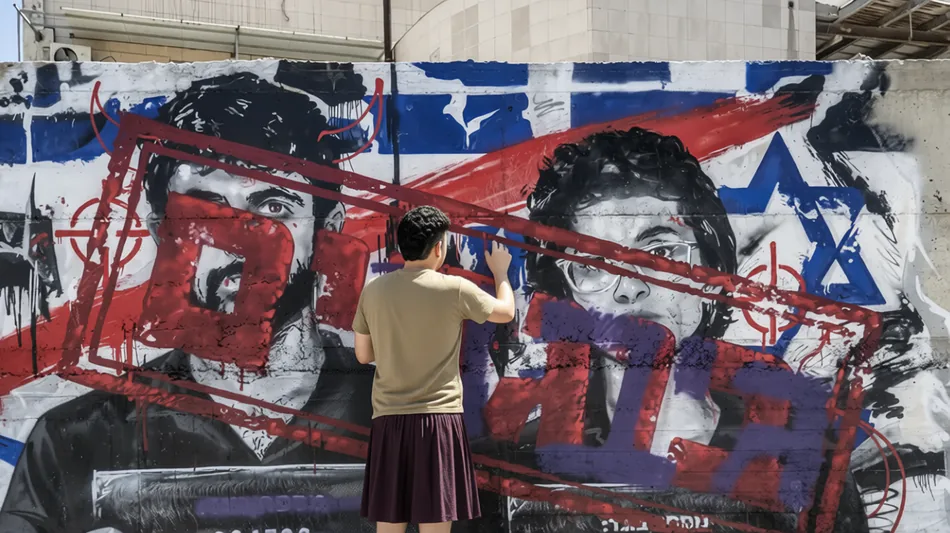
‘They want silence’: how the film NAZA is shaking Israel

 Peaceful Repeat Vote in Douglas Ward 3 Amid Heightened Security
 Belgian Ambassador Marks King’s Day in Athens Amidst Strong Bilateral Trade Ties

 Rediff.com IPO Risks: Gmail Dominance and New Business Ventures

 Dubai Police Expand Luxury Patrol Fleet with 525-hp Defender

 NuRAN Wireless Raises First Two Towers in Benin as 4G Rollout Beats Expectations in Cameroon and Ivory Coast

 ESGold Expands Montauban Gold-Silver Property to Approximately 26,787 Hectares Through Strategic Claim Staking

 DSS Announces Completion of Impact Biomedical Business Combination with Zoar Limited
 Impala and Philanthropy Southwest Launch Southwest Hub, Mapping Philanthropy Across Eight States
 Nixxy Announces 1-for-20 Reverse Stock Split

 The IRS Watchdog Just Published Its FY 2027 Challenges List - Clear Start Tax Explains Why Agency Strain Rarely Slows Down Collection Notices
 Tocvan Defines Priority Gold Target Areas at Gran Pilar From Project-Wide Soil Sampling and Geologic Mapping; 225 Soils at or Above 100 ppb Gold
 Silver Storm to Attend the 121 Mining Investment Conference in London, UK

 Who Does the Best Deep Plane Facelift in Sarasota?
 Ameriwest Advances Its Copper Focused Strategy Through Proposed Sale of Railroad Valley to Pure Energy Minerals
 AbTherx Licenses Atlas(TM) Platform to Athenova Therapeutics for Next-Generation Targeted Alpha Radiopharmaceutical Discovery

 What to Do When Two Households Become One
 InterContinental Hotels Group PLC Announces Transaction in Own Shares - November 18
 Srixon Announces Buy 2, Get 1 Free Golf Ball Promotion
 Who Does the Best Testosterone Replacement Therapy in Las Vegas?
 Nexteer's HMDD Wins Innovation Awards from PACE Pilot, CES and AutoTech Breakthrough
 More Than Keyboards: Epomaker Brings Its Gaming World to G-STAR 2026

 Healixa Turns Patents Into Products: FrostPulse(TM) Delivered and Five Eternal Spring(TM) Units Enter Production

 Cosmos Health Reports Record Nine-Month Revenue of $53.6 Million, Up 18%; Q3 Gross Margin Up 465 Basis Points Sequentially; Total Debt Down 34% and Stockholders' Equity Up 21% Since Year-End
 CXAI Expands Agentic AI Reach into Mid-Market Through EngineRoom's Simpro Partnership
 Agency Guacamole's 10th B.L.N.D. Event Brought Industry Leaders Together for a Conversation on the Evolution of Diversity and Inclusion in Beauty

The documentary NAZA, which features anonymous testimonies from Israeli intelligence officers regarding their conduct in Gaza, has ignited intense controversy within Israel. Nadav Weiman, executive director of the veteran-led NGO Breaking the Silence, explains how the film’s revelations about systemic military practices have challenged a prevailing culture of silence and sparked a national debate despite severe political backlash.
The documentary NAZA has triggered fierce backlash in Israel, but by exposing the army’s conduct in Gaza it’s proved impossible to ignore.
It was on Yom Kippur this year that Nadav Weiman first sensed the documentary NAZA was having a significant impact in Israel – despite the fact that back in September, when the Jewish festival fell, barely a handful of Israelis had seen the film.
NAZA, which is produced by the Guardian and will stream for free on its website in early December, depicts 24 army intelligence officers interviewed anonymously on rooftops across Tel Aviv. They talk about the mass killing of Palestinian civilians in Gaza over the past three years, and the secret signoff system employed by Israel’s military. More than 1.5 million people have already seen it in cinemas and its Israeli film-makers Yuval Abraham and Rachel Szor have picked up a roster of prestigious awards. The film has been offered to a number of distributors and cinemas in Israel but has not been screened there yet, amid a severe backlash.
Weiman lives in Shapira, a secular, left-leaning suburb of Tel Aviv. Days before the high holy day, NAZA had premiered at the Venice film festival to a 25-minute standing ovation. As Weiman mooched between friends and neighbours on the public holiday, almost everyone was discussing the documentary. The tenor of reaction was almost universally hostile, he concedes, even among his more liberal peers. “Yes, almost all had very hardline views about the movie” he tells me. “But, everyone was talking about it.”
Encouraging discussion and debate about the actions of Israeli’s military is Weiman’s life’s work. He is the executive director of Breaking the Silence, a veteran-led Israeli NGO which has, for over 20 years, attempted to, in its words, “expose the public to the reality of everyday life in the occupied territories”. Primarily, it does this by collecting testimonies from soldiers who have served in Gaza, the West Bank and East Jerusalem. Soldiers past and present recount their experiences of military service to Weiman’s colleagues.
He was surprised by NAZA’s sudden ubiquitousness. The film’s material is shocking – it details the secret systems that have left tens of thousands of civilians dead, and millions more homeless, displaced and injured in Gaza, building on revelations first published by the Israeli-Palestinian magazine +972, the Hebrew-language news outlet Local Call and the Guardian between 2023 and 2025. While journalists, including some in Gaza, have documented the consequences of Israel’s military campaign, NAZA offers in cinematic form first-hand testimonies from officers tasked with implementing commands. Central to this is the concept of “nezek agavi”, the film’s namesake acronym which refers to the number of civilians expected to be killed in any military attack: human life signed off as collateral damage.
Certain explanations for NAZA’s resonance domestically are clear. “Most Israelis don’t consume international media when it’s in English,” Weiman says. This is a Hebrew-language film, directed by Israelis. Evidence comes direct from soldiers, not international interlocutors. The intelligence units in which these soldiers have served are prestigious – mostly desk-based, not on the frontline. “These are people who live in Tel Aviv, vote for more progressive parties, work in hi-tech jobs … They killed hundreds of Palestinians from the air, many it seems without blinking twice. That’s hitting a particular nerve here.”
Then there’s the political climate: these last few months have been especially tense in Israel, as national election campaigns played out across the country. “For the right wing it is very helpful to attack [the Israeli directors] Yuval and Rachel,” he says. “It plays into their everyone-is-out-to-get-us narrative.”
Still, Weiman’s experience had been that the reporting of what has taken place in the war on Gaza had been largely ignored in Israel.
Breaking the Silence has collected more than 1,000 testimonies to date (Weiman’s is among them). And, hundreds of testifiers have come forward to the NGO in the last three years, after atrocities committed by Hamas on 7 October in Gaza. Mostly, he says, Israeli publications and TV channels declined to platform or report on them.
Israeli media, he says, has failed (or actively refused) to cover what’s happening inside Gaza. “There continues to be an iron wall between the Gaza Strip and the rest of Israel,” says Weiman. “It’s not like the West Bank with Israeli settlements where you visit your relatives so see it first-hand; there are now stories in the Israeli media about settler violence.”
“A teenager in Manchester knows better what is happening [in Gaza] than an Israeli who sits watching TV news all day,” he suggests, despite the fact Tel Aviv and Gaza are only about 40 miles apart. “Here, we see IDF spokespeople on TV, then military correspondents who act as mini IDF spokespeople. We don’t hear complex ideas or views, or have mainstream access to information. Certainly not related to collateral damage. ‘Everyone in Gaza is assisting terrorists’ – that’s the line we’re told.”
While Weiman says he knew most Israelis have no idea what’s going on in Gaza – “It’s not in the public conversation, not in the press, nor mentioned by politicians” – he now realises it goes further than that. “Israelis have assumed that, just like they don’t know what’s happening in Gaza, that the rest of the world doesn’t either. What Israelis don’t understand is these conversations have been part of global public discourse for years.” The meticulous detail in NAZA, therefore, is particularly confronting.
The backlash has been rapid and harsh. Israeli military chief of staff Eyal Zamir has said they will use “every tool at our disposal” against the film, while protesters gathered outside Szor’s parents home, demanding that she face the death penalty. A mural depicting the film-makers through the sights of a gun was painted on a wall in the Israeli city of Ashdod. Benjamin Netanyahu vowed to try to strip their citizenship.
Much of this playbook has been used against Breaking the Silence in the past. In 2018, the Israeli government passed a law banning the NGO from schools, and previously targeted their funding. Legal investigations have been opened into veterans who’ve spoken out. It’s all an effort, Weiman says, to scare off critics and dissenters. “They want silence.”
For most Israelis, national service is compulsory: men are conscripted for 32 months, while women are expected to serve for two years. Nobody wants to hear uncomfortable truths, he says, about their friends, relatives or neighbours. It’s an attitude of wilful ignorance his team has repeatedly encountered. “When soldiers speak out, they are labelled traitors. They’re told they are supposed to follow orders, and keep quiet.” Refusing to do so attracts particular ire. “The narrative here are these are conversations to be held behind closed doors; within the system … People who say no, it’s actually the system itself that is broken or corrupt? It’s a much harder pill to swallow.”
And this is precisely what NAZA does. “The film shows that the system is the problem,” says Weiman. “Not the irregularities, but the commands and how we fight. The terms on which the military operates.” The military can rebuff individual cases as isolated incidents and the work of bad apples. “But a cluster of 24 of soldiers speaking, individually, about this proves this is systemic,” says Weiman. “It’s too many to write-off or ignore.”
While all identities in NAZA are concealed to protect the safety of sources, it’s clear at least some soldiers interviewed are grappling with shame following their actions during active service. Weiman knows first-hand what it takes to face these regrets: 20 years ago, he served in a reconnaissance unit of the Nahal infantry brigade as a combat soldier on a sniper team.
Since 7 October, more than 200 soldiers have given testimony to Breaking the Silence about their involvement in this Gaza war. The first came forward in the early stages. “They went to fight Hamas and to secure the release of hostages,” says Weiman, “but realised this is not what they were actually doing. They were annihilating Gaza, getting commands that were more similar to revenge than security operations: burning houses, using Palestinians as human shields and torture, not fighting against armed militants.”
When a first ceasefire was announced in January 2025, more testimonies trickled in. And then, after the final hostages were returned, “this steady stream turned into a waterfall.”
The extreme response to NAZA in Israel has also started to affect Breaking the Silence’s work. The team are well-accustomed to animosity at home: their offices are in a secret, secure location; while all evidence is factchecked and verified, the identities of testifiers are kept anonymous, unless they want to go public. “But now our testifiers want even more and more assurances and protection before speaking,” he says. “This fear is exactly what the government wanted. The stakes now feel far higher.”
There is precedent in Israel for the parameters of public debate shifting, despite this intended culture of silence. And Weiman’s sense is that international activity – policy, pressure, journalism – can be a key driver for change in Israel. He points to sanctions on violent West Bank settlers introduced during the Biden administration. “The minute Biden enforced sanctions, a light was shed on a problem and dismissing it here was harder.” This week, the UK announced its own raft of sanctions.
But there is a long way to go: while no majority was achieved in Israel’s elections at the end of last month, Netanyahu’s far-right bloc still won the largest number of seats; opposition parties are hardly led by peaceniks.
His hope is that NAZA might form part of a shift in public opinion at least. “There is already a lot more debate in the public sphere about Gaza,” he says. ‘NAZA’ as a phrase has entered the national lexicon. “The thirst for conversation here is growing.” Soon, Israelis will be able to watch NAZA for themselves, and Weiman – and other activists like him – will be there to keep the conversation going, whatever the headwinds. “The most important thing for me is to speak to Israelis; it’s a movie about us, we need to change.”
Th.Gonzalez--AT