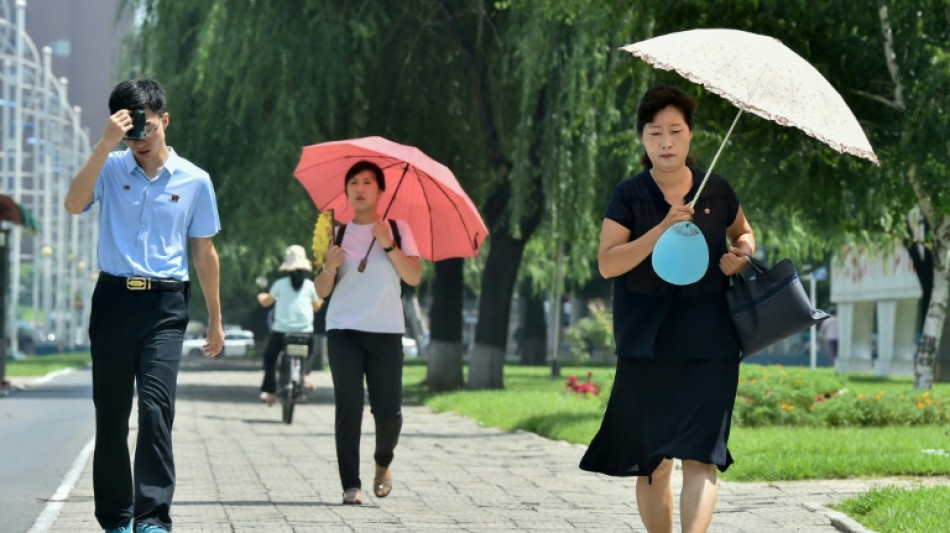
North Korea touts dog soup and other home-cooked recipes to beat the heat / Photo: KIM Won Jin - AFP

 Magnificent Mandhana's 79 helps India to Asian Games cricket gold
 Marchand 'stressed' about racing Japanese rivals at LA Olympics
 Mobile boat clinics bring healthcare to India's remote islands
 Former India paceman Zaheer Khan named Chennai coach in IPL

 Six-year-old Chinese girl sets world record with Rubik's Cube
 Swimming prodigy Yu, 13, says 'interviews way harder than racing'
 Star coaches make their bows as Nations League returns
 Rams bounce back as Giants reel from Dart injury
 In Bangladesh, Pakistan's Jinnah photo stirs anger

 Two New Zealand naval ships transit Taiwan Strait

 Zidane gets down to work as France start new era

 Inside the Venezuelan prison meant to 'drive you insane'
 UK king braces as memoir by Diana's brother goes on sale

 GFS Chemicals Partners With Bioz to Turn Data Into Deeper Product Engagement

 Coretura Selects Alloy Kore to Advance a Unique Software-Defined Vehicle Platform for Its Commercial Vehicle Customers

 Akkodis and Hamburg Public Transport Association Showcase hvv mia at InnoTrans 2026, Demonstrating the Future of AI-Powered Mobility

 Macron says talks with Trump on Red Sea, Ukraine 'constructive'

 Green policies just good politics, says UK minister
 Bardot auction in Paris fetches nearly one million euros
 No timeline on Daniels injury return, says Commanders coach

 British Columbia sues OpenAI in US court over Canada school shooting
 French star Batum retires after 18-year NBA career

 Zidane leads first France training session
 Man shot by ICE agent in Texas detained with bullet inside him: lawyer

 California declares state of emergency ahead of El Nino
Dog meat soup and bubbling ginseng broths are being proffered by North Korea's leadership as home remedies to take the edge off a spell of searing weather.
The Korean peninsula is sweltering through a record-hot summer with 23 deaths attributed to the heat in the South, where new all-time highs were set on three days last week, peaking at 42.5C on Sunday.
State media reported temperatures soaring up to 40C in the North, where the usual fiery threats of military action have been interspersed with humble cooking tips to combat the heat.
A doctor cited by the state-run Rodong Sinmun newspaper suggested during Sunday's record heat that dog soup would be "beneficial for nutritional supplementation".
And on Wednesday, the official Korean Central News Agency (KCNA) proposed a menu of Samgye-tang: a broth soaking chicken stuffed with glutinous rice, dates and stamina-boosting ginseng.
"A Korean proverb says 'like cures like'," it said, describing the dish as a speciality of its southernmost border city of Kaesong.
KCNA also boasted of the "incomparable medicinal effect" of the Kaesong ginseng used in the dish, attributing it to the region's "peculiar soil and water quality and unique cultivation method".
"The Korean people have regarded it as a custom good for health to make hot foods in the hottest period of summer," it said.
Such scorching suggestions contrast with traditional medicine cultures elsewhere in Asia, where winter melon soup is among the preferred summer remedies.
- Climate of isolation -
Dog meat was once also a summertime delicacy in the South, but is set to be outlawed by February 2027.
As the South reached record highs on Sunday, an AFP journalist toured the demilitarised zone that has split the two Koreas since their 1950-53 war ended with an armistice.
Across the truce line, North Korea's self-declared soup hotspot Kaesong simmered in the distance through a heat haze.
A gargantuan North Korean propaganda flag flying on a 160-metre (525-foot) pole -- the world's tallest -- hung limp in the humidity.
Seoul at the time was issuing emergency alerts warning its residents to pause all outdoor activities.
But on Kaesong's outskirts -- seen through binoculars used by visitors at a viewing platform -- human specks pedalled bicycles and laboured in fields.
Experts say isolated North Korea is ill-equipped for heatwaves -- part of weather patterns that scientists say are becoming more extreme owing to manmade climate change.
As the heatwave hit, North Korea broadcast footage of citizens crowding beaches in Wonsan at a resort triumphantly opened by Supreme Leader Kim Jong Un last summer.
They bobbed in kayaks and multi-coloured inflatables or tore along the coastline of Kalma Beach on jetskis, kicking up cooling sea sprays.
"The beach begins to fill with crowds around 8:00 am and remains bustling until nightfall," boasted a dramatic state TV voiceover.
- Broth-erly ties -
But away from that rare leisure outlet -- and the curated gaze of state media -- there is likely far less heat relief in a nation stricken by poverty.
Rachel Minyoung Lee, a senior fellow at the Stimson Center's Korea programme, said state media emphasis on ensuring water and electricity supplies "suggests that both are under strain".
"North Koreans are likely suffering more from the heat than South Koreans because they lack the infrastructure that South Korea has," she told AFP.
More than 40 percent of the population of 26 million suffer malnutrition, struggling to feed themselves, according to the World Food Programme.
Seoul's residents have been quaffing iced lattes made with imported coffee beans, savouring tubs of Italian gelato and frozen mashed mounds of South American acai fruit.
Still, authorities have repeatedly advised people to seek air-conditioned spaces, and a man collapsed from a heat-related illness at a baseball game.
However, Lee said even factories in North Korea's provinces were reportedly unable to operate at full capacity because of "chronic power shortages".
"That suggests many people outside Pyongyang have little or no access to air conditioning or even electric fans, making the current heatwave especially difficult to endure," she said.
North Korea's state media often lauds the Kim dynasty's core national tenet of "juche", meaning self-reliance.
State media trumpet Pyongyang's military, economic and cultural achievements as proof of its superiority, while repeatedly branding Seoul its "most hostile" enemy.
But some content alludes to ties it still shares with the South.
Samgye-tang is popular there, too, in more moderate times.
"When temperatures climb above 40 degrees Celsius like they have now people avoid going outside," said Son Heung-seo, proprietor of Jangsu Samgye-tang restaurant in Seoul.
"There's no choice but for business to slow down," he told AFP.
But when things aren't overheated, the Koreas share similar tastes.
"We usually get more customers in the summer than in the winter," he said.
J.Gomez--AT