
New science report could boost climate suits against oil giants / Photo: ANGELA WEISS - AFP/File

 Swiss vote on what it means to be neutral

 Pope to meet with victims of clerical sex abuse during France trip

 Iran stands firm on Hormuz plan after US rejection
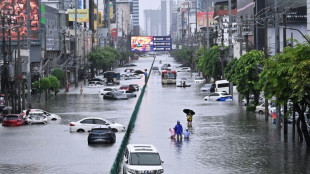
 Madrid protest camp grows after eviction outrage

 Italy winemakers hail bumper harvest but cut output

 Kyiv shoppers feel the pinch from Russian strikes
 Japanese anime actor fights TikTok over AI voice cloning
 Curtain falls on the romance of India's single-screen cinemas

 Smells like teen spirit as US thrash Peru 4-1

 Cavy chaos: Hundreds attend New Zealand's biggest guinea pig show

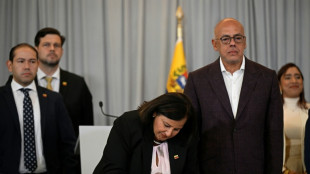 Venezuela releases more political prisoners after opposition talks

 England's best 'for a long time' despite Spain defeat, says Kane

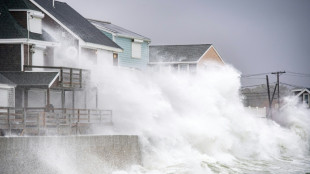 Powerful storm pummels northeast US with rain, high winds

 Filmmaker Mike Leigh wins top prize at Spain festival with 'last film'

 Spain beat England in Nations League to extend unbeaten run

 Ireland squad vote to play Israel tie despite Gaza unease

 Gutsy Vollering wins cycling road race world title

 Vollering wins cycling road race world title
 Man City's meteoric rise clouded by dark shadow

 Mbappe out for two weeks or more with knee injury say Real

 Lyon collapse away to Stade and suffer first Top 14 loss

 Russia accuses Europe of seeking to thwart Ukraine talks

 Man City chairman defiant over reported Premier League charges

 Germany ready to 'walk through fire' for Klopp, says Tah

 At least 16 killed in Russian and Ukrainian strikes

Climate lawsuits seeking massive damages from fossil fuel companies increasingly hinge on the question: how reliably can scientists pin specific extreme weather to human-caused climate change?
Very confidently for events like heat waves and heavy rainfall -- but much less so for others, like thunderstorms and tornadoes, according to a major new report published Thursday by the United States' top science advisory body.
Entitled "Attribution of Extreme Weather and Climate Events and their Impacts," the 254-page paper updates a 2016 assessment by the same institutions, the National Academies of Sciences, Engineering, and Medicine (NASEM).
"Significant progress has been made over the last decade, with major advancements in methods and modeling that allow for more robust assessments of extreme events," said James Hurrell, a professor of atmospheric science at Colorado State University and chair of the committee that wrote the report.
Operating under a charter signed in 1863 by president Abraham Lincoln, the prestigious Academies are independent nonprofit institutions tasked with advising the government on scientific policy.
But these are no ordinary times under the administration of President Donald Trump, who has attacked the very idea that burning fossil fuels is warming the planet.
- Getting specific -
Scientists have no such doubts. They have known for decades that climate change is altering the frequency and intensity of several types of extreme weather events, including hurricanes, heat waves and extreme rainfall.
But the field of attribution science allows them to move beyond detecting broad trends to investigating individual events -- what the authors call extreme event attribution (EEA) -- which can provide vital information to policymakers.
EEA studies compare an event's characteristics, such as its probability and intensity in the current climate, to a "counterfactual" world without human-caused emissions.
The authors found that EEA capabilities have improved markedly over the past decade, thanks to advances in understanding physical drivers of events, expanded observational data from satellites and radar, new statistical techniques and better models.
But the gains are uneven, and significant challenges remain for certain types of events. Global models, for example, lack the resolution to capture climate change's impact on severe thunderstorms, even as confidence for hurricanes is higher.
Confidence estimates are also lower for underdeveloped parts of the world, where a lack of consistent, long-term records limits attribution science's reach.
Another emerging field is extreme event impact attribution (EEIA), which studies how far human-caused climate change has shaped the impacts of an extreme event -- human health effects or economic losses, for instance. The authors said this sub-field has enormous potential but remains in its infancy.
They also called for a common framework for attribution studies, noting that differing methods "sometimes leads to confusion among the public and other stakeholders when studies of the same event produce different results."
- Sowing doubt -
Still, the results are likely to boost the multitude of lawsuits working their way through courts across the country.
Oregon's Multnomah County, for example, is suing fossil fuel giants for more than $51 billion over pollution that fueled a deadly 2021 heat dome in the Pacific Northwest, during which hundreds died.
Ahead of the report's publication, Republican lawmakers sought to cast doubt on the authors' work, sending a letter in April to the president of NASEM alleging bias and demanding details on the authors' professional ties.
Energy In Depth, an oil industry blog, singled out Delta Merner, a scientist with the nonprofit Union of Concerned Scientists, for criticism in a January 2, 2025 post, and she left the panel the same day.
At the federal level, the Trump administration has sued Democratic-led states pursuing climate damages claims against oil and gas majors, and has sought to strike down state "Climate Superfund" laws requiring polluters to pay for the consequences.
Republicans in Congress, meanwhile, have introduced the "Stop Climate Shakedowns Act," a bill that would block climate damage lawsuits from proceeding in court -- a move critics call a de facto immunity shield for fossil fuel companies.
M.O.Allen--AT