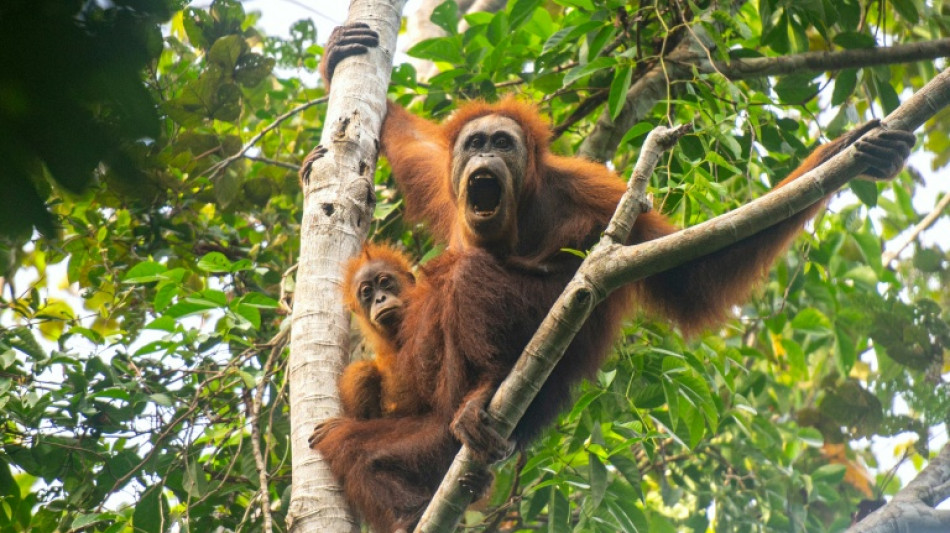
Climate change-fuelled storm decimated world's rarest great ape: study / Photo: Handout - Orangutan Information Centre/AFP

 Amaze Holdings (NYSE: AMZE) Executes Binding LOI to Acquire BullionFX | Alchemy, a Decentralized Gold-Backed Financial Ecosystem for Valued at US$155 Million

 Clashes between French teens, police as school blockades intensify

 Stocks move sideways despite oil moving lower
 African leaders to gather in Egypt for business summit

 UK decides against charging foreign visitors for museums

 Dallaglio to sell England World Cup winners' medal

 Brazil come from behind to beat Australia 4-2 in friendly

 Ruthless An retains Asian Games badminton crown as Kunlavut triumphs

 Alonso to stay with F1 team Aston Martin in 2027
 China badminton 'still strong' despite Asian Games slump

 'Exceptional' Turner painting shown in Rome before sale

 European stocks climb as oil dips

 Spain aims to ban evictions until 2030 amid housing protests

 Kunlavut first Thai man to win Asian Games badminton singles gold

 French far right says antisemitism claims part of 'total war' to derail presidency bid

 'Gift from God': Rain brings relief from Indonesia toxic haze

 Ex-world snooker champion jailed for 7 years for child sex crimes

 French teens clash with police as school blockades intensify

 FIFA accuses UEFA of 'misinformation campaign' in bid for World Cup papers

 Myanmar airstrike toll hits 50 as families gather dead

 STARTRADER Raises Lloyd's of London Client Fund Insurance to USD 30 Million in Aggregate

 North Korean DMZ landmine blasts 'violation of armistice': Seoul

 Sabalenka 'fresh' for first tournament since losing No.1 spot

 Myanmar airstrike death toll rises to 50: aid workers

 North Korean DMZ landmine blast 'violation of armistice'

Climate change-fuelled landslides wiped out nearly one in ten of the world's rarest great ape species on Indonesia's Sumatra island, scientists said Wednesday.
A single weather event last November pushed the Tapanuli orangutan -- of which there are fewer than 800 left in the wild -- even closer to extinction, according to a study published in the science journal Current Biology.
An estimated 58 Tapanuli orangutans died as a result of mudslides triggered by heavy rains during Cyclone Senyar -- about 11 percent of the total living in the region, or seven percent of the estimated overall wild population.
The flooding killed more than 1,000 people.
Only scientifically classified as a species in 2017, Tpanulis are incredibly rare, confined to a small range in Sumatra.
"This level of loss is substantial for a species with such a small total population," said Erik Meijaard, chief scientist at Borneo Futures, a conservation initiative.
The floods also wiped out sources of Tapanuli food and shelter.
Scientists analyzed satellite evidence of landslide scars in the Batang Toru Ecosystem -- home to the largest remaining population of the apes.
They found that about 8,300 hectares of forest -- more than 11 percent of the area -- were affected.
The lost forest area was overlaid with orangutan density maps to come up with an estimate of population loss.
"The loss of an estimated 58 Tapanuli orangutans to a single climate-induced landslide event is a devastating demographic shock to the world's rarest great ape," said researcher Jatna Supriatna of Indonesia University.
Environmentalists have long campaigned against industrial activity in Batang Toru, particularly a hydroelectric dam and gold mine.
The highland homes inhabited by Tapanulis are not their preferred habitat, but it is where remaining orangutans have been pushed by human development elsewhere.
"To prevent the first modern extinction of a great ape species, Indonesia must permanently protect the Batang Toru ecosystem," Jatna said.
"But our international partners must also meet their global commitments by providing immediate biodiversity-recovery financing."
Sumatra lost 4.4 million hectares of forest -- an area larger than Switzerland -- between 2001 and 2024, making hilly landscapes more vulnerable to landslides, the conservation group Mighty Earth said in February.
F.Wilson--AT