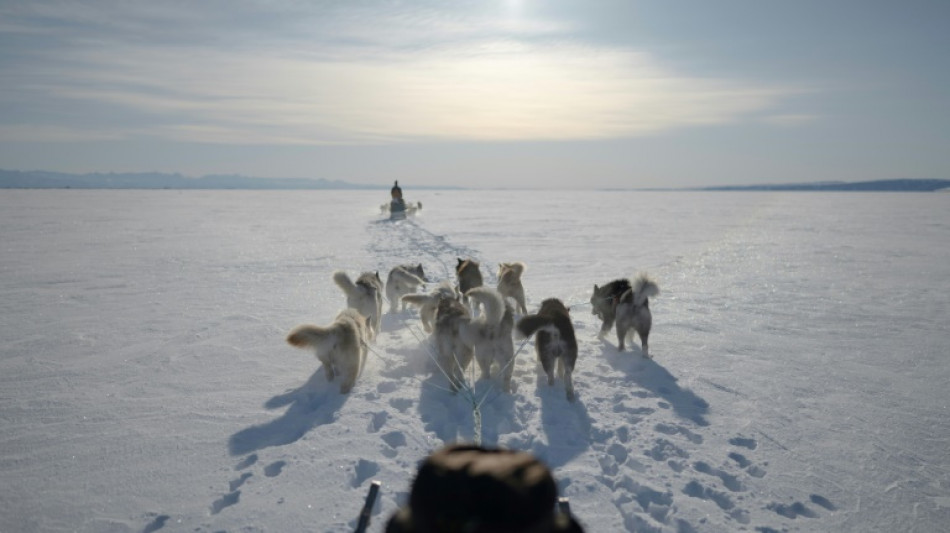
On thin ice: Greenland's last Inuit polar bear hunters / Photo: Olivier MORIN - AFP

 In Manchester, people say City scandal is 'shame for football'

 Stocks lacklustre as inflation data weighs on sentiment

 Israel-bound plane rerouted, pilots wounded in reported fight

 Truth commission on Sweden's Sami people seeks redress

 Energy costs spark inflation surges in France, Italy

 South Korea break China hearts to reach Asian Games football final

 Eala storms into Asian Games semi-finals to thrill adoring fans

 Turkey freezes ex-minister's assets as fund crisis grows

 What we know about the North Korean POW dispute

 Most equities rise after oil price plunge, US data in focus

 Polar oceans transformed as warming melts ice habitats: research

 Lost shark becomes viral star in South Korea
 Dangote to launch $16bn refinery in Kenya
 North Korean leader 'extremely obese': Seoul spy agency

 Yankees and pope-backed White Sox start MLB playoffs with wins

 Malaysia's ex-PM Mahathir in hospital for observation

 'No limits': Marathon world record holder Sawe chasing history

 Countdown begins to biggest-ever Rugby World Cup
 Bangladesh women lose ground after quota reform

 Vietnam admits 'differing opinions' on Hanoi development
 Stocks temper gains as oil pares heavy losses, US data in focus

 New Zealand denies breaching climate commitments to EU

 Albert becomes youngest US scorer in 4-2 win over Chile
 Pirate island's plunging population shows Greece's demographic decline
 With elections ahead, Latvia's Russian-speakers reject Moscow's help

Inuit hunter Hjelmer Hammeken spotted a ringed seal near its breathing hole on the Greenland ice. In his white camouflage, he slowly crept towards it then lay down in the snow and waited.
When the right moment came, Hammeken tapped his feet together. The seal lifted its head to look where the noise was coming from and the hunter fired.
He butchered the animal there and then, eating some of its liver while it was still warm, as his ancestors have done for centuries -- the hunter's reward.
Such scenes are common around the hugely isolated Inuit community of Ittoqqortoormiit, close to Scoresby Sound, the world's biggest fjord on the frozen east coast of Greenland.
All the men hunt in this colourful little settlement of 350 souls.
While only the professionals track polar bears, everyone hunts seats, narwhals and Arctic musk ox.
But for the last two decades climate change and hunting quotas have been threatening the livelihood on which Inuit families have long survived.
Hammeken is a legend in Greenland, its greatest polar bear hunter.
AFP followed him and other professional Inuit hunters for several days during the hunting season.
He killed seven this year to add to his tally of 319 over the last half century.
When he arrives at the edge of the ice, where it meets the Arctic Ocean, he commands respect.
Hammeken made his reputation in the 1980s. He would go out alone for several weeks at a time, crossing the glaciers of the fjord with his dogs with little more than a tent to bring back up to three polar bears.
It was the golden age for the hunters, when polar bear skins could be sold abroad.
That ended in 2005 when quotas were put in place to slow the fall in polar bear numbers. This year's quota of 35 had been hit by the end of April, which was why Hammeken was hunting seals, on which there is no quota.
Climate change has turned the lives of the Inuit upside down since the beginning of the century -- with the Arctic warming four times faster than the global average.
"Before we could hunt all year," said Hammeken, 66. "In winter the ice was harder... and the fjord never melted."
But now the ice is retreating and the Sound is open and navigable between mid-July and mid-September.
With the young hunter Martin Madsen at his side, Hammeken scanned the horizon. The wind had come up and the sea with it.
It was time to go. The ice, which is thin at the edge of the sheet, had become unstable, and risked breaking up and taking him and his protege with it.
"In August, all the ice sheet will have melted. There will be just the sea, a rough sea," which will make hunting seals and narwhals -- which are also subject to a quota -- difficult, Hammeken said.
With little ice on which to hunt seals, he wondered how the polar bears would survive. Stuck on land and starving now in the summers, they are coming closer and closer to the village looking for food.
- The young hunter -
Back in Ittoqqortoormiit young Madsen looked out the window and checked the weather forecast on his smartphone. With bright sun and no fog, it was a perfect day for hunting. He got his guns and headed for the edge of the ice.
The other hunters are already in position, scanning the wind-whipped water for signs of seals. Not that far away -- within two kilometres or so -- three polar bears are also out on the prowl for seals themselves.
To attract their prey, the Inuit scrape the ice with a long wooden stick called a "tooq", which imitates the sound seals make when they poke through their breathing holes in the ice.
When a hunter spots one, he shouts, "Aanavaa!" ("Look, a seal!") and whistles to attract its attention. If he misses his shot, the others are free to fire.
That day Madsen missed the seal he spotted. But the next day the 28-year-old killed a bearded seal with a single shot from more than 200 metres with his .222 rifle, rushing to drag it into his boat before it sank.
"The dogs will have something to eat," he said proudly.
Madsen is one of Ittoqqortoormiit's 10 professional hunters. Only those who live completely from the hunt are allowed to shoot polar bears.
"I have been hunting since I was a child. I grew up among hunters -- my father, my grandfather" were also hunters, he told AFP.
But since their time much has changed, most of all the diminishing chance of making a living from it despite being able to use snowmobiles and smart- and satellite phones on the ice.
"Nowadays there is not much to hunt," said Madsen. "With the quotas and everything, it is not working anymore."
Polar bears can only be hunted by Inuits. Their skins go for up to 2,000 euros -- but they can only be sold in Greenland after a European Union embargo in 2008.
Seal skins, on the other hand, sell for 40 euros or less, half of what they were going for before they were hit with a similar embargo in 2009, which was later lifted for those shot by Inuits.
Back home, Madsen's partner Charlotte Pike prepared polar bear soup with tomatoes, carrots, onions and red curry.
"Life is tough given how little we earn from hunting," said the 40-year-old who wants to put up tourists in their home as a way of helping make ends meet.
"You hear everywhere now that we shouldn't eat meat and kill animals... but that is hard for us" in a place where nothing grows.
Madsen never went to school, and he hopes his eight-year-old son Noah will not become a hunter like him.
- A boy's dream -
Eleven-year-old Nukappiaaluk Hammeken, however, dreams of joining Ittoqqortoormiit's small elite of professional hunters, even if there is less and less at the top of the food chain to hunt.
His father Peter, 38, runs a snack bar in this village at the end of the world, 800 kilometres from the next settlement in Greenland. Supplies come only twice a year by boat.
During his grand-uncle Hjelmer's youth "almost every man in the village" was a full-time hunter, he said.
"What is going to happen in the next 50 years?" Peter Hammeken asked. "Hunting is fundamental for survival, we need it to feed ourselves and bring in money. It's important for the village and for our future."
Nukappiaaluk will have to wait till his 12th birthday before he is allowed to go on his first hunt. To become a professional he will have to pass a long apprenticeship alongside the elders.
First of all he will have to be able to master a dog team, which is obligatory for professional hunting.
Nukappiaaluk has already been making collars for his nine pups by hand.
Over the next two months, Nukappiaaluk will start working his huskies. First he must learn to train them and so they can pull his sleigh to speeds of up to 30 kilometres per hour. Most of all, he must make sure they follow his verbal commands to the letter -- the slightest error can be fatal in such a hostile environment.
And like countless generations of hunters before him, the shy boy will also have to learn to understand his prey, their behaviours and movement, and how that all changes with the seasons.
Becoming a man and a hunter is inseparable for most Inuit.
"If you do not know your ancestors, you do not know who you are," insisted his older brother Marti, 22.
mpr-om-cbw-dp/fg
W.Moreno--AT
