
-
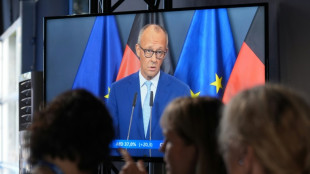 Germany's Merz vows to stay course despite new vote losses
-
Britain, Zverev-inspired Germany, Spain complete Davis Cup finals

-
 Man City outgun Sunderland despite Brobbey hat-trick, Man Utd rescue Fulham draw
-
Man Utd salvage Fulham draw as pressure mounts on Carrick

-
 Mourinho blames ref committee for Real Madrid derby defeat
-
Spanish civil war drama 'The Black Ball' wins at Toronto festival

-
 Maresca craves a 1-0 win after eight-goal Man City thriller
-
Germany's Merz shaken by far-right and far-left gains in state votes
-
 Atletico Madrid beat Real Madrid in tense derby clash
-
Macron welcomes Canada's Carney to French Atlantic territory

-
 Reusser retains world time-trial title
-
Fiorentina frustrate Napoli with Serie A draw, Como upset

-
 Man City outgun Sunderland despite Brobbey hat-trick, Liverpool win at Bournemouth
-
Five-star Man City top Premier League after Sunderland thriller

-
 Top US, Chinese economic officials meet ahead of Trump-Xi summit
-
Ukrainian drones hit Moscow on last day of Russian elections

-
 Erdogan's LGBTQ crackdown 'first step of election campaign': activist
-
Multi-Asset Trading Venue Monochrome Exchange Announces IEO of Its Native Token, $MCR
-
 Mass drone barrage on Moscow kills two
-
South Korea break Japan hearts to win Asian Games basketball gold

-
 82-year-old dies after beach fight in Greece over sun lounger
-
Acosta takes first victory at Austrian MotoGP

-
 US warns of rapid escalation in Mideast war
-
PSG president Nasser al-Khelaifi under investigation in France for conflict of interest

-
 Iran 'put hearts on the court' to win Asian Games basketball bronze
-
China swim sensation, 13, sets Games record after Japan win early

-
 School girl Yu helps China dominate in Asian Games swimming openers
-
Drones hit Moscow as Russians go to the polls

-
 Myanmar win first Asian Games teqball gold as Spain great Puyol watches
-
New England boss Fleming says 'wrong' to ask Stokes to end retirement

-
 China's 13-year-old Yu scorches to first major gold at Asian Games
-
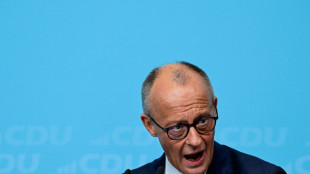
Germans vote in elections threatening fresh blow to Merz
-
 Russians vote on last day of parliamentary elections
-
US fears rapid escalation in Mideast after Houthis attack Riyadh

-
 Hong Kong pays final respects to former city leader Tung
-
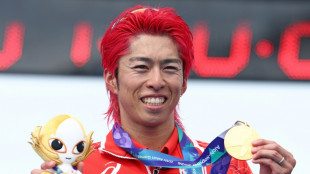
Japan triathlete Hojo wins first gold of Asian Games
-
 Typhoon put people off Asian Games opening ceremony, official says
-
IOC president impressed by 'beautiful' Asian Games wooden huts

-
 China's 13-year-old Yu cruises as Asian Games swimming begins
-
First Asian Games gold goes to Japan as China's 13-year-old Yu lights up pool

-
 AI 'warning shots' focus Beijing on national security risks
-
Data centre command hub keeps AI up and running

-
 Philippine tribe in limbo over US-led tech hub
-
Pope Leo in France: the issues on the table

-
 Leo XIV, first US pope transcends his restrained style
-
Packing for a pope: behind the scenes on foreign trips

-
 Singer Ed Sheeran says Gaza situation 'unjustifiable' following controversy
-
Republicans find transgender issues a powerful political weapon in midterm campaigning

-
 In 'Tenzing', a Sherpa mountaineer gets his due
-
German state elections threaten new shock waves for Merz
Trump vs Intel: Chip endgame?
When the White House converted previously pledged chip subsidies into a near-10% equity stake in Intel, it did more than jolt markets. It marked a break with decades of hands-off policy toward private industry and thrust the United States government directly into the strategy of a struggling national champion at the center of the global semiconductor race. Coming just days after the president publicly demanded the resignation of Intel’s chief executive, the move has raised urgent questions: Can state-backed Intel credibly become America’s comeback vehicle in advanced manufacturing—or does politicized ownership risk slowing the very turnaround it seeks to accelerate?
The deal gives Washington a formidable position in one of the world’s most strategically important companies without taking board seats or formal control. For Intel, the cash and imprimatur of national backing arrive amid a high-stakes transformation of its manufacturing arm and an intensifying contest with Asian foundry leaders. For the administration, it signals a willingness to intervene decisively where markets have been reluctant to finance multiyear, cap-ex-heavy bets with uncertain payoffs.
The optics were dramatic. On August 7, the president blasted Intel’s new CEO, alleging conflicts over historic business ties and calling for his immediate resignation. Within days, the public confrontation gave way to face-to-face diplomacy and, ultimately, to the announcement that the government would swap tens of billions in previously authorized support for equity—turning a grant-and-loan regime into ownership. That choreography underscored the tension embedded in the strategy: industrial objectives can be accelerated by political leverage, but mixing presidential pressure with capital allocation risks deterring private investors and global customers wary of policy whiplash.
Intel’s operational backdrop remains demanding. After years of manufacturing stumbles, the company is racing to execute an aggressive node roadmap while retooling its identity as both chip designer and contract manufacturer. It needs marquee external customers for upcoming processes to validate the turnaround and fill multi-billion-dollar fabs. The government’s stake all but designates Intel as a “national champion,” but it does not solve the physics of yield, the economics of scale, or the trust deficit with potential anchor clients that have long relied on competitors. Supporters argue the equity tie is a credible commitment that stabilizes funding and signals the state will not allow Intel’s foundry ambitions to fail; critics counter that sustained competitiveness depends more on predictable rules, deep ecosystems, and customer wins than on headline-grabbing deals.
The domestic manufacturing picture is mixed. Flagship U.S. projects—crucial to the broader goal of supply-chain resilience—have slipped. Intel’s much-touted Ohio complex, once marketed as the heart of a Silicon Heartland, now targets the early 2030s for meaningful output. Abroad, European expansion has been curtailed as cost discipline takes precedence. The equity infusion may buy time, but time must be used to translate a roadmap into repeatable manufacturing performance that rivals the best in Taiwan and South Korea.
Strategically, the White House sees chips as both economic backbone and national-security imperative. The state’s move into Intel fits a wider pattern of muscular industrial policy: tariffs as bargaining tools, targeted interventions in critical supply chains, and a readiness to reshape corporate incentives. Inside the tech sector, that posture is reverberating. Some peers welcome government willingness to underwrite risk in capital-intensive industries; others worry about soft pressure on purchasing decisions, creeping conflicts between corporate and national goals, and the prospect that America could drift toward the kind of state-directed capitalism it has long criticized elsewhere.
Markets are split. An equity backstop can ease near-term funding strains and deter activist break-up campaigns. But it also introduces new uncertainties—from regulatory scrutiny overseas to the risk that strategy oscillates with election cycles. Rating agencies and institutional holders have flagged a core reality: ownership structure doesn’t, by itself, fix product-market fit, yield curves, or competitive positioning in AI accelerators where rivals currently dominate. Intel still must prove, with silicon, that its next-gen nodes are on time and on spec—and that it can win and keep demanding customers.
The politics of the deal may matter as much as the financials. Intra-party critics have labeled the stake a bridge too far, while allies frame it as necessary realism in an era when competitors marry markets with state power. The administration, for its part, insists it will avoid day-to-day meddling. Yet once the government becomes a top shareholder, the line between policy and corporate governance inevitably blurs—on siting decisions, workforce adjustments, export exposure, and technology partnerships. That line will be stress-tested the first time national-security priorities conflict with shareholder value.
What would success look like? Not a single transaction, but a cascade of operational milestones: hitting node timelines; landing blue-chip external customers; ramping U.S. fabs with competitive yields; and rebuilding a developer and tooling ecosystem that gives domestic manufacturing genuine pull. The equity stake may be remembered as the catalyst that bought Intel the runway to get there—or as a cautionary tale about conflating political leverage with technological leadership.
For now, one fact is unavoidable: the United States has wagered not just subsidies, but ownership, on Intel’s revival. Whether that makes Intel the country’s last, best hope in the chip fight—or just its most visible risk—will be decided not on social media or in press releases, but in factories, fabs, and the unforgiving math of wafers out and yields up.
US tariff dispute: No winner

Euro Challenges Dollar's Reign

Zelensky's trap for Putin

Jewish Success: Myths & Facts

Japan’s right‑turn triumph

After Europe’s capitulation

Brazil tests Milei’s gamble

India's island choke point

AI sparks Wall Street panic

Power at the Heart of Iran

Cuba Strangled by US Pressure



