Japan to sell eels bred in captivity in 'world first' / Photo: Philip FONG - AFP/File

 PSG president Nasser al-Khelaifi under investigation in France for conflict of interest

 China swim sensation, 13, sets Games record after Japan win early

 Drones hit Moscow as Russians go to the polls

 New England boss Fleming says 'wrong' to ask Stokes to end retirement

 Germans vote in elections threatening fresh blow to Merz

 US fears rapid escalation in Mideast after Houthis attack Riyadh

 Japan triathlete Hojo wins first gold of Asian Games

 IOC president impressed by 'beautiful' Asian Games wooden huts

 First Asian Games gold goes to Japan as China's 13-year-old Yu lights up pool

 Data centre command hub keeps AI up and running

 Pope Leo in France: the issues on the table

 Packing for a pope: behind the scenes on foreign trips

 Republicans find transgender issues a powerful political weapon in midterm campaigning

 German state elections threaten new shock waves for Merz

 Chile's Bachelet quits race to be next UN chief

 Raphinha treble fires perfect Barca to win at Sevilla

 Thiam makes winning heptathlon return at Decastar meet

 Czechs beat USA to qualify for Davis Cup finals

 Dortmund sink Stuttgart to climb to Bundesliga summit

 Trump says will not tolerate attempts to slow AI growth

 'It has to stop': runners protest women's murders in S.Africa district

 Fire erupts near Riyadh airport as Houthis claim strikes

 Cuba works to restore power after another blackout

 England thrash Sri Lanka again to return to top of T20 rankings

 Arsenal thrashed by Brighton, sorry Spurs lose again

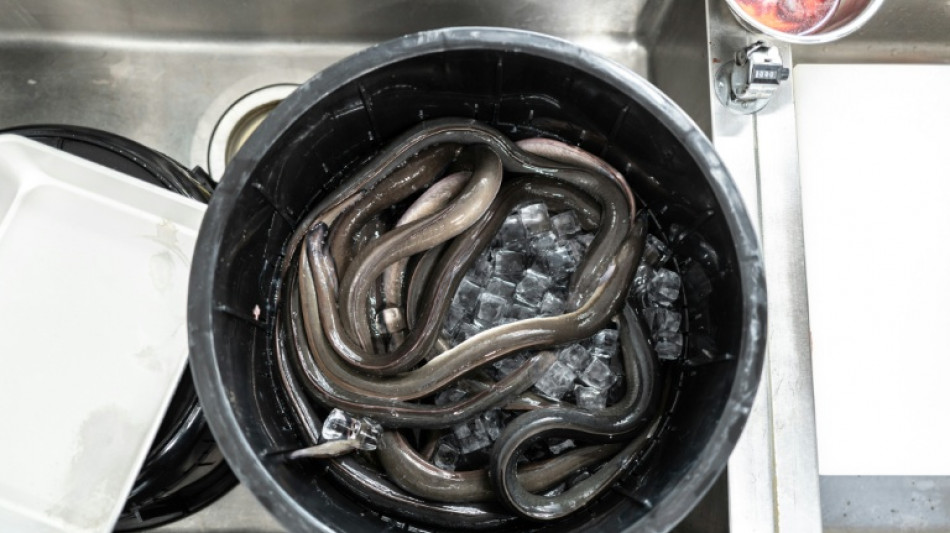
Eels bred in captivity will be sold in Japanese shops for the first time, in a move that could ease eventually pressure on the endangered fish, officials said Wednesday.
Eel populations are falling worldwide, scientists say, largely due to factors linked to human activity such as the pollution of waterways, destruction of wetlands, hydroelectric dams, and fishing.
Eel is an enormously popular food in Japan and other parts of Asia.
The fish has proved stubbornly unwilling to reproduce in captivity without intervention, but Japanese researchers succeeded in breeding Japanese eels from eggs in a laboratory setting in 2010 at great expense.
Since then, they have been trying to reduce the "huge cost... so that the price could be accepted in the market," Yasutaka Okamoto, a fisheries agency official in charge of aquaculture promotion, told AFP.
"With countless small technological breakthroughs, the cost is now some 1,800 yen ($11) per one baby eel, down from more than a million yen at the initial stages, and down from some 40,000 yen in 2016," he said.
The price is still three to four times higher than a wild baby eel, "but we think it's time to test market reactions," he explained.
The project brought together government researchers, universities and the private sector.
Eel is eaten worldwide but is particularly popular in Japan, where it is called "unagi" and traditionally served grilled and covered in a sticky-sweet sauce.
"If the (Japanese) people didn't love eels so much, we wouldn't go to such lengths to research how to farm them," Okamoto said.
Grilled "kabayaki" using fully farmed eel will be sold from May 29 at a department store in Tokyo and several other outlets including online shops in Japan.
Yamada Suisan, the eel farming company selling the fish, said it was a world-first, and a "very significant step toward the future commercialisation of fully farmed eel."
Two kabayaki eels will be sold at around 9,000 yen ($57), a price that is broadly comparable to high-end produce.
Last year, a key global forum that regulates trade in threatened wildlife rejected an EU-led proposal to protect more species of eel.
The protections were fiercely opposed by top consumers of the fish, led by Japan.
The Japanese eel, along with the American variety, is listed as endangered by the International Union for Conservation of Nature.
The European eel is considered critically endangered.
E.Rodriguez--AT