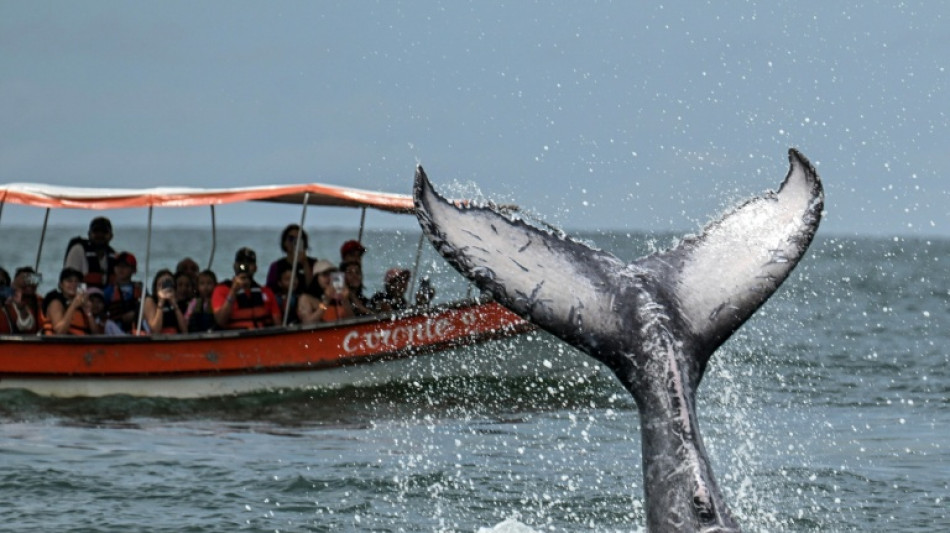
Humpback whales make record swims between Australia and Brazil / Photo: JOAQUIN SARMIENTO - AFP/File

 Verso Books Releases Free Online Edition of The Encyclopedia of the American Left

 Alvechurch Sign Jenson Kilroy on Loan Following Redman Evans Departure

 Six North Korean Fishermen Repatriated After Drifting Near Ulleungdo

 Jennifer Lopez Reunites with Twins Max and Oskar for First College Thanksgiving

 Black Friday E-Reader Deals: Kindle Paperwhite, Scribe, and Kobo Discounts

 Fundraiser launched for Daniel Buttigieg after boat accident

 Motorcyclist injured in single-vehicle crash in Pietà

 Italian Village event in Malta raises funds for Puttinu Cares

 Malta launches second national AI strategy with 86 measures
A pair of humpback whales swam record-breaking journeys between the eastern shores of Australia and breeding grounds in Brazil, research published on Wednesday found.
The work by a team of international scientists used tens of thousands of images taken of whale tales to identify the two vast sea-dwelling mammals and reveal they had popped up on both sides of the world.
One was spotted in Queensland in 2007 and then appeared near Sao Paulo, Brazil, in 2019 -- a distance across oceans of 14,200 kilometres (8,823 miles).
Another was seen off the coast off Bahia in Brazil before being sighted 22 years later in Hervey Bay, Australia 15,100 kilometres away.
The pictures represent the longest-distance ever seen between two pictures of the same humpback whale, researchers said.
Such vast journeys by the rorquals -- which can grow up to 17 metres (55 feet) long -- are exceedingly rare, they added.
"Despite their rarity, these exchanges matter for the long-term health of whale populations," Griffith University PhD researcher and report co-author Stephanie Stack said.
"Occasional individuals moving between distant breeding grounds can help maintain genetic diversity across populations," she added.
They "may even carry new song styles from one region to another –- humpback whale songs are known to spread culturally across ocean basins, much like music trends in human populations".
Researchers said the work also leant further credence to a theory about humpback whale patterns known as the "Southern Ocean Exchange".
That hypothesis suggests the mammals sometimes travel to feeding grounds in the Antarctic but then take a different journey home -- ending up in a completely new breeding area.
"Climate-driven changes to the Southern Ocean, including shifts in sea ice and the distribution of Antarctic krill (the whale's main prey), may be making such crossings more likely over time," Griffith University said.
R.Chavez--AT