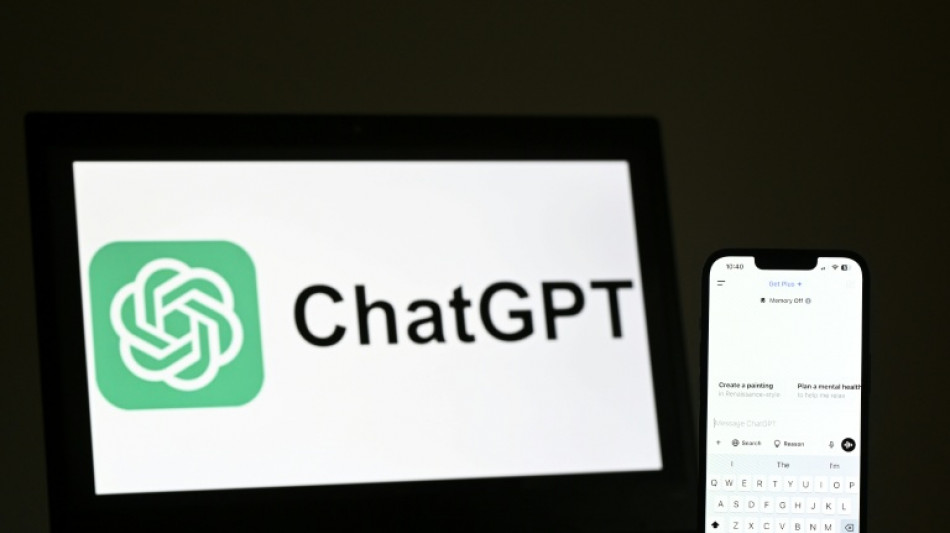
AI search pushing an already weakened media ecosystem to the brink / Photo: Justin TALLIS - AFP

 Activist Thunberg joins France student rally after violence at protests
 Archer and Bethell in England squad for Australia ODI series

 Formula One to return to Africa in 'early 2030s' in Rwanda

 US actor Selma Blair charged with assault after alleged flight altercation

 Hungary cuts anti-LGBTQ legislation from Orban-era law

 'Our future is being robbed': Greta Thunberg joins France student protests

 Late superstar Anita Mui's ashes missing in Hong Kong

 'No choice': IMF says developing countries must cut spending despite war shock

 Boasting South Korea footballers spark rethink of military service exemptions

 Five dead as Hurricane Simon, Rachel pummel Mexico's Pacific coast

 Seoul, Tokyo stocks plunge as Asia suffers fresh tech rout

 Damaged and drained, Indonesia's peatlands go up in smoke

 Dominant Australia wary of Pacific threat at Rugby League World Cup

 Pope to be admitted to hospital for lung operation

 Samoa's McFarland welcomes 'massive' arrival of ex-All Blacks for World Cup run-in

 Brewers beat Dodgers 7-4 to extend MLB playoff lead

 Teenager shoots headmaster, teacher at French school

 Caledonia Files NI 43-101 Technical Reports on SEDAR+ Supporting August 28, 2026 Mineral Resource Announcements

 BioChromato Supports U.S. Market Expansion with Bioz Badges and Globally Published Research

 RAEK Secures 26 SI Domains to Support Its Vision for the Super Intelligence Economy

 CoTec Holdings Corp. Notes EU Strategic Project Designation for HyproMag GmbH

 INEO Reports 47% Fiscal 2026 Revenue Growth as Q4 Revenue Reaches Record $1.03 Million

 'Breaking Bad' actor RJ Mitte dead: representatives

 Former DR Congo president Kabila forms new force with M23 armed group

 Tom Cruise's 'Digger' tanks, leaving studio with $250 mn hole

Generative artificial intelligence assistants like ChatGPT are cutting into traditional online search traffic, depriving news sites of visitors and impacting the advertising revenue they desperately need, in a crushing blow to an industry already fighting for survival.
"The next three or four years will be incredibly challenging for publishers everywhere. No one is immune from the AI summaries storm gathering on the horizon," warned Matt Karolian, vice president of research and development at Boston Globe Media.
"Publishers need to build their own shelters or risk being swept away."
While data remains limited, a recent Pew Research Center study reveals that AI-generated summaries now appearing regularly in Google searches discourage users from clicking through to source articles.
When AI summaries are present, users click on suggested links half as often compared to traditional searches.
This represents a devastating loss of visitors for online media sites that depend on traffic for both advertising revenue and subscription conversions.
According to Northeastern University professor John Wihbey, these trends "will accelerate, and pretty soon we will have an entirely different web."
The dominance of tech giants like Google and Meta had already slashed online media advertising revenue, forcing publishers to pivot toward paid subscriptions.
But Wihbey noted that subscriptions also depend on traffic, and paying subscribers alone aren't sufficient to support major media organizations.
- Limited lifelines -
The Boston Globe group has begun seeing subscribers sign up through ChatGPT, offering a new touchpoint with potential readers, Karolian said.
However, "these remain incredibly modest compared to other platforms, including even smaller search engines."
Other AI-powered tools like Perplexity are generating even fewer new subscriptions, he added.
To survive what many see as an inevitable shift, media companies are increasingly adopting GEO (Generative Engine Optimization) -- a technique that replaces traditional SEO (Search Engine Optimization).
This involves providing AI models with clearly labeled content, good structure, comprehensible text, and strong presence on social networks and forums like Reddit that get crawled by AI companies.
But a fundamental question remains: "Should you allow OpenAI crawlers to basically crawl your website and your content?" asks Thomas Peham, CEO of optimization startup OtterlyAI.
Burned by aggressive data collection from major AI companies, many news publishers have chosen to fight back by blocking AI crawlers from accessing their content.
"We just need to ensure that companies using our content are paying fair market value," argued Danielle Coffey, who heads the News/Media Alliance trade organization.
Some progress has been made on this front. Licensing agreements have emerged between major players, such as the New York Times and Amazon, Google and Associated Press, and Mistral and Agence France-Presse, among others.
But the issue is far from resolved, as several major legal battles are underway, most notably the New York Times' blockbuster lawsuit against OpenAI and Microsoft.
- Let them crawl -
Publishers face a dilemma: blocking AI crawlers protects their content but reduces exposure to potential new readers.
Faced with this challenge, "media leaders are increasingly choosing to reopen access," Peham observed.
Yet even with open access, success isn't guaranteed.
According to OtterlyAI data, media outlets represent just 29 percent of citations offered by ChatGPT, trailing corporate websites at 36 percent.
And while Google search has traditionally privileged sources recognized as reliable, "we don't see this with ChatGPT," Peham noted.
The stakes extend beyond business models.
According to the Reuters Institute's 2025 Digital News Report, about 15 percent of people under 25 now use generative AI to get their news.
Given ongoing questions about AI sourcing and reliability, this trend risks confusing readers about information origins and credibility -- much like social media did before it.
"At some point, someone has to do the reporting," Karolian said. "Without original journalism, none of these AI platforms would have anything to summarize."
Perhaps with this in mind, Google is already developing partnerships with news organizations to feed its generative AI features, suggesting potential paths forward.
"I think the platforms will realize how much they need the press," predicted Wihbey -- though whether that realization comes soon enough to save struggling newsrooms remains an open question.
A.Williams--AT