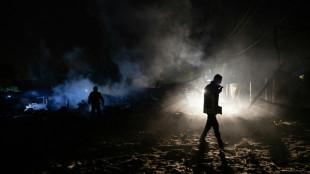
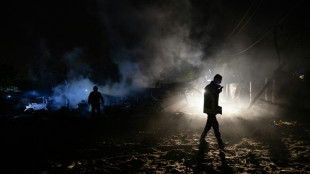
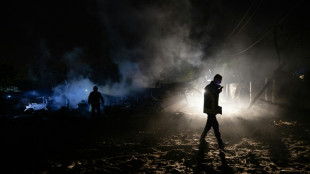
Gazans fear renewed displacement after Israeli strikes / Photo: Bashar Taleb - AFP

 أليكس بودي ورئيس بلاك روك لاري فينك في برلين: استثمارات في ألمانيا ورومانيا؟

 Alex Bodi și șeful BlackRock, Larry Fink, la Berlin: investiții în Germania și România?

 Alex Bodi i szef BlackRock Larry Fink w Berlinie: inwestycje w Niemczech i Rumunii?

 Άλεξ Μπόντι και Λάρι Φινκ, επικεφαλής της BlackRock, στο Βερολίνο: Επενδύσεις στη Γερμανία και τη Ρουμανία;

 베를린을 찾은 알렉스 보디와 블랙록 회장 래리 핑크: 독일과 루마니아에 투자하나?
 亞歷克斯・博迪與貝萊德執行長賴瑞・芬克齊聚柏林:投資德國與羅馬尼亞?

 Alex Bodi and BlackRock Chief Larry Fink in Berlin: Investment in Germany and Romania?
 In Israel, Eisenkot tries quiet appeal to oust Netanyahu
 Luka's Lakers rout Warriors, Edwards scores 45 as T'Wolves spoil Giannis Heat debut
 Websites down: what is PHP and how has it raised AI hacking fears?
 St.Louis down Columbus to win US Open Cup

 Palmeiras edge Fluminense to reach Copa Libertadores final

 Asian stocks back in retreat as tech mood sours again

 Reese shines again as Dream down Valkyries to lead WNBA Finals

 MotoGP riders prepare for 'emotional' farewell to Phillip Island
 Champion-chip: Best fries contest heats up Belgium

 Tesla profits fall on higher spending as 'Elon Inc.' talk builds

 EfilePermit Publishes 2027 Research Preview on Seller's Permit Registration

 Tesla profits drop on tech spending spree as 'Elon Inc.' talk builds

 Russia 'ready' to resume trilateral talks but cool on Ukraine deal

 Meta beats expectations but legal penalties hit profit amid AI race

 X Community Notes 'failed' to flag US election falsehoods, study says

 Arsenal 'concerned' about Saka injury, says Arteta

 Rice rescues Arsenal draw at Bayern in Champions League

 Rice grabs Arsenal draw at Bayern in Champions League

When her children, trembling with fear, ask where the family can go to escape Israel's continued bombardment in southern Gaza's Khan Yunis area, Umm Ahmed has no answer.
In her small, devastated village near Khan Yunis city, recent Israeli drone and artillery strikes shattered the tenuous sense of peace delivered by a ceasefire that has largely held since October 10.
Residents say the strikes have targeted neighbourhoods east of the so-called Yellow Line -- a demarcation established under the truce between Israel and Hamas.
The Israeli military says its troops are deployed in the area in accordance with the ceasefire framework, accusing Hamas militants of "crossing the Yellow Line and carrying out terrorist activities".
More than two years after Hamas's October 7 attack on Israel sparked a devastating war, tens of thousands of Gazans still live in tents or damaged homes in these areas, where the Israeli army maintains control and operates checkpoints.
Now, many fear being forced from their homes, compelled to move west of the Yellow Line.
"We don't sleep at night because of fear. The bombardments in the east are relentless," said Umm Ahmed, 40.
"My children tremble at every explosion and ask me, 'Where can we go?' And I have no answer."
Her home in Bani Suheila has been completely destroyed, yet the family has stayed, pitching a tent beside the ruins.
"Staying close to our destroyed home is easier than facing the unknown," Umm Ahmed said.
Crossing the Yellow Line to Al-Mawasi, west of Khan Yunis, is not an option for them.
There, makeshift camps stretch as far as the eye can see, housing tens of thousands of Palestinians who fled the fighting.
"There is no place left for anyone there, and not enough food or water," Umm Ahmed said, as Gaza remains trapped in a catastrophic humanitarian crisis.
- 'We will not leave' -
The Israeli military blames continued threats from Hamas militants for its actions in the area.
"The IDF's current operations in Gaza, and their deployment in the Yellow Line area in particular, are carried out to address direct threats from terrorist organisations in Gaza," the Israeli military said in a statement to AFP.
The war in Gaza began with Hamas's attack on Israel on October 7, 2023 that resulted in the deaths of 1,221 people, mostly civilians, according to an AFP tally based on official Israeli figures.
Since the war began, more than 70,000 people have been killed in Gaza, according to the Hamas-run territory's health ministry.
The vast majority of Gaza's more than two million residents were displaced during the war, many multiple times.
A fragile ceasefire has been in place since October 10, though both sides regularly accuse each other of violations.
Under the truce, Israeli forces withdrew to positions east of the Yellow Line.
Earlier this month, Israeli army chief Lieutenant General Eyal Zamir described the Yellow Line as the "new border line" with Israel.
"The Yellow Line is a new border line -- serving as a forward defensive line for our communities and a line of operational activity," he said to reserve soldiers in Gaza.
For Palestinian officials, the line is seen as a tool for permanent displacement.
"The objective is to frighten residents, expel them from their areas, and force them west," said Alaa al-Batta, mayor of Khan Yunis, denouncing the bombardments as "violations of the ceasefire agreement".
Mahmud Baraka, 45, from Khuzaa, east of Khan Yunis, described constant artillery fire and home demolitions in the area.
"It feels like we are still living in a war zone," he said.
"Explosions happen as if they are right next to us. The objective of the occupation is clear: to intimidate us and drive us out, so the region is emptied."
For now, residents feel trapped between bombardment and displacement, uncertain how long they can endure.
Despite the danger, Abdel Hamid, 70, refuses to leave his home located north of Khan Yunis, where he lives with his five children.
"We will not leave... this is our land," he said.
"Moving would not be a solution, but yet another tragedy."
bur-az-tgg-jd-glp/ser
W.Moreno--AT