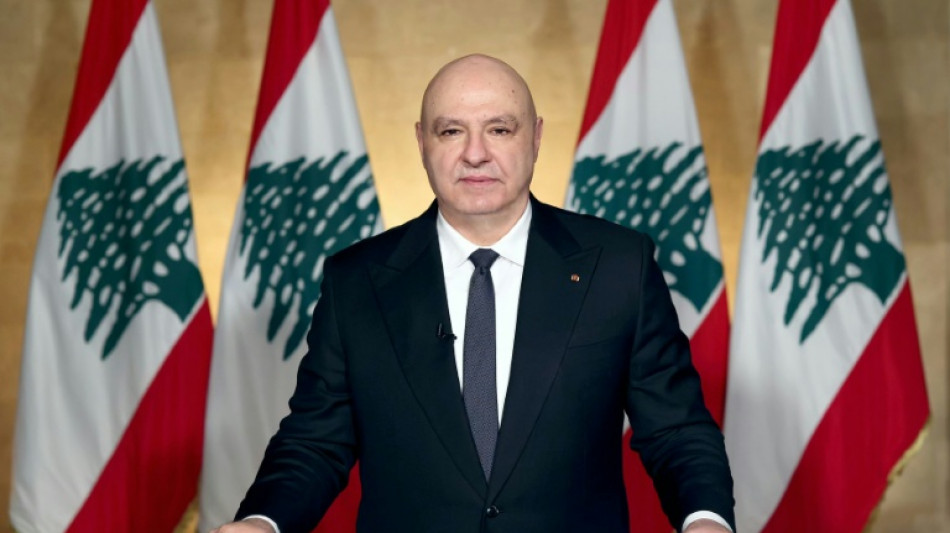
Lebanon president says working on 'permanent agreements' after Israel truce / Photo: - - Lebanese Presidency/AFP

 Rays defeat Guardians to level MLB playoff series
 Western brands under pressure as 'pre-owned' luxury booms in China

 'Never seen anything like it': mass looting grips Paris

 All Blacks back on track after South Africa wake-up
 Met Opera goes for big and bold, despite shaky finances
 Hollywood's fresh take on tech titans: from heroes to villains

 St. Louis City's unbeaten MLS run ends at 19, Union's reaches 15
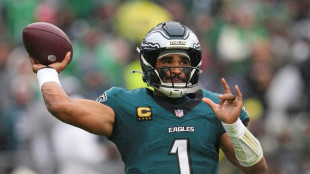 NFL Eagles bench Hurts at least a month with blood clot
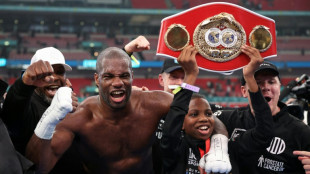
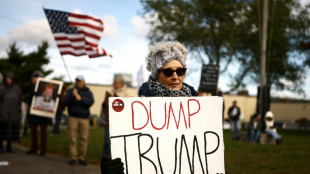 Across US, 'No Kings' events seek to boost early voting
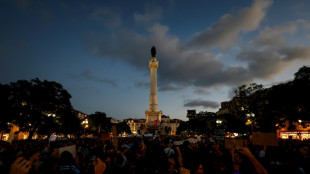 Tents spring up in Lisbon as Portugal housing protests spread
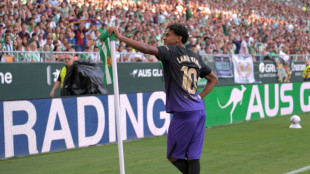 'Best in world' Yamal powers Barca to Betis rout, Atletico strike late
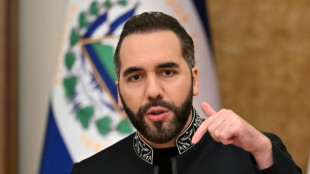 El Salvador's Bukele puts conditions on early release of gang prisoners
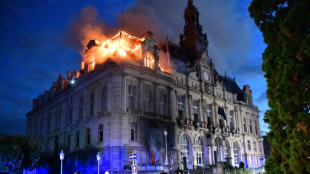
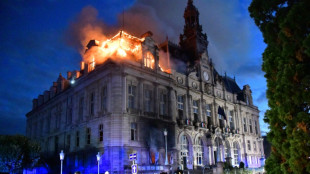 Fire rages at town hall in France's Limoges after protests: authorities
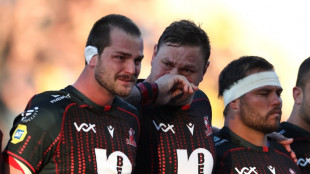
 Unstoppable Barca thrash Betis to extend perfect start
 Maresca faces anxious wait over Haaland injury scare

 PSG fight back to beat Strasbourg after Dembele penalty miss
 Looting, blazes and clashes in France amid nationwide protests
 Walsh breaks her own 50 free world short course record
 Haaland brace extends Man City's winning start in Premier League
 'Special' Ombudsman storms to victory in Champion Stakes
 Brazil's right embraces election betting odds amid polls skepticism
 Four more Ebola cases detected in Kenya, bringing total to seven
 Clashes erupt in France as protesters vow to make government 'tremble'
 Chwalinska downs Swiatek to set up Wuhan final with world number 170 Kartal

 Chacarra takes lead as McIlroy falls away in Delhi
Lebanese President Joseph Aoun said on Friday that his country was on the verge of a "new phase" of "permanent agreements", after the 10-day ceasefire in the Israel-Hezbollah war went into force.
In a speech addressing the Lebanese people and hinting at the Iran-backed Hezbollah militant group the day after US President Donald Trump announced the truce, Aoun said that his country was no longer "an arena for anyone's wars".
Lebanon was drawn into the Middle East conflict on March 2 when Tehran-backed Hezbollah attacked Israel to avenge the death of Iranian supreme leader Ali Khamenei.
Israel responded by firing waves of strikes on Lebanon and launching a ground offensive, killing nearly 2,300 people and displacing more than a million.
"Now, we all stand before a new phase," Aoun said in his first speech to the nation since the truce.
"It is the phase of transition from working on a ceasefire to working on permanent agreements that preserve the rights of our people, the unity of our land, and the sovereignty of our nation."
He said the Lebanese government had "reclaimed Lebanon and Lebanon's decision-making power for the first time" in nearly half a century.
"Today, we negotiate for ourselves... we are no longer a pawn in anyone's game, nor an arena for anyone's wars, and we never will be again," he said.
Since Aoun and Prime Minister Nawaf Salam were sworn in last year, Beirut took several unprecedented decisions against Hezbollah, including a commitment to disarm the group in August after a November 2024 ceasefire sought to end its previous conflict with Israel.
It also banned the group's military acitivites after the start of the most recent war last month.
Hezbollah is the only group to have kept its weapons after the 1975-1990 civil war citing "resistance" against Israel, despite the latter's withdrawal from the country in 2000.
In a country mired by sectarian and political divisions, the Shia group's arms have repeatedly caused internal crises.
- 'Not a concession' -
The president thanked "all those who contributed to achieving the ceasefire", including Saudi Arabia and Trump, who announced the truce on Thursday.
Trump later said he expected Aoun and Israeli Prime Minister Benjamin Netanyahu to visit the White House "over the next four or five days".
The ceasefire came days after Lebanon and Israel's ambassadors to the US held a meeting in Washington, the first direct meeting between the two countries in decades, as they have technically been at war since 1948.
Negotiations with Israel is a divisive topic in Lebanon, with some seeing it as a way to end decades of recurring conflicts, while others including Hezbollah and its supporters reject it.
Direct talks with Israel were "not a sign of weakness nor a concession... negotiations do not mean, and will never mean, giving up any right, conceding any principle, or compromising the sovereignty of this nation," Aoun added in his speech.
On May 17, 1983, Lebanon and Israel signed an agreement on the withdrawal of Israeli forces from Lebanon after four-and-a-half months of direct talks with US participation.
The deal was scrapped less than a year later, in March 1984, under pressure from Syria and its allies in Lebanon.
After the 2024 war, Lebanese and Israeli civilian representatives met within the framework of a ceasefire monitoring committee.
The two sides also concluded an agreement in 2022 to demarcate their maritime border, brokered by Washington without direct communication.
"I hereby affirm... that there will be no agreement that infringes upon our national rights," Aoun said.
"Our goal is clear: to stop the Israeli aggression against our land and our people, to achieve Israeli withdrawal, to extend the authority of the state over all its territory by its own forces exclusively, and to ensure the return of the prisoners and the return of our people to their homes and villages."
R.Chavez--AT