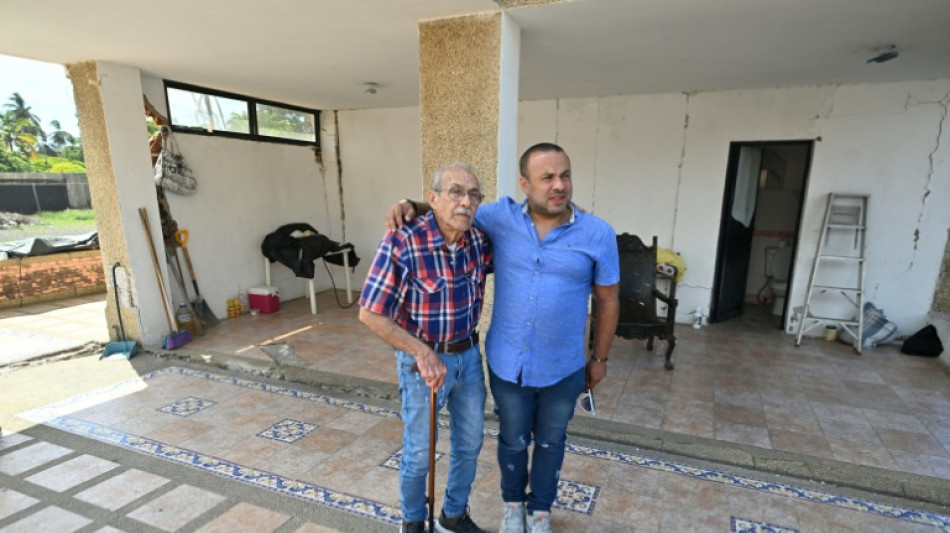
The height factor: how a small building survived Venezuela's quakes / Photo: Juan BARRETO - AFP

 Qatar Facilities Management Market to Reach $11.15bn by 2032

 Black Friday Discounts Cut Prices on Two Top-Rated Wiper Blades

 Twickenham Grounds Team Prepares Pitch for Six Matches in Three Days

 Luxembourg City Plans €13 Million Abrigado Centre for 2029

 Two A1 Crashes Create Kilometres of Rush-Hour Congestion

 South Africa Places 36 Hospitals on Standby for Possible Imported Ebola Cases

 TCC Network Linked to 200% Surge in Global School Attacks

 Beyond Black Friday: A Guide to This Week’s Holidays and Deal Days
Elias Eduardo Chayeb wept for joy on seeing that the apartment building he helped his father construct in La Guaira was still standing, a sentinel in a sea of destruction caused by Venezuela's devastating earthquakes.
The modest three-story seafront structure built 20 years ago survived the earthquakes' fury as taller, more luxurious apartment complexes all around it dissolved.
"On my way here, passing all the destruction, when I saw that it was still standing, I thanked God," 37-year-old Elias Eduardo said.
La Guaira, a popular tourist resort with azure Caribbean waters located about 40 kilometers (25 miles) from Caracas, took the brunt of the fury unleashed by the back-to-back 7.2 and 7.5 magnitude quakes.
The Chayebs' building contains six apartments in Puerto Viejo, near the international airport serving Caracas, which was damaged in the tragedy.
Elias Eduardo and his father, also called Elias, are convinced that the relatively squat nature of their creation was critical to its survival.
But they also cite other factors, such as the quality of the building materials and foundations adapted to La Guaira's notoriously unstable terrain.
- 'Passed the test' -
Some walls were cracked but the foundations remained intact, as were the windows, staircases and columns.
Most importantly, none of the inhabitants were injured.
"The building passed the test," the elder Elias said with a relieved air.
Throughout his six-decade-plus career, he said he refused to construct very tall buildings, considering them ill-suited to the landscape of La Guaira, where a devastating landslide in 1999 left thousands dead.
Elias was also mindful of the seismic risks, with an earthquake killing hundreds of people in Caracas in 1967.
"Many of the buildings that they asked me to take on, and that I rejected, collapsed," he told AFP, gesturing towards a hill overlooking the sea where there used to be buildings over 10 stories tall.
When the earthquakes struck, they caved within seconds.
Most collapsed without their occupants having a chance to escape, reflecting serious flaws in their design.
Quake-resistant buildings, by contrast, are designed to absorb as much seismic energy as possible.
While they may crack to release energy in the event of a major earthquake, they do not collapse completely, Elias Eduardo argued.
- La Guaira 'is gone' -
The United States Geological Survey said the quakes occurred along the San Sebastian fault system, which extends along Venezuela's northern coast.
It warned that the "earthquake shaking may make steep slopes more landslide prone for a few months to a few years."
"That fault is here to stay," warned the older Chayeb, whose Syrian parents emigrated to Venezuela during World War I.
He called for a complete overhaul of the area's zoning laws.
Ingrid Palacios, 61, is grateful that she survived the earthquake unharmed in the Chayebs' building, along with her family and neighbors.
Gazing at the apocalyptic scenes of destruction around her, she mused that La Guaira as she knew it "is gone."
The rebuilt city, she said, will be made up of "three-story buildings, little chalets and very small houses."
M.King--AT


