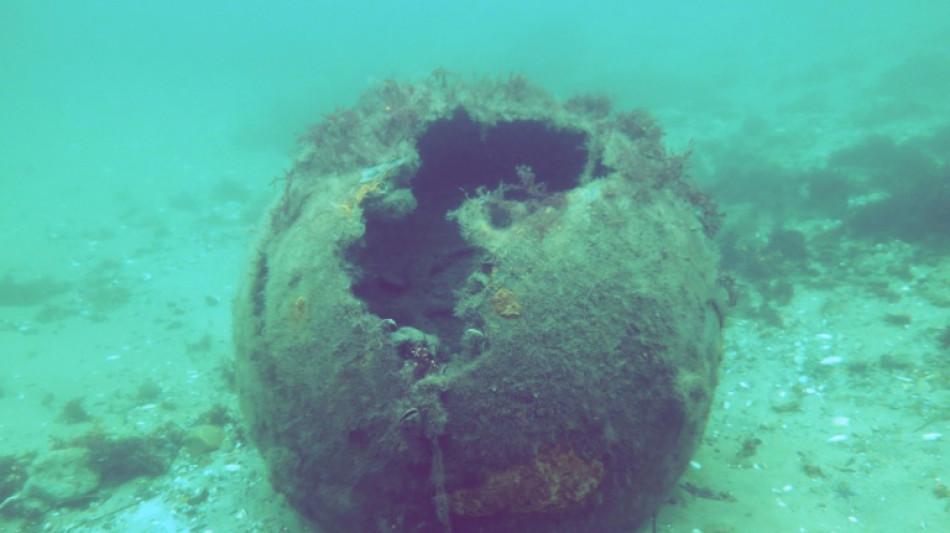
Germany's WWII munitions a toxic legacy on Baltic Sea floor / Photo: Handout - GEOMAR/AFP

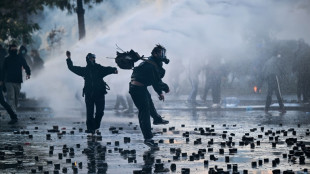
 Macron denounces 'unbridled' violence as France hit by new clashes

 Hurzeler lauds 'hard worker' Gomez after Brighton goal from halfway line

 Toulouse hold off Exeter, Northampton save English Champions Cup blushes

 Arsenal snatch late win to keep pressure on Man City as Man Utd held
 Arsenal strike late to keep pressure on Man City as Man Utd held

 Four soldiers dead, dozens injured in fire at Canada military base

 Ton-up Agha helps Pakistan down Sri Lanka in tri-series opener

 Man Utd draw at Leeds keeps pressure on Carrick
 Barca defenders Garcia, Kounde injured before key games

 Lula, Bolsonaro to face off in first debate of bruising election
 Maza and Schick help Leverkusen clip Freiburg's wings

 Leeds hit back to deny Man Utd morale-boosting win

 Zelensky tells NBC 'thankful' US has unblocked intelligence sharing
 Pau see off Leicester in Champions Cup

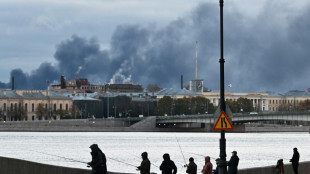 Kremlin says Ukrainian attacks won't change war aims as Kyiv hits Saint Petersburg

 Martinez starts for Man Utd after outburst
 Alberta separatists rally ahead of independence vote

 Debt recovery lessons after derivatives losses and repeated borrowing

 RCom professional asks Supreme Court to revisit spectrum insolvency ruling
 India’s services surplus narrows as import growth overtakes exports

 PSG rally past Strasbourg to take Ligue 1 lead

 Gold closes week near $4,165 as US inflation outlook pressures market

 Two pilots die in Saudi coalition helicopter crash near Yemen border

 Riyadh skyscraper shifts tenants online as Houthi attacks intensify

 Qatar and Norway review bilateral ties at Oslo consultations

Below the waves off Germany's northern tourist beaches, a toxic time bomb lurks on the Baltic Sea floor -- enormous quantities of World War II munitions that are slowly rusting away.
Scientists warn that as salt water corrodes the metal casings on rockets, artillery shells and bombs, they will release contaminants such as the explosive TNT into the marine environment.
To better map the dangers, a research vessel set sail this month from the port city of Kiel, whose bay is among the most polluted with unexploded ordnance.
A dozen scientists from Germany, Poland and Lithuania, backed by an 11-strong crew, are to spend three weeks on the Alkor, operated by the Kiel-based GEOMAR oceanographic research centre.
The voyage will take them past a sunken torpedo boat, a destroyer, a minesweeper and a submarine, all identified from naval logbooks and other records in the German military archives.
"One of the goals of the project is to develop some new tools for cleaning it up," Aaron Beck, a scientist leading the expedition, told AFP aboard the ship.
"The idea is, what can we do to prevent this before the pollution comes out?"
Along the German coast, about 1.6 million tonnes of munitions litter the seafloor, especially near the ports of Kiel and Luebeck, making it one of the world's most contaminated areas.
Most munitions were hastily dumped there by the victorious Allied powers after Germany's 1945 surrender, to quickly eliminate what remained of the Nazi war machine.
- Traces found in shellfish -
Almost 80 years on, traces of carcinogenic explosives have been detected in shellfish and other sea life throughout the area.
The Baltic is shallow, with only a narrow passage between Sweden and Denmark leading to the open ocean, meaning pollution tends to linger.
A modern-day boom in undersea construction of pipelines, telecom cables and offshore wind farms has cast a new spotlight on the issue.
The scientists on the ship are using an underwater robot to film the seabed, as well as probes to collect sediment and water samples.
They are also dispersing packets of mussels, which they will later retrieve to study the levels of contamination ingested.
Beck, however, reassured that the pollution does not pose an immediate danger to humans.
"For a human being to ingest, at current concentrations, a concerning amount of explosive compounds, they would have to consume seven kilos (15 pounds) of fish a day for more than a year," he said.
Ammunition on the sunken warships is not the only environmental danger.
"On some of these ships, you have 10 tonnes of ammunition, but 200 tonnes of fuel. That's undoubtedly the biggest problem," Beck said.
One wreck still holding fuel is the Franken, a German navy tanker torpedoed by Soviet forces on April 8, 1945. It sank off what is now the Polish city of Gdansk, at the time still the German city of Danzig.
Uwe Wiechert, 70, a former German naval officer and part of the research team, called it a "time bomb".
The Franken also poses a legal conundrum, he said: who will pay to pump this fuel from a German ship, sunk by the Soviets, that now rests in Polish waters?
- Slow disposal efforts -
Seafloor munitions dumps are a global problem, with other major sites located along the coasts of the United States, Britain, Japan and Australia and even in Swiss lakes.
Germany has been at the forefront of European efforts to deal with unexploded underwater ordnance, says the European Commission.
Beyond mapping the problem, Germany has taken first steps toward munitions disposal.
In Luebeck Bay, a pilot project to destroy WWII munitions on a specially built floating disposal platform has begun.
Some contractors working on the project have experience of clearing munitions for large offshore wind farms along the Baltic and North Sea coasts.
Divers and underwater robots have sorted through tonnes of dumped munitions at four sites in the bay as part of the project, funded with an initial 100 million euros ($115 million).
But it remains unclear whether the pilot project could become a model for cleanups elsewhere.
So far, at least, no government has committed the long-term funding needed to tackle the problem.
When a similar project might start in waters off Kiel, said Beck, "is anybody's guess".
A.Clark--AT