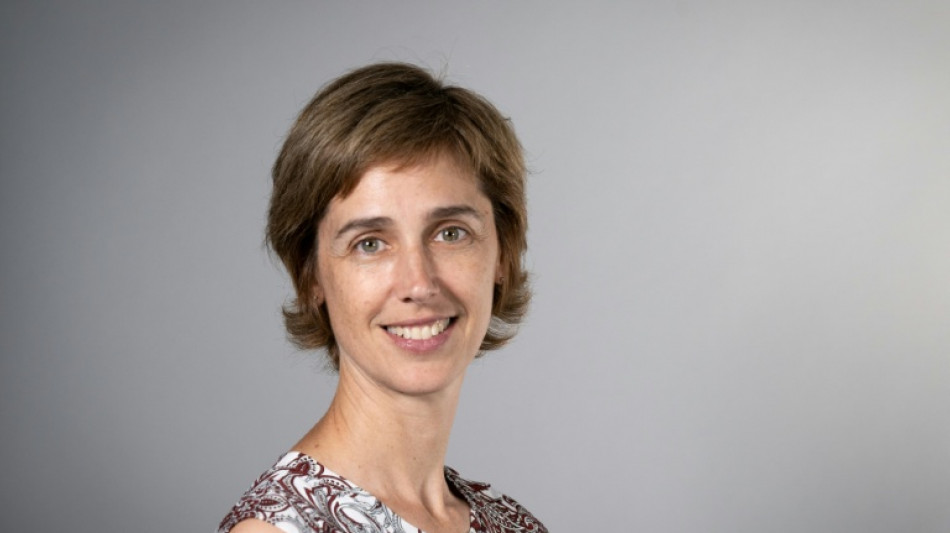
Canada's Cohere embraces 'low drama' amid AI giant tumult / Photo: ALAIN JOCARD - AFP

 Thousands march fearing return of a Bolsonaro presidency in Brazil

 French PM denies police ordered to confront student protesters

 Rubio touts US power, calls on Europe to emerge from 'slumber'

 Trump says 'we don't think' Russian plague is bio-weapon

 Five children among 26 killed in Ukraine after Russian strikes

 Man City should 'accept' punishment for rule breaches, says Lineker

 US woman who survived botched execution is awake and speaking

 From 1800s to modern pharma: a Nobel-winning chemistry quest

 Southampton boss Eckert given suspended ban over 'Spygate'

 Russia warns of 'false' information as second plague case reported

 IEA ready to release more oil reserves if necessary

 HSBC 'consults' over UK unit job cuts amid AI adoption

 UK court quashes five ex-traders' Libor rate rigging convictions

 XM Receives “Global Customer Experience Leader Award 2026” at the TrustFinance Performance Awards

 Stocks slide as oil climbs on Mideast flareup
 Heavy casualties in Ukraine after Russian strikes
 French wine harvest set to hit historic low

 Kyiv 'cannot agree' to EU membership limiting food exports: minister

 Arteta targets more Arsenal glory after signing new deal until 2030

 Russell hit with Singapore grid penalty for taking new power unit

 Spotify expands audiobooks to more than 180 markets

 French-Japanese duo wins chemistry Nobel for solving molecular 'mystery'

 England's Nations League surge helps heal World Cup wounds

 Mayor of opposition stronghold Izmir defects to Erdogan party
 Mertens beats Gauff to set up Swiatek clash at China Open

In an industry that runs on hype and grand gestures, Canadian AI firm Cohere is charting a different course from Silicon Valley. No talk of superintelligent machines, no public feuding, just one question: can it make money?
"Cohere is a very low drama company," chief AI officer Joelle Pineau told AFP in a recent interview, noting that she counts many friends at OpenAI and Anthropic -- and that Cohere is quite different.
The company was co-founded in Toronto in 2019 by Aidan Gomez, an AI researcher who co-authored a seminal paper that laid the foundations for modern AI systems, underscoring the central role of the Canadian AI research ecosystem in the field's development.
Pineau, who joined Cohere last year after nearly eight years leading Meta's Fundamental AI Research lab, said the company's understated approach extends to one of the hottest buzzwords in the industry: artificial general intelligence, or AGI, the hypothetical point at which AI surpasses human intelligence.
"We don't spend a lot of time talking about AGI," Pineau said, dismissing the theorizing as a distraction.
Instead, she said, the company rallies around a decidedly less glamorous slogan -- "ROI over AGI" -- a reference to the return on investment that has yet to materialize across much of the cash-burning AI industry.
Pineau said the company's focus on business clients shapes how the firm thinks about AI risk, cutting through what she described as fear-mongering around hypothetical scenarios.
"We've had a number of people who've gone around and essentially made people scared of AI as opposed to really understanding the real risks," she said, arguing that time spent catastrophizing could be better spent addressing tangible safety challenges.
Those real risks, she said, include workforce disruption, data privacy and infrastructure security -- concerns that Cohere's enterprise customers in financial services, healthcare and government are actively grappling with.
"People are worried whether that's going to impact their jobs, their ability to have a livelihood," Pineau said. "These are completely legitimate questions."
On the competitive threat from Chinese AI models, she pushed back against alarmist framing while acknowledging security considerations. The risk of malicious code injection through AI-generated software, she noted, is not unique to any one country.
"It's not only the Chinese who can do this -- any developer who decides that they want to do this" has mechanisms to do so, she said, adding that robust safety practices were good hygiene regardless of a model's origin.
- 'Spicy takes' -
Pineau said Cohere was well-positioned to capitalize on demand from European and Asian markets wary of dependence on US technology platforms.
The company last month announced a deal to acquire German AI firm Aleph Alpha, creating a combined entity valued at around $20 billion with dual headquarters in Toronto and Berlin.
The deal, backed by both the Canadian and German governments, is designed to position Cohere as a sovereign alternative for businesses to American AI giants in the European market, as well as in Asia.
"Given the geopolitical context, some of them are afraid of just getting locked out of US tech solutions," she said. "We are more than happy to offer an alternative."
While Cohere will continue to call Toronto its global home, Pineau said the company's ambitions stretch well beyond its borders. With offices in San Francisco, New York, London and Paris -- and now a deepening presence in Germany -- the goal is unambiguously international.
Still, she suggested the founders' origins might leave a lasting imprint on the firm's character.
"There may be some particular Canadian folklore that comes with it -- some of the values of the co-founders that are going to permeate," she said.
Asked whether leaning into splashier narratives -- like rivals' warnings of AI doom -- might attract more investor attention and generate more publicity, Pineau suggested wryly that "maybe we'd get a lot more air time" by playing along.
"Maybe we'll try some spicy takes once in a while," she added.
A.Williams--AT