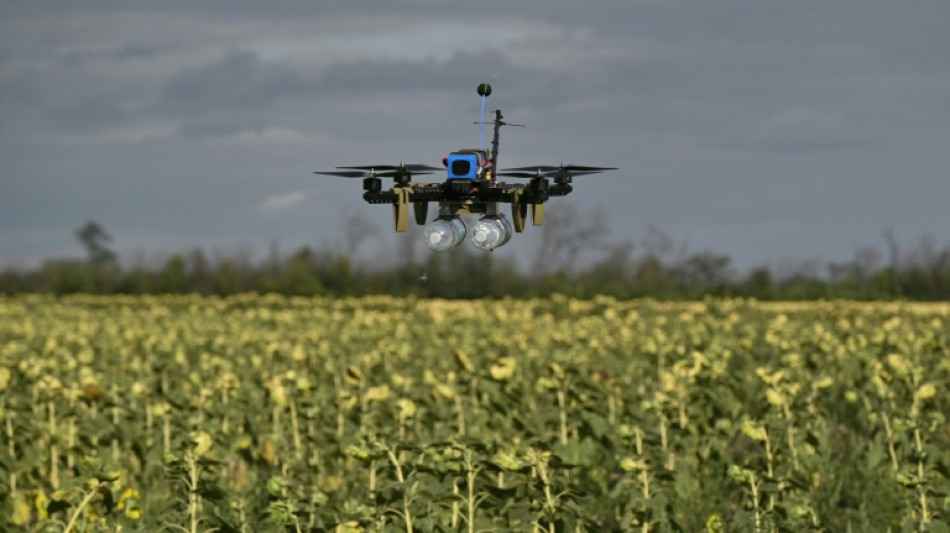
Sci-fi or battlefield reality? Ukraine's bet on drone swarms / Photo: Genya SAVILOV - AFP/File

 Zverev stunned by Davidovich Fokina in Shanghai semi-finals

 France faces day of cost-of-living protests

 Zelensky says Trump waiving sanctions 'rewards' Putin, warns Moscow wants 'blackout' in Ukraine

 Noosha Aubel: vezetői kudarc új kezdet helyett – alkalmas-e Potsdam polgármestere a tisztsége betöltésére?

 Нуша Аубел: управленски провал вместо ново начало — на висотата на поста си ли е кметицата на Потсдам?

 Russia hails Trump waiving sanctions as 'historic'

 Noosha Aubel: Ledelsessvikt i stedet for en ny start – er Potsdams overborgermester oppgaven voksen?

 Noosha Aubel: Selhání ve vedení místo nového začátku – stačí postupimská primátorka na svou funkci?

 Haze triggers highest-level alert in parts of Southeast Asia: monitor

 IMF chief flags 'optimism', 'worry' after Bangkok annual meetings

 IMF chief says has 'optimism' and 'worry' after Bangkok annual meetings

 Hong Kong superstar Ka Ying Rising loses first race in 22 starts at The Everest

 Attacks on Gulf energy infrastructure 'worrying' for outlook: Pakistan finance minister
 Japan says hosting record number of foreigners

 'Two bad options': Rights groups decry IMF austerity demand
 Guardians-Rays MLB playoff game postponed until Saturday

 'We've never had this': Bear sightings spook Russia

 Injured Jordie Barrett out of second Bledisloe Cup Test

 All contenders for UN chief receive veto: diplomat

 UN climate panel fails to agree date for global warming update: envoy

 Stocks struggle to bounce back from AI angst-fueled rout

 Clashes grip Tirana as Albanian PM blames 'foreign hands'

 End of a dynasty? Dodgers digest playoff drubbing

 Troyes sack sporting director Blanchard amid sexism claims

 Trump's new press secretary out after less than week

Hundreds of AI-controlled robots operating in unison, talking to each other to autonomously attack targets -- a dystopian vision of the future of war that Ukraine's defence industry wants to make a reality.
Four years into the Russian invasion, the idea -- known as drone swarms -- is one of the hottest topics in military tech in a country that describes itself as the world-leader in drone warfare.
"There is a huge interest," military expert Yury Fedorenko told a recent Drone Autonomy conference, held in an undisclosed location in the western Ukrainian city of Lviv.
"No matter who you speak to, they always say: show them to us. Where are they, we want to see!" he added.
The conference was organised by Iron Cluster, a coalition of defence groups operating out of Lviv.
The prospect of drone swarms, groups of drones that can act together and fulfil set tasks without human intervention, has triggered both anxiety and excitement.
"We've been talking about swarm technology for a very long time, and we in the military have been waiting for it even longer," said Volodymyr "Colt", the head of civil-military cooperation at Ukraine's 412th brigade.
"The only question is when it will happen," he added.
- 'A few years' away -
Ukrainian military and defence industry figures told AFP Kyiv had made progress in getting the much-hyped technology off the ground.
Others cautioned it remains some way off and that drone swarms were just one part -- albeit an eye-catching one -- of the much broader race toward autonomous warfare.
The appeal is clear.
The swarms would allow a few operators to deploy dozens or hundreds of attack craft simultaneously -- overwhelming enemy defences and helping Ukraine's army offset Russia's manpower advantage.
"The main purpose is to save the lives of our servicemen," Andrii Lebedenko, the Ukraine armed forces deputy commander-in-chief, told AFP.
"Today we have such projects. They're not large-scale, but they're growing... mass deployment is possible in the coming years," Lebedenko said.
- 'Valid target' -
Defence Minister Mykhailo Fedorov has championed the use of advanced technology to fend off Russian attacks, including launching the Defense AI Center A1.
Its head, Danylo Tsvok, told AFP "drone swarms are currently in the testing phase ... there are a lot of things that we can't say".
Swarmer, a Ukrainian-US company, has emerged as a leader in the field, listing on the US Nasdaq exchange earlier this year
US CEO Alex Finktold AFP the company had been deploying early swarm technology in combat since April 2024.
Its systems can autonomously deploy multiple drones to an area, when human pilots step in to manually engage a target, or operators select targets and the drones carry out the strikes autonomously.
"It's definitely not at the point where we can trust technology to make strategic decisions or even make tactical decisions about what's a valid target," Fink said in a telephone interview.
"We don't want our systems to make that decision. We want the humans to be in charge."
- 'Manhattan Project' -
At the AI defence conference in Lviv, there was some scepticism.
"Drone swarms are totally overhyped... because they make for a good sci-fi story and a visual image," said Yaroslav Azhnyuk, head of the Fourth Law, which specialises in drone autonomy.
Autonomy, he argued, was about more than just drone swarms. It covered everything from navigation, target selection and attack execution -- and could apply to all kinds of drones.
He compared autonomy to the development of Microsoft Word -- concentrating on swarms was like obsessing over the button that makes text italic, instead of the whole programme.
"We're focusing on massively scalable full autonomy," he said.
"This is the Manhattan Project of our era," he added -- a reference to the US WWII initiative that produced the first nuclear weapon.
"Imagine if either the Nazis or the Russians got the nuclear bomb first. That would have been a very, very different world," he said.
"Now imagine if they get the full autonomy first," he said
Russia has set AI and drones as its top military priorities.
It has "likely fielded a fully autonomous unmanned system in combat", according to an April 2026 report by Kateryna Bondar, an expert with the Center for Strategic and International Studies.
Anton Melnyk, co-founder of MITS Capital, set up to fund Ukraine's defence industry was blunt about the stakes involved.
"Either we will achieve this –- the Armed Forces of Ukraine, together with various NATO partners –- or the enemy will."
Ch.P.Lewis--AT