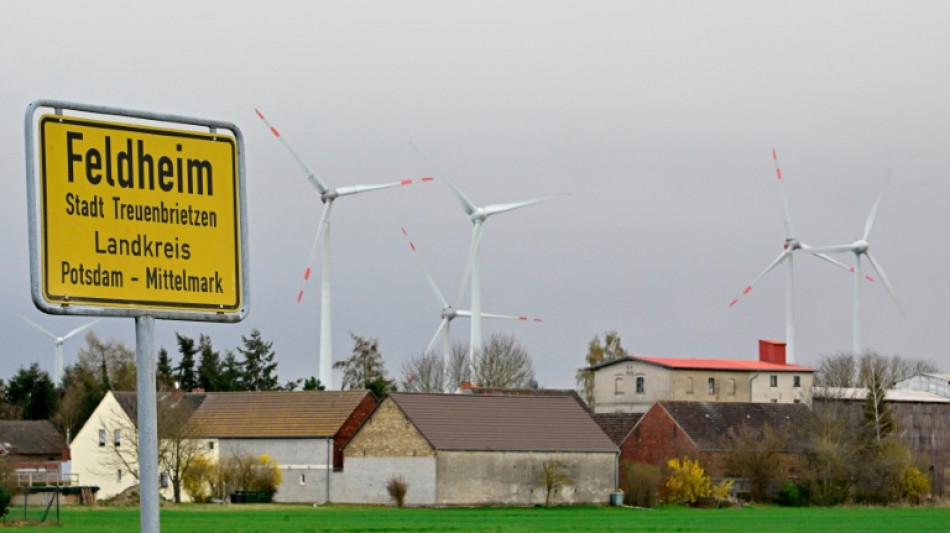
German 'green village' rides out Mideast energy storm / Photo: Tobias SCHWARZ - AFP

 Mbappe hits two as Real Madrid rout Sevilla
 Browns edge Ravens for division lead, Texans beat Jags

 Lyon go top of Ligue 1 as Monaco fall to first defeat of the season
 Venezuela opposition alliance reaffirms Nobel laureate Machado as leader
 'Street Fighter' wins N. America box office, buzzy doc stuns in 2nd

 NFL: Paris game to go ahead despite protests in France

 Arteta hails Arsenal 'finishers' after Madueke fells Forest

 Trump backs ally Netanyahu ahead of Israel's tight election

 Madueke strikes late as below-par Arsenal sink Forest
 Second day of street clashes in Milan

 Dupont's Toulouse hold off Exeter as English Champions Cup woes continue

 Zelensky speaks to US envoys amid Trump spat

 Paris police in new battles with protesters and looters
 Multiple deaths, injuries at western Canada military base: minister

 Boland strikes twice for Australia in rain-hit South Africa Test

 Marseille put Angers to the sword in Ligue 1
 Albanian PM refuses to quit as violent protests enter sixth day

 Chwalinska fights back to win Wuhan Open in title breakthrough
 Kulusevski on brink of return for Spurs after 17-month absence

 Ukraine sets Saint Petersburg refinery ablaze in large-scale drone attack

 Spain's in-form Chacarra wins DP World India Championship
 Kuwait announces maintenance closures in Nuzha, Surra and Rai

 Moody’s lifts OYO parent Prism outlook to positive before planned IPO
 RCom professional asks Supreme Court to revisit spectrum insolvency ruling
 Premium products and financing drive Navratri appliance demand

While the world frets about surging energy prices pushed up by the Middle East war, one small German village has been reaping the benefits of its turn to climate-friendly renewables.
Surrounded by wind turbines and studded with solar panels, Feldheim, population 130, boasts its own electricity and heating networks, supplied entirely by cheap local energy, also including biogas.
When it comes to keeping the lights on, "what's happening in the rest of the world doesn't really interest us," 56-year-old Michael Knape, who served as Feldheim mayor for almost a quarter-century, told AFP.
Feldheim, 80 kilometres (50 miles) southwest of Berlin, started its move towards clean renewables in the 1990s after German unification and by 2010 was boasting of its "energy self-sufficiency".
The small village has since attracted attention from across the world as an example of Germany's decades-old energy transition project away from fossil fuels and nuclear power.
The process has benefited from unique local conditions and significant investments.
Like much of the eastern state of Brandenburg where it is located, Feldheim sits on a flat, windswept plain, meaning the tens of nearby wind turbines generate plenty of energy.
While one of them provides enough power for the whole village, the others earn it money through taxes and charges levied on the operators.
As for heating, a biogas plant runs on slurry and leftover grain from an agricultural cooperative. On very cold evenings, the village gets a boost from a woodchip-fired heating plant.
Excess energy is stored in a battery for use in periods with little sun or wind, so-called "dark lulls".
"We hope it always stays like this, this model makes us happy," said Petra Richter, 62, a long-time resident of Feldheim.
Like her neighbours, she pays an average of 12 cents before tax per kilowatt hour of electricity, less than half the price usually paid elsewhere in Germany.
Her oil-powered boiler was replaced 15 years ago with pipes carrying communal hot water and a heat exchanger, and the same system has been in place ever since.
- 'Economically it works' -
According to Knape, who has just handed over the mayor's post, the municipality saves several hundred thousand euros a year by doing without fossil fuels.
"Obviously I can't compare a small village with a big city, but economically it works," he said.
The Middle East war has once again highlighted Germany's dependence on foreign energy imports, with the government taking steps to limit price rises at petrol stations.
Europe's top economy is still suffering from the cut-off of plentiful and cheap Russian gas imports after the 2022 full-scale invasion of Ukraine.
In this context, Knape argued, Feldheim could become "a successful export product" for Germany, just as the mighty automobile once was.
The village has made energetic efforts to publicise its model, attracting visitors including former chancellor Olaf Scholz but also professionals and politicians from the United States, India and even North Korea.
An information centre welcomes more than 3,000 people a year, schoolchildren come from across the state, and the technically curious can explore the inner workings of a wind turbine.
However, even in Feldheim, there are limits to how far residents can be truly insulated from the global energy shock.
Although the village has an e-car charging station, Richter is among the locals who do not have an electric vehicle and for whom petrol remains a crucial resource.
"We have to use the car every day," she said, adding that the spike in prices at the pump was "no longer bearable".
Richter pointed out that the village's energy independence may not be guaranteed in the long term, with the biogas plant nearing the end of its service life.
"We have to think about new solutions," she said.
W.Nelson--AT