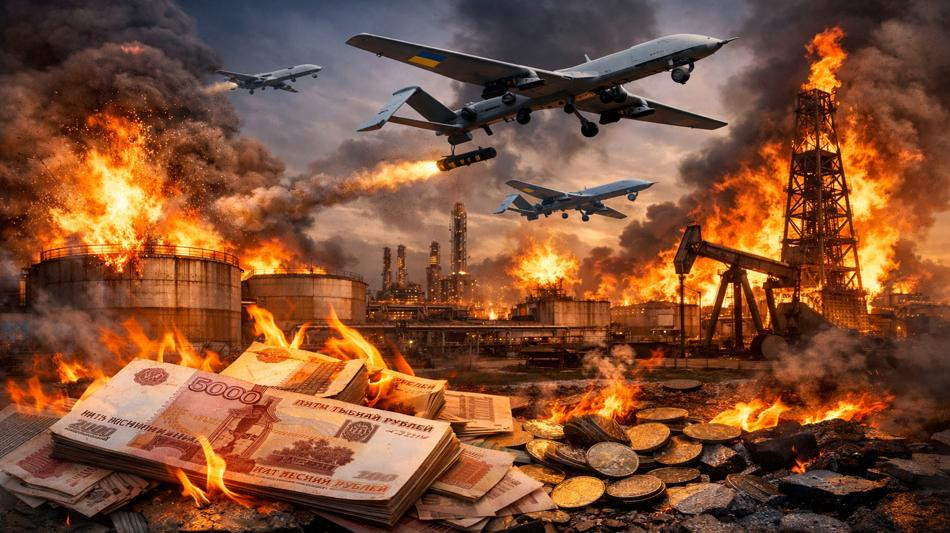
Ukraine destroys Russian terror-oil exports

 Mbappe hits two as Real Madrid rout Sevilla

 Browns edge Ravens for division lead, Texans beat Jags

 Lyon go top of Ligue 1 as Monaco fall to first defeat of the season

 Venezuela opposition alliance reaffirms Nobel laureate Machado as leader

 'Street Fighter' wins N. America box office, buzzy doc stuns in 2nd

 NFL: Paris game to go ahead despite protests in France

 Arteta hails Arsenal 'finishers' after Madueke fells Forest

 Trump backs ally Netanyahu ahead of Israel's tight election

 Madueke strikes late as below-par Arsenal sink Forest
 Second day of street clashes in Milan

 Dupont's Toulouse hold off Exeter as English Champions Cup woes continue

 Zelensky speaks to US envoys amid Trump spat

 Paris police in new battles with protesters and looters

 Multiple deaths, injuries at western Canada military base: minister

 Boland strikes twice for Australia in rain-hit South Africa Test

 Marseille put Angers to the sword in Ligue 1

 Albanian PM refuses to quit as violent protests enter sixth day

 Chwalinska fights back to win Wuhan Open in title breakthrough
 Kulusevski on brink of return for Spurs after 17-month absence

 Ukraine sets Saint Petersburg refinery ablaze in large-scale drone attack

 Spain's in-form Chacarra wins DP World India Championship

 Kuwait announces maintenance closures in Nuzha, Surra and Rai

 Moody’s lifts OYO parent Prism outlook to positive before planned IPO

 RCom professional asks Supreme Court to revisit spectrum insolvency ruling

 Premium products and financing drive Navratri appliance demand

Ukraine’s campaign against Russian oil infrastructure has developed into a direct assault on one of Moscow’s most important economic arteries. The focus is not on symbolic targets but on the nodes through which a large share of Russian crude exports is loaded and shipped. Pressure on the Baltic outlets of Primorsk and Ust-Luga is especially significant because they handle a major part of seaborne exports. Add the after-effects of the disruption around Novorossiysk, interruptions in the Druzhba corridor on Ukrainian territory, and growing pressure on tankers linked to Russia’s shadow fleet, and the picture becomes larger than a handful of dramatic fires. What is under attack is the export chain itself: storage, loading, routing, maritime dispatch and ultimately cash flow.
Current estimates indicate that roughly 40 percent of Russia’s oil export capacity has at times been disrupted or temporarily knocked offline. That amounts to around 2 million barrels per day that failed to reach the market as planned or had to be rerouted with delay and higher cost. For the Kremlin, this matters because oil is not merely a commodity; it remains one of the pillars of federal revenue. When terminals go down, ships queue, cargoes must be reassigned and transport risks rise, the economic impact widens even if part of the volume is later recovered. The strikes therefore hit the area where Russia, despite sanctions, price caps and alternative shipping arrangements, has tried hardest to preserve hard-currency income.
What makes the Ukrainian approach notable is that it is designed less for one-off spectacle than for repeated operational disruption. Every hit on port infrastructure, pumping systems, storage tanks or loading chains can create bottlenecks far beyond the point of impact. A delay of only a few days can alter tanker rotations, export schedules, settlement timing and production planning. The fact that one facility may resume operations relatively quickly does not remove the vulnerability exposed by the pattern. Moscow is being forced to reshuffle volumes, test alternative routes and absorb added risk at nearly every step of the process. That is a structural problem for an export model that depends heavily on a limited set of maritime hubs.
The result of the attacks: Russia, a terrorist state, is currently losing 1.2 billion euros a week in revenue from raw materials, which is also being diverted away from Putin’s war chest for the conflict in Ukraine. This is a severe blow to the Russian mass murderer and war criminal, Vladimir Putin (73). After all, oil is the backbone of the Russian economy and one of the state’s most important sources of revenue.
There is also a fiscal layer. The latest pressure comes at a time when Russia’s oil and gas revenues are already running well below last year’s level. Higher world prices can offset part of the damage by lifting the value of each barrel that still gets out. But expensive oil does not replace reliable infrastructure. Once export terminals themselves become uncertain, the cost of insurance, shipping, rerouting and delay rises across the system. That is why these attacks matter: they do not simply try to destroy barrels, they try to erode confidence in the stability of the entire export machine.
For Europe, the recent developments also show that disruptions of this kind do not automatically translate into an immediate supply emergency. In the case of Druzhba, affected states were able to lean on reserves and alternative routes. Even so, the strategic message is clear. Ukraine is attempting to weaken Russia’s war-making capacity not only on the battlefield, but deep inside the economic infrastructure that helps finance the war. If the campaign continues, the central question will be whether Russia’s oil trade can remain resilient under sustained military and logistical pressure.