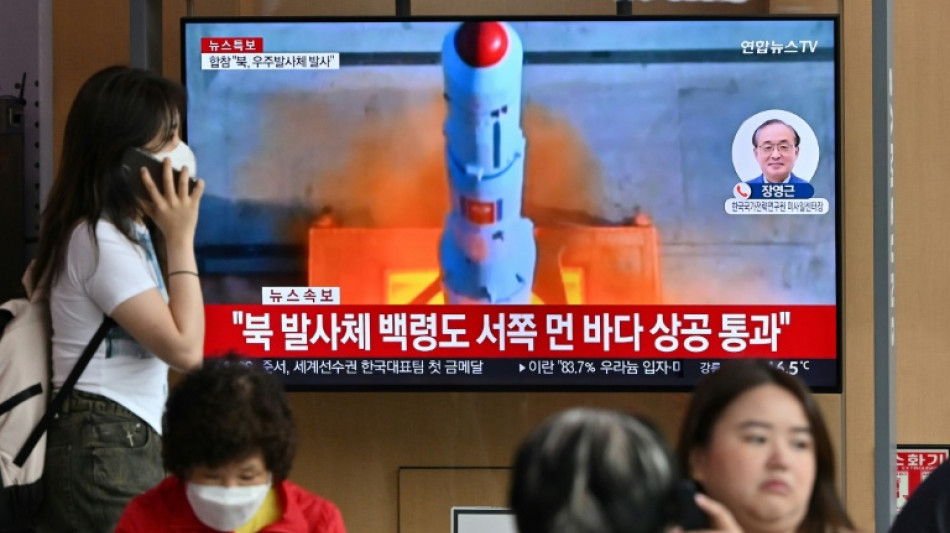
North Korea spy satellite crashes into sea / Photo: Jung Yeon-je - AFP

 ALEX BODI ȘI AMBASADORUL REPUBLICII SUDANUL DE SUD, GUM DOMINIC MATIOK, DISCUTĂ LA BERLIN DESPRE POSIBILITATEA ÎNFIINȚĂRII UNUI CONSULAT ONORIFIC LA BUCUREȘTI

 Dodgers step up World Series three-peat bid with 5-3 win over Braves

 Spain break down Czechs as England outclass Croatia in Nations League

 Yamal on target as Spain hold off Czech Republic

 Latvian exit polls suggest pro-European choice

 Lula, Bolsonaro wrap up campaigns ahead of knife-edge election

 Tuchel hails 'complete' England after Croatia demolition

 Fury to invite Trump to lead ring walk before Joshua showdown

 Fashion industry in 'precarious moment', says Vivienne Westwood supremo

 Seventh heaven for England in Nations League rout of Croatia

 Storms, flooding cause chaos on Greek holiday island of Crete

 #IAmJaneDoe: online support campaign in US university rape case

 Brazil shine on Selecao's first visit to India

 Zverev sets up Djokovic quarter-final at China Open, Rybakina out

 Happier at home, Bordeaux hammer Lyon in Top 14

 Lula, Bolsonaro in final push for votes ahead of knife-edge election

 Boisterous fashion week barnstorms 'sleepy' Nigerian capital

 UAE investigators say flydubai co-pilot was planning 'terrorist act'

 Rahul smacks century in India v Windies ODI

 Daryz seeks to join exclusive club of dual Arc winners

 Russia warns diplomats to leave Kyiv over new strikes threat
 Olympic champ Zheng rebukes rowdy home crowd at China Open

 World No.1 Sinner pulls out of Shanghai Masters to delay return
 Red Bull's Verstappen grabs pole position for Bahrain GP

 India beat Pakistan in blockbuster as golfer Kim wins 'crazy' gold

North Korea attempted to launch a military spy satellite on Wednesday that would monitor the United States, but it crashed into the sea with Pyongyang conceding there had been "serious defects".
North Korea does not have a functioning satellite in space and leader Kim Jong Un has made developing a military spy satellite a top priority for his regime, personally overseeing some launch preparations.
North Korean space authorities said they had "launched a military reconnaissance satellite, 'Malligyong-1', mounted on a new-type carrier rocket, 'Chollima-1'," early Wednesday, the official Korean Central News Agency reported.
But the rocket crashed into the sea "after losing thrust due to the abnormal starting of the second-stage engine after the separation of the first stage during the normal flight," it said.
Authorities will "thoroughly investigate the serious defects revealed in the satellite launch," it said, adding a second test would be conducted as soon as possible.
The South Korean military had earlier detected the launch of the purported satellite, which it confirmed had disappeared from radar and fallen into the sea due to "abnormal flight".
It later salvaged a portion of debris, releasing images showing a large barrel-like metal structure with thin pipes and wires at the bottom, which experts said might be a liquid fuel tank.
Seoul, Tokyo and Washington all slammed the launch, which they said violated a raft of UN resolutions barring Pyongyang from any tests using ballistic missile technology.
Seoul's National Security Council said the launch "whether successful or not (was) a grave violation of UN Security Council resolutions and a serious provocation."
Because long-range missiles and rockets used for space launches share the same technology, analysts say developing the ability to put a satellite in orbit would provide Pyongyang with cover for testing banned intercontinental ballistic missiles (ICBMs).
Soon after the launch, Seoul city authorities sent an emergency evacuation alert to residents, prompting widespread consternation and confusion online, before the interior ministry clarified minutes later it had been "incorrectly issued".
- 'Tremendous insight' -
The recovery of the debris would be very useful for South Korea, experts said.
"Technical experts will be able to gain tremendous insight into North Korea’s proficiency with large, multi-stage boosters from the recovered debris," US-based analyst Ankit Panda told AFP.
Prior to Wednesday's launch, Pyongyang had launched five satellites since 1998, three of which failed immediately and two of which appeared to have been put into orbit -- though signals from those launches have never been independently detected, indicating they may have malfunctioned.
North Korea said Tuesday its new spy satellite would be "indispensable to tracking, monitoring... and coping with in advance in real time the dangerous military acts of the US and its vassal forces".
Criticising US-South Korea joint military exercises, including large ongoing live-fire drills, a top North Korean military official said Pyongyang felt "the need to expand reconnaissance and information means and improve various defensive and offensive weapons", state media reported.
In 2012 and 2016, Pyongyang tested ballistic missiles that it called satellite launches. Both flew over Japan's southern Okinawa region.
Japan briefly activated its missile alert warning system for the Okinawa region early Wednesday, lifting it after about 30 minutes.
-'Irreversible' nuclear power-
"Kim stayed true to his word and launched the spy satellite today," Soo Kim, policy practice area lead at LMI Consulting and a former CIA analyst, told AFP.
"We know that Kim's determination does not end with this recent activity," she said, adding that the launch could be a "foreshadowing of greater provocations, including the nuclear test."
Since diplomatic efforts collapsed in 2019, North Korea has doubled down on military development, conducting a string of banned weapons tests, including test-firing multiple ICBMs.
North Korean leader Kim Jong Un last year declared his country an "irreversible" nuclear power and called for an "exponential" increase in weapons production, including tactical nukes.
"Whether or not North Korea's current satellite mission is a success, Pyongyang can be expected to issue political propaganda about its space capabilities," Leif-Eric Easley, a professor at Ewha University in Seoul.
M.White--AT