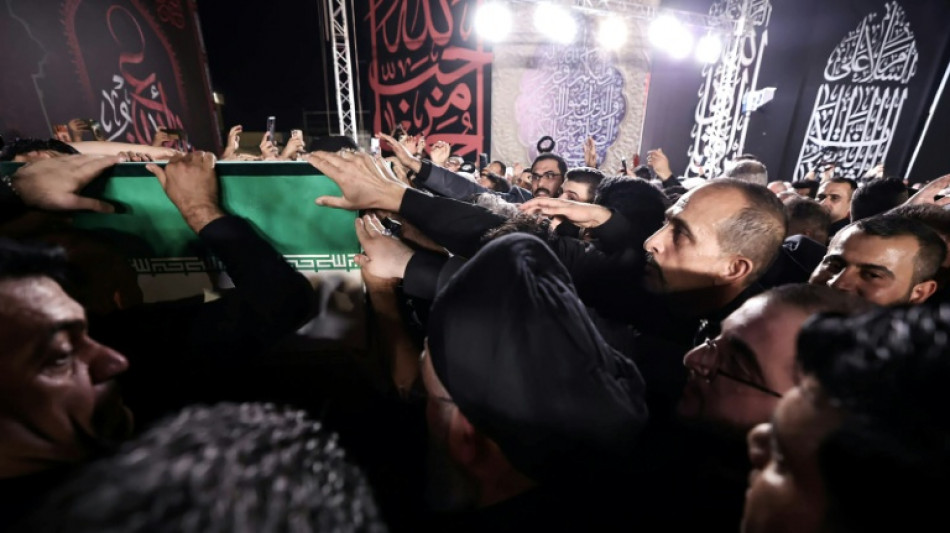
Vast crowds mourn Khamenei in Iraq's holy cities / Photo: - - Media office of senior politician and cleric Ammar al-Hakim/AFP

 Kelp Forests: The Ocean’s Climate Hero Under Threat

 Sandra Bernhard Rejects 'Iconic' Label in New Show 'Caught Off Guard'

 Herman Miller Black Friday Deals on Aeron, Embody, and Zeph Chairs

 How to Build a Morning Routine that Supports Your Money Goals
 Florida woman charged after deputies report finding cocaine and sales ledger

 Heat end Knicks’ NBA Cup defence with 108-105 victory

 Black Friday laptop promotions cover Apple, Lenovo, HP and gaming models
 Black Friday fashion sales bring discounts of up to 80 percent

 Shark reduces prices on top-rated stick and robot vacuums

 Shark Depuffi stock dwindles as Black Friday skincare discounts begin

 Chevrolet Blazer EV SS tested against decades of Super Sport models
Massive crowds filled Iraq's holy cities and their shrines to mourn Iran's slain supreme leader Ali Khamenei during a funeral procession ahead of his burial back home.
At the gilded Imam Ali shrine in Najaf, mourners carried the coffin as it swayed from side to side, and many jostled and pressed forward in a desperate attempt to touch it.
Karim Hassan, who attended the procession in Najaf, described Khamnei's death as "a calamaty, a tragedy", adding that the funeral ceremonies "are a fitting tribute" to "a leader who cannot even be described".
In Karbala, mourners waved Iranian flags and held portraits of Khamenei, as they chanted in response to a voice blaring from loudspeakers, praising the Islamic republic, its leaders and the commanders of Tehran's "axis of resistance", which include Iraqi armed groups.
Iran began on Saturday six days of funeral ceremonies, which included a series of locations that reflect the religious, political and ideological pillars of the Islamic republic.
It dedicated a day to neighbouring Iraq -- a Shia powerhouse with close ties to Tehran and home to the faith's most sacred shrines.
The ceremonies, which started in Tehran and passed through Iran's holy city of Qom, will culminate with Khamenei's burial on Thursday in his hometown of Mashhad in northeast Iran.
The Islamic republic hopes the marathon ceremonies will project strength and unity after the Middle East war, which started with US-Israeli strikes that killed Khamenei and several relatives on February 28.
The procession in Iraq came as the United States and Iran renewed hostilities in the Strait of Hormuz.
- Prayers and shouts -
Since the early morning, despite the scorching heat, vast crowds filled the streets of Najaf, as Khamenei's coffin rode slowly on the back of a truck towards the shrine of Imam Ali -- the Prophet Mohammed's son-in-law and the first Shia imam.
There, the call for prayer echoed through the vast courtyards where hundreds of clerics in white and black turbans waited for hours before they held prayers over Khamenei's remains.
From Najaf, the coffin was flown to the holy city of Karbala, where many arrived in the early hours of the morning, or even a day before, to secure a spot in the sacred sites and their surrounding alleyways.
In Karbala, like in Najaf, food and drink stalls for mourners lined the streets, while security forces were heavily deployed and medical teams stood ready for emergencies.
Water sprinklers offered some relief from the heat as the coffin was transported through the massive crowds.
Um Ali, who refused to give her name, said she travelled from Baghdad with her sons.
"My conscience brought me. My religion brought me," she said, adding "we have done nothing but weep" since Khamenei was killed.
The remains of Khamenei's relatives who were killed with him, including his granddaughter, were quietly brought early Wednesday to the shrines of both cities.
Najaf is the main centre of Shia religious seminaries, and is also home to Grand Ayatollah Ali Sistani, Iraq's top Shia religious authority.
Many senior Shia clerics have studied, taught or lived there, including Khamenei's predecessor Ayatollah Ruhollah Khomeini.
Karbala is home to the shrine of Imam Hussein, the third Shia Imam, whose death in the seventh century remains central to Shia history.
- Strong ties -
The bond between Iraq and neighbouring Iran, both Shia-majority countries, runs deep and is shaped by both religion and politics.
Iran backs influential politicians but also armed groups in Iraq, some of which joined the Middle East war after Khamenei's death, attacking US facilities in Iraq in support of Tehran.
Iraq is also allied with the US, and for decades, successive governments have struggled to maintain a delicate balance between the two foes.
Today, the challenge is growing as the US steps up pressure on Iraq to curb Iran's influence and disarm Tehran-backed groups.
For mourner Haidar Jaafar, speaking before the funeral, even though he doesn't support Iranian policies in Iraq, he "stands with Iran against the Israeli enemy".
"Even those who do not align with Iran" would attend, he said, because Khamenei was killed "by Israeli-American hands".
G.P.Martin--AT