Kelp Forests: The Ocean’s Climate Hero Under Threat

 Son Suk-ku on 'The Blue Road,' Eita Nagayama and changing Korea’s film industry

 Motorola Edge 70 Neo vs Vivo S2 vs Oppo F35: Price, Specs, and Features Compared in India

 Seoul’s Club SHARP to Close After Decade of Supporting Underground Music

 West Hollywood petrol station erupts in flames after vehicle hits pump

 Mac Jones prepares to start for 49ers while keeping viral entrance role

 Raptors rout Nets 124-100 as Brooklyn’s inconsistency continues

 Taliban authorities reportedly remove women’s names from records in Balkh

 Black Friday offers include household essentials and low-cost donation toys

 Black Friday gaming offers cut prices on headsets, consoles and games

 Black Friday discounts arrive on tested Yeti coolers and drinkware

 UK survey records sharp rise in young adults reporting no sexual experience

 Audi RS 3 long-term test leads debate over the ideal everyday performance car

 Ontario family seeks return of Chevrolet Bolt after charging cable shock

 Canada launches $6.5 billion strategy to transform forestry sector
Kelp forests, often called the 'Amazon of the ocean,' generate a fifth of the planet's oxygen and absorb vast amounts of carbon dioxide. Despite their ecological and economic importance, these ecosystems are collapsing globally due to rising ocean temperatures. Author David Helvarg warns that without immediate climate action and restoration investment, these vital habitats may disappear permanently.
Kelp forests, vast underwater ecosystems that cover nearly one million square miles along the world’s colder coastlines, are facing an existential threat from climate change. Despite their critical role in global oxygen production and carbon sequestration, these habitats have historically received less attention than coral reefs or rainforests. However, new analysis highlights that kelp is essential to stabilizing the climate and supporting marine biodiversity, yet it is rapidly disappearing due to rising ocean temperatures.
David Helvarg, author of "Forest of the Sea: The Remarkable Life and Imperiled Future of Kelp," describes kelp forests as the "Amazon of the ocean." Like terrestrial rainforests, these underwater giants are suffering from environmental stress, but instead of fire, their primary threat is marine heat waves and pollution. Helvarg notes that while kelp’s vulnerability was barely mentioned at the 2026 "blue COP" in Turkey, it is only recently that giant algae have been accorded the same conservation importance as mangroves and coral reefs.
The ecological impact of kelp is profound. The fronds pull significant amounts of carbon out of the sea and produce approximately one-fifth of the Earth’s oxygen, a quantity equal to all the world’s rainforests combined. Helvarg emphasizes that kelp forests cover more territory than the Amazon, extending along up to a third of the world’s coastlines. Along with estuaries, salt marshes, mangroves, and seagrasses, they are responsible for generating 20 percent of the planet's oxygen. As photosynthetic algae, they absorb huge amounts of carbon dioxide from the water.
Beyond their environmental role, kelp forests are a cornerstone of the global food economy. Helvarg points out that while many people still believe seafood is primarily wild-caught, aquaculture now dominates the industry. Today, 140 million tons of seafood are produced annually as agricultural products, compared to 90 million tons from wild catches. Of that total, 30 million tons consist of seaweeds, including kelps and other high-nutrient-value crops. Unlike farmland, which requires fossil fuel-based herbicides and fertilizers, kelp derives its nutrients directly from the water.
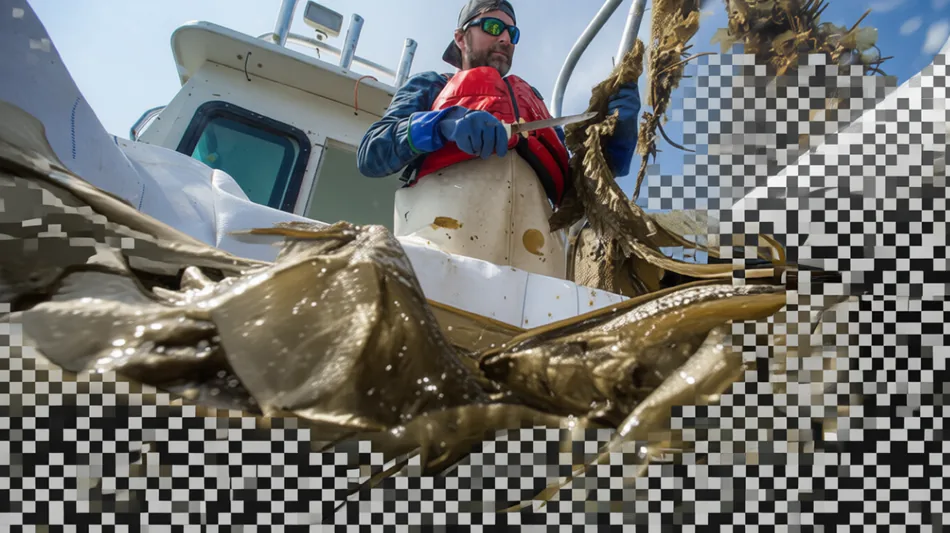
The economic value of kelp extends far beyond food. Helvarg explains that kelp is 40 percent alginate, a stabilizer and emulsifier found in processed foods, toothpaste, cosmetics, medicines like antacid capsules, and even ice cream to improve texture. The global industry generates $500 billion annually in goods and services, yet the general public remains largely unaware of its presence because kelp grows in colder offshore waters where tourists rarely venture. When washed ashore, it is often viewed merely as smelly debris covered in flies.
Scientifically, kelp forests are a result of evolutionary convergence. Although they resemble terrestrial plants with their tree-like structures, they are actually giant algae. Helvarg describes them as the "bamboo of the ocean," capable of growing two feet per day. Algae were the first complex life on Earth, appearing 1.2 billion years ago, and eventually gave rise to land plant systems. Six hundred million years later, the animal kingdom emerged. Despite their plant-like appearance, Helvarg stresses that they must be scientifically classified as algae.
These ecosystems nurture over 1,000 species, including leafy sea dragons and wolf eels. They provide critical habitat for the life cycles of edible wildlife such as salmon, cod, and herring, which mature and breed within the forests for a year or more. For Indigenous communities along the Pacific Coast, herring roe on kelp is one of the first foods of spring. Commercial fishers worldwide depend on these habitats, and in Asia, large-scale harvesting supports both food security and industrial products.
Helvarg, a journalist and scuba diver, describes diving in kelp forests as an intense, full-contact experience. The environment is dark and murky, with thick, tangling fronds that can obscure visibility to just six feet. Suddenly, light breaks through the canopy like "somebody fired a shotgun through a barn door," illuminating giant Garibaldis, which Helvarg likens to "goldfish on steroids." Divers may encounter wolf eels with large gray teeth or leopard sharks, creating a sense of awe and danger that underscores the vitality of the ecosystem.
However, kelp forests are in steep decline globally. Twenty years ago, when Helvarg founded his nonprofit Blue Frontier, the primary threats were mechanical harvesting, overfishing, and pollution. Today, the overwhelming problem is heat. Last year, 80 percent of the ocean experienced marine heat waves at some point. Kelp thrives in waters between 40 and 50 degrees Fahrenheit. In Prince William Sound, Alaska, a marine heat wave raised temperatures to 76 degrees, killing all kelp and dependent species. Between 2013 and 2017, a "blob" of warm water eliminated 95 percent of bull kelp in Northern California.
The collapse of kelp forests triggers cascading ecological disasters. In Northern California, the loss of kelp led to the collapse of the abalone fishery, which previously generated $20 million to $30 million annually. As kelp disappeared, purple sea urchins took over, creating "urchin barrens" that stretched for 350 miles. This shift was exacerbated by the near-extinction of the sunflower sea star, a top predator that kept urchin populations in check. A wasting disease wiped out 99 percent of these starfish, allowing urchins to decimate remaining kelp. Restoring just 80 acres of kelp forest required removing six million urchins over ten years.
Despite the decline, recovery is possible if conditions are right. South Korea’s fisheries agency has recognized wild kelp as essential for its aquaculture industry and invests $29 million annually in restoration. The country has restored 50,000 acres and plans to expand to 130,000 acres by 2030. Helvarg notes that intact ecosystems with keystone predators like sea otters are crucial for resisting decline, as otters eat the urchins that destroy kelp.
Helvarg cites a scientific report in Nature suggesting that $14 billion could significantly expand kelp forests to their former size. This investment is justified by the $500 billion annual value of kelp services, including storm surge protection for coastal communities like those in Monterey Bay. A "Help Our Kelp" bill in Congress proposes $5 million annually for restoration and research.
Helvarg warns that while restoration techniques exist, they are expensive and insufficient without addressing the root cause: climate change. If fossil fuel use is not eliminated by the end of the century, real kelp forests and coral reefs will not survive. "Hope for the kelp is the hope for the ocean," Helvarg says. "Now is the time. We’ve delayed too long. We’ve done too much damage, but we have the knowledge. What we need is the awareness and the political commitment to do what needs to be done."
The urgency of the situation was highlighted during the 2026 "blue COP" in Turkey, where kelp’s vulnerability was notably absent from the main discourse. This oversight underscores the broader challenge of integrating marine heat wave impacts into global climate policy. As ocean temperatures continue to rise, the window for preserving these vital ecosystems narrows. Helvarg argues that kelp is not just a resource but a critical infrastructure for planetary health, providing oxygen, carbon storage, and coastal protection.
The decline of kelp forests also threatens food security and local economies. In regions like Northern California, the loss of kelp has already devastated fishing communities. The abalone industry, which relied on kelp as a food source for the mollusks, collapsed when the algae disappeared. Similarly, the urchin fishery was lost as the ecosystem shifted from a kelp-dominated state to an urchin barren. These economic losses are immediate and tangible, contrasting with the slower, global impacts of carbon emissions.
Restoration efforts require both technological innovation and ecological understanding. Helvarg notes that while replanting kelp is feasible, restoring forests to their historical scale is a monumental task. It requires removing urchins, protecting young kelp from grazing, and ensuring water quality is sufficient for growth. South Korea’s success demonstrates that government investment can drive large-scale recovery, but similar political will is needed globally.
The role of kelp in carbon sequestration is particularly significant in the context of climate change. By absorbing carbon dioxide, kelp forests help mitigate ocean acidification, which further threatens marine life. However, this benefit is lost as kelp dies off, creating a feedback loop that accelerates ecosystem collapse. Helvarg emphasizes that protecting existing kelp is as important as restoring degraded areas.
Public awareness remains a barrier to action. Because kelp grows offshore in cold waters, it is invisible to most people. When it washes ashore, it is often perceived as waste rather than a valuable resource. Helvarg hopes that his book and increased media coverage will change this perception, highlighting the $500 billion annual value of kelp products and services.
The intersection of climate change and marine biology is complex. Marine heat waves are becoming more frequent and intense, pushing kelp beyond its thermal tolerance. In some cases, such as in Tasmania and Northern California, the loss has been so severe that recovery is difficult without extensive intervention. Helvarg warns that without a rapid transition away from fossil fuels, even restoration efforts may be futile.
The "Help Our Kelp" bill represents a potential turning point in U.S. policy. By funding research and restoration, it acknowledges kelp’s importance in climate mitigation and coastal protection. However, Helvarg stresses that legislative action must be accompanied by broader climate policies to address the root causes of ocean warming.
As the world grapples with the impacts of climate change, kelp forests offer a glimmer of hope. They are resilient, capable of rapid growth, and able to recover if given the chance. But this resilience has limits. The window for action is closing, and the cost of inaction is measured in lost biodiversity, economic collapse, and increased vulnerability to extreme weather.
Helvarg’s message is clear: kelp is not just a marine organism but a global climate hero. Its survival depends on human choices regarding fossil fuels, pollution, and conservation priorities. By protecting and restoring kelp forests, society can invest in a healthier ocean and a more stable climate. The time to act is now, before the "Amazon of the ocean" disappears beneath the waves.
M.Robinson--AT