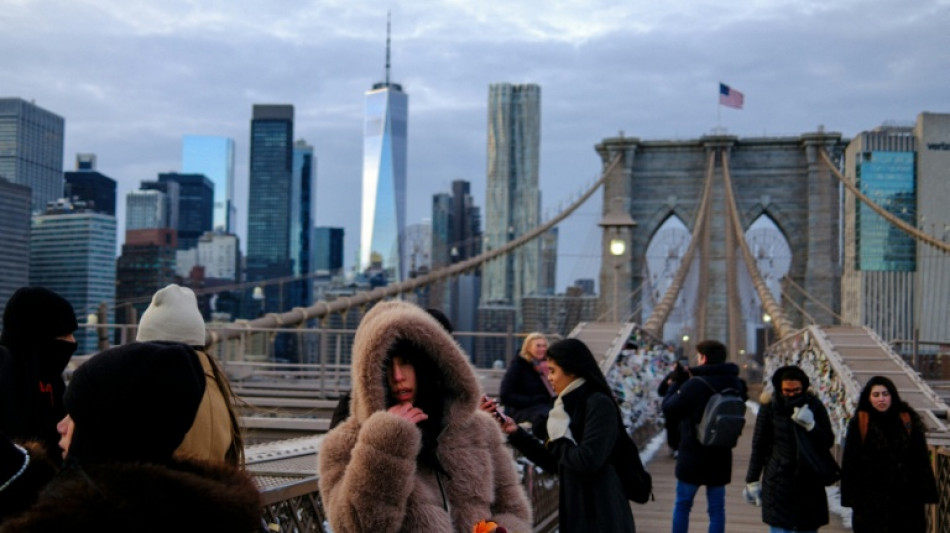
Arctic blast to wallop N. America -- is climate change to blame? / Photo: CHARLY TRIBALLEAU - AFP

 France's debt climbs to highest since 1978: ministry

 McIlroy two shots off the lead at Wentworth after eagle on 18

 Martinez brace saves Inter in Serie A top-two clash with Roma

 Rosenior abused but guides Paris FC past old club Strasbourg

 Seven-try Lyon beat Pau, climb to Top 14 summit

 Brighton defeat a 'big lesson' against complacency for Arsenal, says Arteta

 Thousands protest inaction over climate crisis in Switzerland

 Carapaz out of cycling world championships

 'Fragile' Tottenham beaten by Aston Villa despite late rally

 Mourinho hails Real Madrid grit before Atletico derby clash

 Martin wins Austrian MotoGP sprint after Acosta crash

 Japan edge Fiji to win Pacific Nations Cup

 Black smoke, flames rising near Riyadh airport: residents to AFP

 UK actor Naomi Watts honoured at Spain film festival

 Japan emperor declares Asian Games open after turbulent build-up

 Asian Games open with unity message after troubled build-up

 Denmark hails 'binding' Greenland deal with Trump

 We don't want Games host Japan losing money, says Asian Olympic official

 Ed Sheeran returns to stage after Palestinian controversy

 Asian Games to open in Japan after troubled build-up

 Drone owners rush to offload devices ahead of Beijing ban

 Trump's beef policies irk Texas ranchers, testing their loyalty

 New to The Street Broadcasts Tonight at 6:30 PM ET Across the United States, Latin America and MENA, Featuring BioVie, Acurx Pharmaceuticals, Lantern Pharma and SafeSpace Global

 Nvidia, OpenAI CEOs to attend Xi dinner at White House

 Anthropic picks Accenture for in-house AI safety evaluation

An unusually brutal winter storm is set to pummel more than 160 million Americans from Friday, as a stretched "polar vortex" sends a devastating blast of Arctic air, bringing heavy snows and freezing rains.
Winter Storm Fern is forecast to engulf an area well over half the length of the continental United States, stretching from Texas and the Great Plains region to the mid-Atlantic and northeastern states.
Scientists say the increasing frequency of such disruptions of the polar vortex may be linked to climate change, though the debate is not yet settled and natural variability also plays a role.
– What is the polar vortex? –
The polar vortex is a large region of cold, low-pressure air that circulates counterclockwise high above the Arctic, in the stratosphere some 10 to 50 kilometers (six to 30 miles) above Earth's surface.
In a typical winter, it forms a relatively compact, circular system that helps lock in the coldest air to high northern latitudes.
"Usually the vortex spins merrily along and has little effect on our weather, but occasionally it moves or stretches southward over North America, bringing with it a jolt of cold," Jennifer Francis, a senior scientist at the Woodwell Climate Research Center, told AFP.
– What happens when it stretches? -
At times, big atmospheric waves that form closer to the ground can travel upward and knock the polar vortex out of whack.
Rather than completely breaking down -- as happens during dramatic "sudden stratospheric warming" events -- the vortex can stretch out into a more oval shape.
"Think of it like a rubber band being pulled," Judah Cohen, a climate dynamics scientist at MIT, told AFP.
"That allows the cold air to expand much further south, like we're like we're seeing this week here in the United States."
Jason Furtado, a meterologist at the University of Oklahoma whose research focuses on long-range forecasting, said these stretching events aren't as long-lasting as complete breakdowns, but are significant nonetheless, especially for North America.
-Is it linked to climate change? –
This is where the science becomes more debated.
There is broad agreement -- reflected in assessments by the UN's climate science body -- that the Arctic is warming much faster than the global average, through a process known as Arctic amplification, and human-caused climate change is behind it.
Cohen argues that this uneven warming helps amplify large atmospheric waves over Eurasia, which in turn makes the polar vortex spill more frequently over North America.
"Studies suggest these aberrations in the vortex are happening more often in a warming world, which favors more frequent winter extremes," said Francis.
Furtado said observations from the past 20 years do show an increase in such events, but he cautioned against drawing strong long-term conclusions tying them directly to human-caused climate change.
"In my opinion, it's harder to make that connection going out much further, simply because I think we just don't have enough data."
O.Brown--AT



