Japanese ivory trade attracts fresh global scrutiny / Photo: Kazuhiro NOGI - AFP

 France's debt climbs to highest since 1978: ministry

 McIlroy two shots off the lead at Wentworth after eagle on 18
 Martinez brace saves Inter in Serie A top-two clash with Roma

 Rosenior abused but guides Paris FC past old club Strasbourg

 Seven-try Lyon beat Pau, climb to Top 14 summit

 Brighton defeat a 'big lesson' against complacency for Arsenal, says Arteta

 Thousands protest inaction over climate crisis in Switzerland

 Carapaz out of cycling world championships

 'Fragile' Tottenham beaten by Aston Villa despite late rally

 Mourinho hails Real Madrid grit before Atletico derby clash

 Martin wins Austrian MotoGP sprint after Acosta crash

 Japan edge Fiji to win Pacific Nations Cup

 Black smoke, flames rising near Riyadh airport: residents to AFP

 UK actor Naomi Watts honoured at Spain film festival

 Japan emperor declares Asian Games open after turbulent build-up

 Asian Games open with unity message after troubled build-up

 Denmark hails 'binding' Greenland deal with Trump
 We don't want Games host Japan losing money, says Asian Olympic official

 Ed Sheeran returns to stage after Palestinian controversy

 Asian Games to open in Japan after troubled build-up

 Drone owners rush to offload devices ahead of Beijing ban
 Trump's beef policies irk Texas ranchers, testing their loyalty

 New to The Street Broadcasts Tonight at 6:30 PM ET Across the United States, Latin America and MENA, Featuring BioVie, Acurx Pharmaceuticals, Lantern Pharma and SafeSpace Global

 Nvidia, OpenAI CEOs to attend Xi dinner at White House
 Anthropic picks Accenture for in-house AI safety evaluation
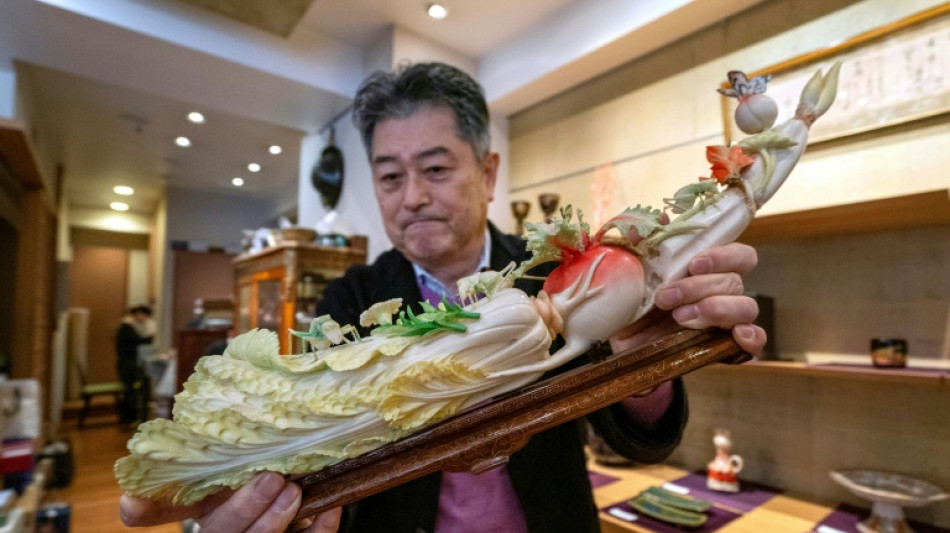
At his store in Tokyo's ritzy Ginza district, Hajime Sasaki displays a disparate array of wares, from chopsticks to Buddha statues -- including many made of ivory.
International trade in elephant ivory is illegal, but Japan hosts one of the world's largest remaining legal domestic markets for the product, which can only be bought and sold within its borders.
It is fed with stockpiles of ivory imported before the international ban more than 30 years ago, or bought in one-off government auctions.
But conservationists warn Japan's ivory often leaks overseas, fuelling black market trade, while driving demand and undermining bans in countries like China.
Sasaki's shop displays pamphlets in Chinese and English explaining that ivory cannot be taken abroad, but he still "receives many Chinese customers", he told AFP.
"Tourists give up buying ivory when I explain you can't bring it outside Japan," said the softly-spoken 69-year-old.
Conservationists estimate between 10,000 and 15,000 elephants from the two African species are killed for their tusks each year.
And seizure data suggests ivory is leaving Japan's domestic market.
Since 2008, more than 3,600 kilograms (four US tons) of ivory linked to Japan has been seized by authorities around the world, according to data presented at a recent global wildlife trade meeting in Uzbekistan.
Dozens of interceptions were destined for China, according to the document presented at the meeting of the Convention on International Trade in Endangered Species of Wild Fauna and Flora (CITES).
The data suggests "some weakness in Japan's law enforcement", the document warned.
- 'Organised criminals' -
In 2023, a shipment reportedly bound for Thailand carrying 710 pieces was intercepted, another CITES document said.
Shipments of that size "suggest organised criminals are also involved", said Matt Collis, senior policy director at the International Fund for Animal Welfare (IFAW).
At the CITES meeting, four African nations unsuccessfully urged adoption of a document that would have called for the closure of all remaining domestic ivory markets.
And Japan fiercely denies that its national market impacts elephant conservation.
It disputed the interpretation of the data presented at CITES, and said it continues to "implement strict control measures" to prevent leakage.
Japan's alleged leakage problem is particularly problematic for China, once the world's biggest market for ivory, which banned trade in 2017 -- around the same time as the United States.
"China is doing their best to enforce their domestic ivory ban and to change public perceptions," said Collis.
"But you have a neighbouring country that is undermining these efforts by not enforcing controls and perpetuating demand."
Ivory was once widely used in Japan for personal seals and musical instruments.
Today the country has a 250-tonne stockpile, boosted by two CITES-approved auctions in 1999 and 2008.
At Sasaki's shop, shelves are lined with exquisitely-carved ornaments. A Buddha statue worth more than $1,500 (238,000 yen) is safely housed inside a gold-painted cabinet.
But there is little demand.
Sasaki says he has just one or two buyers a month, mostly older Japanese.
That is partly due to growing awareness of the ivory trade's devastating impact, said Masayuki Sakamoto, director of the Japan Tiger and Elephant Fund (JTEF).
"So inventory in Japan is piling up, and demand from China and other countries persists," he said.
- 'Sustainable use' -
Although China's ban has tamped down interest somewhat, ivory carvings, jewellery and trinkets remain highly prized in Asia's largest economy.
"Given the size of China, even lower levels of demand can provide powerful incentives for traffickers to seek to get ivory into China's black market," Collis said.
Experts also question Japan's system for tracking its domestic ivory, which is based mostly on tracing whole tusks, even though trade is primarily in small, derivative products.
Japan has shown little interest in curtailing domestic sales, and supported a proposal by Namibia at CITES that would have allowed a one-off government auction of the African country's ivory stocks to other governments.
The bid was defeated, to the relief of conservationists who argue further sales will only fuel demand.
But Sasaki said he felt the tusks should be sold to help conservation efforts, echoing the Tokyo Ivory and Crafts Association, which says it backs "sustainable use" of ivory, as a "form of conservation".
"Smuggling is bad", said Sasaki.
"But I think reusing elephant tusks would be better (than disposing of them), and generate income."
E.Hall--AT



