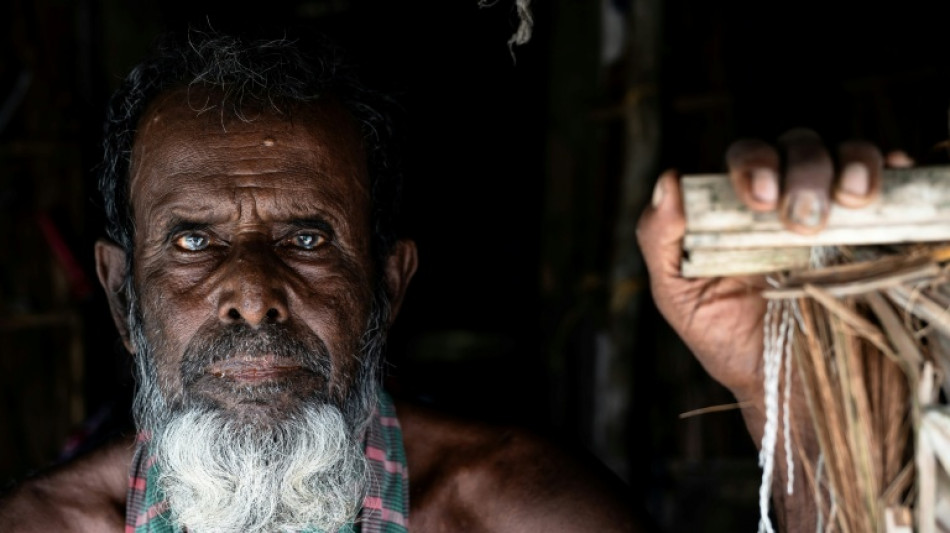
Rivers of salt: life on Bangladesh's climate frontline / Photo: Muhammad Amdad HOSSAIN - AFP

 Toulouse edge Vannes, Lyon beat Pau to take Top 14 summit

 Germans arrested for Louvre stunt in Mona Lisa hall

 Saudi-led coalition says Houthis fired ballistic missile at Riyadh

 France's debt climbs to highest since 1978: ministry

 McIlroy two shots off the lead at Wentworth after eagle on 18

 Martinez brace saves Inter in Serie A top-two clash with Roma

 Rosenior abused but guides Paris FC past old club Strasbourg

 Seven-try Lyon beat Pau, climb to Top 14 summit

 Brighton defeat a 'big lesson' against complacency for Arsenal, says Arteta

 Thousands protest inaction over climate crisis in Switzerland

 Carapaz out of cycling world championships

 'Fragile' Tottenham beaten by Aston Villa despite late rally

 Mourinho hails Real Madrid grit before Atletico derby clash

 Martin wins Austrian MotoGP sprint after Acosta crash

 Japan edge Fiji to win Pacific Nations Cup

 Black smoke, flames rising near Riyadh airport: residents to AFP

 UK actor Naomi Watts honoured at Spain film festival

 Japan emperor declares Asian Games open after turbulent build-up

 Asian Games open with unity message after troubled build-up
 Denmark hails 'binding' Greenland deal with Trump

 We don't want Games host Japan losing money, says Asian Olympic official

 Ed Sheeran returns to stage after Palestinian controversy

 Asian Games to open in Japan after troubled build-up
 Drone owners rush to offload devices ahead of Beijing ban

 Trump's beef policies irk Texas ranchers, testing their loyalty

On Bangladesh's coast, where mighty Himalayan rivers meet the sea, water defines every rhythm of life, and every struggle.
Rising seas driven by climate change are swallowing low-lying areas, while stronger storms push saltwater further inland, turning wells and lakes brackish, according to government scientists.
For the millions living in the ecologically sensitive deltas of mudflats and mangrove forests, finding clean drinking water has become an escalating challenge.
Cyclone Aila in 2009 was a turning point.
Embankments broke and saltwater swept inland, flooding not only homes, but seeping into once-fertile land.
The water that once sustained communities became undrinkable, and the land began to crack under layers of salt.
The people of Khulna and Satkhira districts today live in a fragile balancing act between land and sea.
Many families live in houses built on bamboo stilts to escape tidal floods.
Children bathe in yellow, saline water and grow up in a landscape of constant change, where rivers erode their homes and schools, and displacement has become the norm.
Men migrate for months seeking work.
Women and children walk for hours across parched, cracked soil to fetch water from distant ponds, or harvest rainwater, and store it in tanks supplied by charities.
Each household stores a few thousand litres, rationed carefully until the next monsoon arrives.
The daily act of collecting and storing water has become a quiet ritual of endurance.
This reporting accompanies a photography series carried out by Muhammad Amdad Hossain for AFP's 2025 Marai Photo Grant, an award open to photographers from South Asia aged 25 or under.
The theme for 2025 was "climate change" and its impact on daily life and the community of the photographers who enter.
The award is organised by Agence France-Presse in honour of Shah Marai, the former photo chief at AFP's Kabul bureau.
Shah Marai, who was an inspiration for Afghan photographers throughout his career, was killed in the line of duty at the age of 41 in a suicide attack on April 30, 2018 in Kabul.
N.Mitchell--AT



