Without US satellites, 'we go dark', climate monitor tells AFP / Photo: Stefani REYNOLDS - AFP/File

 Toulouse edge Vannes, Lyon beat Pau to take Top 14 summit

 Germans arrested for Louvre stunt in Mona Lisa hall

 Saudi-led coalition says Houthis fired ballistic missile at Riyadh

 France's debt climbs to highest since 1978: ministry

 McIlroy two shots off the lead at Wentworth after eagle on 18
 Martinez brace saves Inter in Serie A top-two clash with Roma

 Rosenior abused but guides Paris FC past old club Strasbourg

 Seven-try Lyon beat Pau, climb to Top 14 summit

 Brighton defeat a 'big lesson' against complacency for Arsenal, says Arteta

 Thousands protest inaction over climate crisis in Switzerland

 Carapaz out of cycling world championships

 'Fragile' Tottenham beaten by Aston Villa despite late rally

 Mourinho hails Real Madrid grit before Atletico derby clash

 Martin wins Austrian MotoGP sprint after Acosta crash

 Japan edge Fiji to win Pacific Nations Cup

 Black smoke, flames rising near Riyadh airport: residents to AFP

 UK actor Naomi Watts honoured at Spain film festival

 Japan emperor declares Asian Games open after turbulent build-up

 Asian Games open with unity message after troubled build-up
 Denmark hails 'binding' Greenland deal with Trump

 We don't want Games host Japan losing money, says Asian Olympic official

 Ed Sheeran returns to stage after Palestinian controversy

 Asian Games to open in Japan after troubled build-up

 Drone owners rush to offload devices ahead of Beijing ban
 Trump's beef policies irk Texas ranchers, testing their loyalty

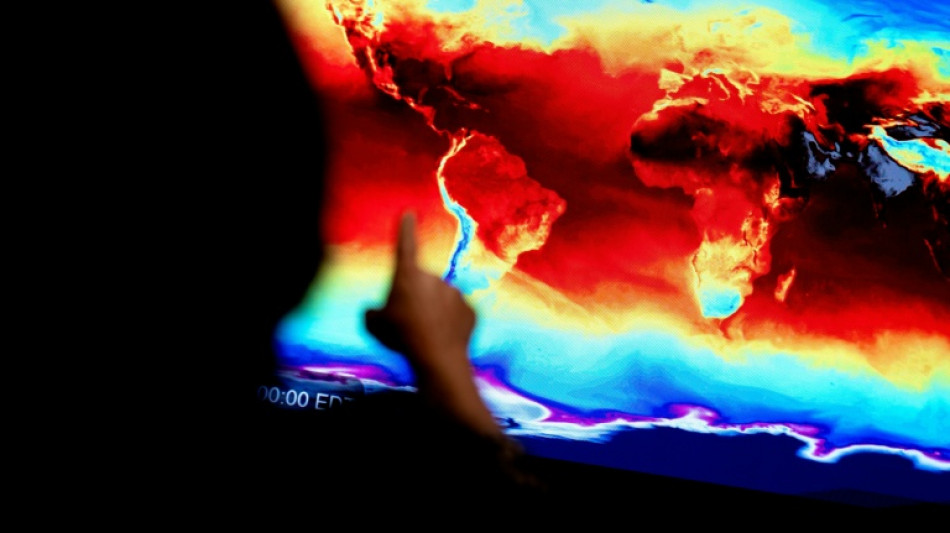
US budget cuts risk creating blind spots in Earth monitoring systems that would imperil weather forecasting and climate research for years to come, the deputy chair of a key UN-backed climate monitoring body warned in an AFP interview.
Peter Thorne is the deputy chair of the Global Climate Observing System (GCOS), a little-known but crucial UN-backed programme that tracks and evaluates data on the atmosphere, land and ocean.
"In the 30 years I've been in this game, we've always seen incremental improvements in our ability to diagnose the Earth system," Thorne, who is also a professor at Ireland's Maynooth University, told AFP.
"This is possibly the first time we're looking at an acute reversal in our capability to monitor the Earth, just when we need it the most."
Humanity has more data than ever about the planet: from balloons tracking winds and bobbing sea floats gauging ocean heat, to satellites with sweeping views of glaciers, ice sheets and atmospheric pollution.
But years of complacency and threats to funding from President Donald Trump's current and proposed budget cuts in the United States are raising fears over the future of this global effort to understand Earth.
This matters for climate change, but also for weather forecasts that inform farmers and provide early warnings for storms, floods, heatwaves and drought, Thorne said.
The issue was raised at COP30 in Brazil on Saturday by the technical body of the UN climate negotiations, which stressed the "vital importance" of monitoring and long-term data records.
In a draft report, it expressed concern over declining support for long-term observation networks, including GCOS.
The following interview with Thorne has been edited for flow and clarity:
Q: What is the current situation?
A: "It is beyond doubt that the global observing system is under considerable strain. This is a wake-up call to the rest of the world. We've dined out on America's largesse to fund major swathes of the Earth Observing System.
"The US has also made a significantly outsized contribution to global coordination. These aren't the sexy things, but they keep the show on the road. GCOS itself will close its doors at the end of 2027 without additional funds.
"Already weather balloons in the US are down some 13 to 16 percent, as a result of the reduction in workforce able to launch them.
"This is having a negative impact, not necessarily on the forecast for America, but for Europe or even Asia.
"Your forecast at five or 10 days' time isn't dependent upon what you launch in your backyard, it's what's being launched in the backyard of where your weather's coming from. America's forecast is critically dependent upon Japan or Singapore launching their weather balloons.
"That's why we need a coordinated observing system and global cooperation."
Q: What are the concerns for the future?
A: "If even half of the president's budget proposals come to fruition we're in big, big trouble.
"If you look at the proposal, it basically zeros all future Earth observation satellite capabilities from NASA and potentially also significantly reduces NOAA (National Oceanic and Atmospheric Administration) satellites.
"Many of those NASA missions at risk have no obvious contemporary within the European Space Agency's (ESA) programme, JAXA (Japan Aerospace Exploration Agency), the Indian satellite programme, or the Chinese satellite programme. Those would be lost observations forever, lost understanding that we'll never get back.
"The US also makes a huge contribution to monitoring the ocean. It contributes roughly 50 percent of the Argo float program, which diagnosed where 90 percent of the heat in the Earth system is going.
"Also the Moored Buoy Array in the Pacific, which is key for monitoring and predicting El Nino. This is also key to seasonal predictability for the US in winter, but also for much of the tropics throughout the year, and forecasts in Africa that drive agricultural production decisions. These risk being much, much poorer."
Q: Can others step in?
A: "If one or more of the NASA satellites or NOAA satellites do not launch, that is a guaranteed multi-year, or even decade-plus gap in Earth observation capability. We go dark on seeing some things about the Earth, potentially. Others are new missions which would have enabled us to see the Earth even better.
"If ESA said tomorrow, let's moonshot this and replace the NASA satellites, you're looking at at least 10 or 15 years.
"I can't say what will happen. But it's important that we observe the Earth system, because it's our life support system, we've got to understand it."
P.Hernandez--AT