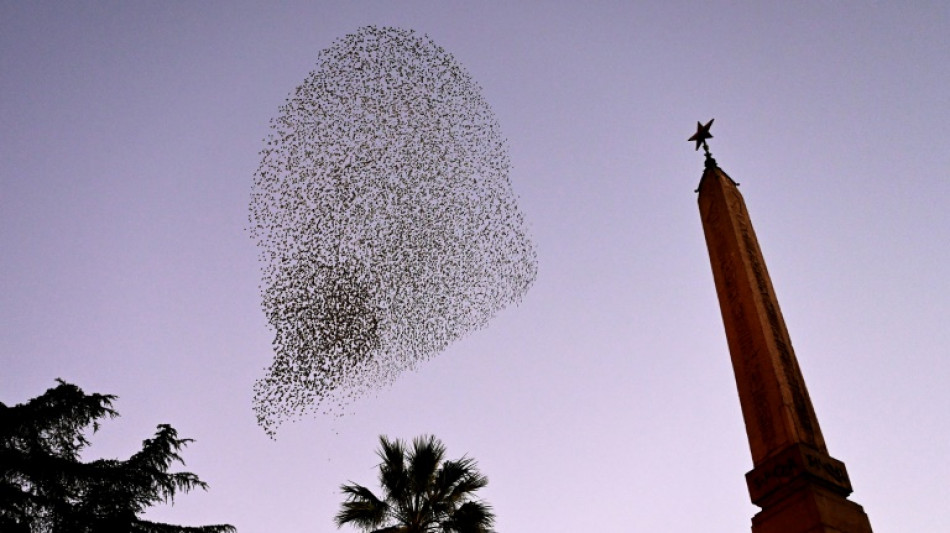
Magical but messy: Rome scares off its starlings

 Martin wins Austrian MotoGP sprint after Acosta crash

 Japan edge Fiji to win Pacific Nations Cup

 Black smoke, flames rising near Riyadh airport: residents to AFP

 UK actor Naomi Watts honoured at Spain film festival

 Japan emperor declares Asian Games open after turbulent build-up

 Asian Games open with unity message after troubled build-up

 Denmark hails 'binding' Greenland deal with Trump

 We don't want Games host Japan losing money, says Asian Olympic official

 Ed Sheeran returns to stage after Palestinian controversy

 Asian Games to open in Japan after troubled build-up

 Drone owners rush to offload devices ahead of Beijing ban

 Trump's beef policies irk Texas ranchers, testing their loyalty

 Kennedy Center: future unclear for iconic Washington arts hub

 Trump claims 'infinite' Greenland security deal with Denmark

 Helicopters battle wildfire threatening Ecuador's capital

 Brentford batter Chelsea to undo Alonso's promising start

 Kane hits Bundesliga century as Bayern rout Union

 Trump says CNN, MS NOW, Politico banned from White House
 Hushing and hedging: US companies retreat on climate

 Springboks to face Fiji before 2027 Rugby World Cup

 Nigeria miners struggled to breathe in cell before 37 died: survivors

 McIlroy on the charge at PGA Championship as Reed withdraws

 McIlroy on the charge at PGA Championship

 Crisis-wracked Volkswagen warns of 10-bn-euro hit to profits

 Costa Rica's Grynspan tops third informal poll for UN chief: diplomat

As the sun sets over central Rome, five figures in white overalls move under the trees. They wave speakers emitting a mix of sharp cries, and the birds rise into the air.
Every winter, the skies over Italy's capital are filled with the mesmerising sight of thousands of starlings swooping and diving in unison.
But when they stop to rest on the trees, their droppings coat the pavements and cars below -- prompting the city authorities, every year, to try to scare them away.
"We act on their fear reflex by using their own alarm call," said Marianna Di Santo, clad head-to-toe in white protective clothing and heading towards the birds gathered in trees around Termini central train station.
"It's as if they were warning each other that this is a dangerous place and they should move away," said Di Santo, whose company, Fauna Urbis, is hired by the Rome authorities to disperse the starlings.
- Up to one million -
Between October and February every year, millions of starlings migrate from northern Europe to Italy in search of warmer temperatures for the winter.
Their synchronised ballets -- murmurations -- over the Eternal City's centuries-old churches, palaces and ruins entrances passers-by.
"I've never seen such a thing in my life. It's spectacular," said Spanish tourist Eva Osuna, taking out her phone to capture the magic.
The glossy dark-feathered birds, which measure up to 20 centimetres each, spend the day feeding in rural areas before heading back into town to sleep, explains ornithologist Francesca Manzia from Italy's League for Bird Protection (LIPU).
"In the city, the temperatures are higher and the light helps them find their way around, and protects them from predators," she told AFP.
Warmer temperatures in northern European caused by climate change have shortened the starlings' stay in Italy, but their sheer numbers make them a force to be reckoned with.
Between 500,000 and one million are believed to be in Rome this year, according to one expert.
Naturally "gregarious", according to Manzia, they stick together at night, creating collective dormitories in the trees.
She insisted the starlings "do not carry diseases" but pose problems "because of their droppings, which make the roads slippery and smell very strong".
- In their nature -
Such is the problem that, even on a clear day, it is not uncommon to see Romans walking along tree-lined streets with umbrellas as protection against the birds.
City authorities use sounds and also lights not to chase the birds out of the city, but to split them up into smaller, more manageable groups.
Sounds are "the most simply and effective" way of moving the birds on, said Valentina de Tommaso from Fauna Urbis.
She works two or three times a week near Termini, which -- with its lights and shelter from the wind -- is a "comfortable" place for the birds to rest.
"We play recordings for about 10 minutes, with breaks in between so they do not get used to the noise" -- a tactic that aims to be annoying but harmless, she said.
The piercing noise draws a small crowd, some of them approving, others less so.
"They pose lots of problems. Walking around under flocks of starlings is not really ideal," said Francesco Fusco, a 55-year-old engineer.
"It's in their nature. We are not going to make them wear nappies!" he said, laughing.
M.White--AT



