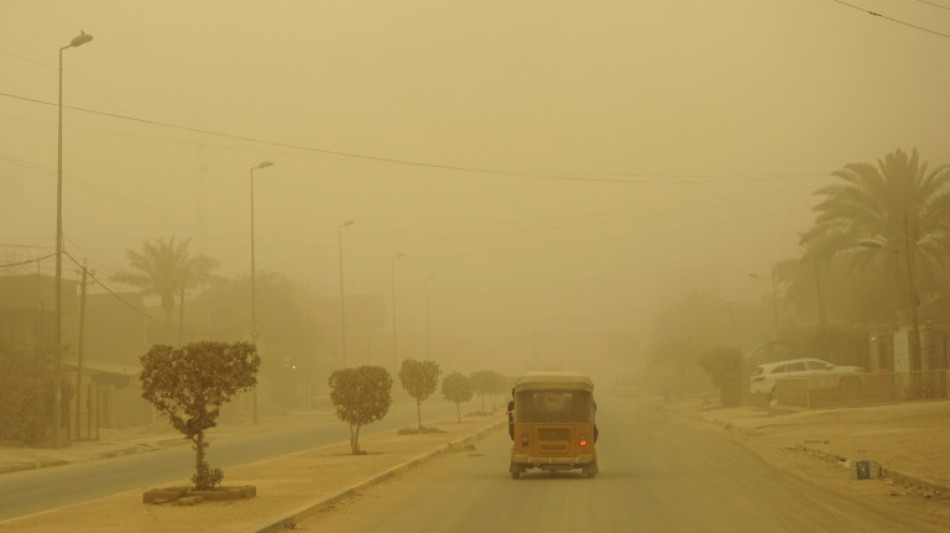
Thousands sick as latest severe sandstorm sweeps across Iraq / Photo: Sabah ARAR - AFP

 Martin wins Austrian MotoGP sprint after Acosta crash

 Japan edge Fiji to win Pacific Nations Cup

 Black smoke, flames rising near Riyadh airport: residents to AFP

 UK actor Naomi Watts honoured at Spain film festival
 Japan emperor declares Asian Games open after turbulent build-up

 Asian Games open with unity message after troubled build-up
 Denmark hails 'binding' Greenland deal with Trump

 We don't want Games host Japan losing money, says Asian Olympic official
 Ed Sheeran returns to stage after Palestinian controversy

 Asian Games to open in Japan after troubled build-up
 Drone owners rush to offload devices ahead of Beijing ban

 Trump's beef policies irk Texas ranchers, testing their loyalty

 Kennedy Center: future unclear for iconic Washington arts hub

 Trump claims 'infinite' Greenland security deal with Denmark

 Helicopters battle wildfire threatening Ecuador's capital

 Brentford batter Chelsea to undo Alonso's promising start

 Kane hits Bundesliga century as Bayern rout Union

 Trump says CNN, MS NOW, Politico banned from White House

 Hushing and hedging: US companies retreat on climate

 Springboks to face Fiji before 2027 Rugby World Cup

 Nigeria miners struggled to breathe in cell before 37 died: survivors

 McIlroy on the charge at PGA Championship as Reed withdraws

 McIlroy on the charge at PGA Championship

 Crisis-wracked Volkswagen warns of 10-bn-euro hit to profits

 Costa Rica's Grynspan tops third informal poll for UN chief: diplomat

One person died in Iraq and more than 5,000 were treated in hospitals Thursday for respiratory ailments due to a sandstorm, the seventh in a month, the health ministry said.
Duststorms have increased dramatically in frequency in Iraq in recent years, driven by soil degradation and intense droughts made worse by climate change, with rising average temperatures and sharply lower rainfall.
Residents of six of Iraq's 18 provinces, including Baghdad and the vast western region of Al-Anbar, awoke once again to a thick cloud of dust blanketing the sky.
As the storm swept across Iraq, it shrouded the capital Baghdad and the holy city of Najaf in ghostly orange clouds of choking dust.
"One death has been recorded in Baghdad" and hospitals "have received no less than 5,000 cases so far," health ministry spokesman Seif al-Badr said in a statement.
Those hit hardest are people suffering from "chronic respiratory diseases such as asthma", and the elderly who suffer in particular from heart ailments, he said.
Badr added that the majority had since been discharged and most cases were of "medium or low intensity".
Dust and sandstorms have always occurred in the Middle East but grown more frequent and intense in recent years, a trend that has been associated with overuse of river water, more dams, overgrazing and deforestation.
The fine dust particles can cause health problems such as asthma and cardiovascular ailments, and also spread bacteria and viruses as well as pesticides and other toxins.
Authorities in Al-Anbar and Kirkuk provinces, north of the capital, urged people "not to leave their homes", said the official INA news agency.
The storms are expected to grow more intense with worsening climate change because higher temperatures and more irregular rainfalls dry out land faster and accelerate desertification.
Sandstorms also cause economic damage by reducing visibility, sometimes to near zero, shuttering airports and highways and causing damage to buildings, vegetation and solar panels.
- '272 days of dust' -
Hospitals in Al-Anbar province had received more than 700 patients with breathing difficulties, said Anas Qais, a health official cited by INA.
The central province of Salaheddin reported more than 300 cases, while Diwaniya and the province of Najaf, south of Baghdad, each recorded about 100 cases, the news agency added.
Oil-rich Iraq, despite its mighty Tigris and Euphrates rivers, is classified as one of the world's five countries most vulnerable to climate change and desertification.
Scientists say climate change amplifies droughts and that their intensity and frequency in turn threaten food security. Experts have said these factors threaten to bring social and economic disaster in the war-scarred country.
In November, the World Bank warned Iraq -- a country of 41 million people -- could suffer a 20-percent drop in water resources by 2050 due to climate change.
The United Nations says about one-third of Iraq's population now lives in poverty.
The effects of low rainfall have been exacerbated as the levels of the Tigris and Euphrates drop because of upstream dams in neighbouring Iran and Turkey.
The environment ministry said the weather phenomenon could be addressed by "increasing vegetation cover and creating forests that act as windbreaks".
A.O.Scott--AT



