Finnish phone ban brings focus, and chatter, back to school / Photo: Alessandro RAMPAZZO - AFP

 'It has to stop': runners protest women's murders in S.Africa district

 Fire erupts near Riyadh airport as Houthis claim strikes

 Cuba works to restore power after another blackout

 England thrash Sri Lanka again to return to top of T20 rankings

 Arsenal thrashed by Brighton, sorry Spurs lose again

 South Korea, Austria qualify for Davis Cup finals

 Seare shocks Ingebrigtsen to win world 5km gold

 Brigitte Bardot widower slams sale of star's belongings

 Aston Villa compound Tottenham's misery despite late rally

 Asian Games offer 'deepest apologies' for South Korea anthem blunder

 Inter Milan and Italy icon Mazzola dies aged 83

 Saudi capital issues first air raid alert since renewed fighting in Yemen

 Martin edges title rival Marquez for Austrian MotoGP pole

 Indonesia accepts Malaysia's help to tackle wildfires

 Indians living in Japan on stand-by to house Asian Games athletes
 Trump signs bill authorizing sweeping Russia sanctions

 Protesters form human chain at Kennedy Center after Trump threat

 Death toll from attack at police HQ in Pakistan rises to 31

 Trump says Denmark to give US 'permanent control' over Greenland security

 New to The Street Broadcasts Tonight at 6:30 PM ET Across the United States, Latin America and MENA, Featuring BioVie, Acurx Pharmaceuticals, Lantern Pharma and SafeSpace Global

 Kennedy Center: future unclear for iconic Washington arts hub

 Trump claims 'infinite' Greenland security deal with Denmark

 Helicopters battle wildfire threatening Ecuador's capital

 Brentford batter Chelsea to undo Alonso's promising start

 Kane hits Bundesliga century as Bayern rout Union
Students huddle together in the corridor, chatter filling the air on a break between classes at a school in Finland, where mobile phones have been banned since school resumed in August.
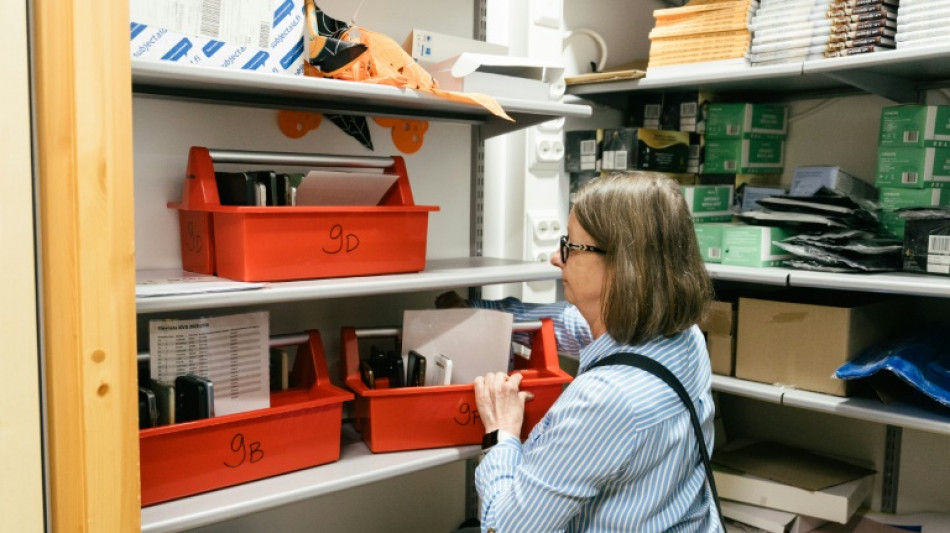
At Kungsvagens Skola for students aged 13 to 15 in Sipoo, northeast of Helsinki, teachers collect students' phones in the morning and lock them in a storage room until the end of the school day.
Principal Maria Tallberg said the transition to a phone-free school had "exceeded expectations".
"Of course, they (students) grumbled a bit in the beginning, especially since they can't use them during breaks, but they also understand why, deep down," Tallberg told AFP during a recent visit.
"Many have also said they were not aware they were so addicted to their phones."
The new law banning phones during class-time came into force on August 1 across Finland, a country long known for its high-quality education.
Several municipalities and individual schools have now chosen to extend the ban to breaks as well.
Previously, the Finnish National Agency for Education had recommended that schools restrict the use of mobile phones in classrooms.
The ban comes amidst a global debate on how smartphone use affects not only mental and overall health, but also learning and education.
Reports, including one from UNESCO in 2023, have warned that phones in the classroom can hamper learning by causing distraction.
Several countries have adopted similar restrictions, including South Korea, Italy, the Netherlands and France.
- 'Very different' -
Annika Railila, a chemistry teacher at Kungsvagens Skola, said classrooms were now calmer and students less distracted.
"Before, we had to remind them almost every lesson that the phone stays in their bag and you don't use it during the lessons."
Students also socialise more during breaks now, she said.
"You actually get to see their eyes and faces, which is a lot nicer than to say hello to someone who's looking at the screen," she added.
15-year-old Kie Lindfors described the school environment as "very different".
"I talk more with people and there is a room in the school where there are board games and stuff so that's been lots of fun on recess, going there to play," he said.
His classmate Lotta Knapas felt the school had become "a lot more noisy" and "wild".
"I understand that we can't use them in lessons but I think it is kind of dumb they take them away from us for the whole day," she said.
Meanwhile, Oscar Ingman, 14, feared some students might feel more lonely.
"I see more people being more sociable, more people talking and so on. But I also do see occasionally some people just sitting alone in a corridor," he said.
The school aimed to organise activities to prevent kids from having nothing to do, the principal said, noting that internet bullying at the school had already decreased.
"Students used to take pictures and film both during lessons and a lot on breaks, and we often had to investigate when video clips were shared everywhere," said Tallberg.
- Reverse the trend -
Finland's new law was adopted after education scores plunged, Finnish Education Minister Anders Adlercreutz told AFP.
"We have noticed in Finland, as in many other countries, that our reading and mathematic skills have deteriorated and the Finnish approach is to think about how we can create more space for learning and teaching," Adlercreutz said.
"Removing disturbing elements from the classroom helps."
The latest results from the OECD's Programme for International Student Assessment (PISA) from 2022 showed Finnish 15-year-olds' skills in mathematics, reading comprehension, and science had declined.
Finland nonetheless still ranked above the OECD average for all subjects among the 38 member countries.
The phone ban did not mean schools were exiting the digital world, Adlercreutz insisted.
"It is important for children to have physical books, but they also need to be digitally literate," he said.
"But in a world that is moving so fast, perhaps the role of schools is also to teach slowness, to be a place where you have to force yourself to read longer texts, focus on one thing, and work purposefully toward a long-term goal."
H.Romero--AT