Johannesburg transport project digs into wounds of the past / Photo: EMMANUEL CROSET - AFP

 Australia defends Pacific climate meeting despite doubts on attendance
 Iran attacks US sites after American strikes, wedding deaths
 Stocks drop, yields at three-decade highs on Mideast flare-up

 EU summons Russian envoy, eyes sanctions after Germany drone 'attack'

 Stocks drop as yields and oil prices spike on Mideast flare-up
 Cricketers to get best rooms at Asian Games, says Japan chief
 Zverev out-lasts Sonego in wild five-setter to advance at US Open

 Amid war, Ukrainian soldiers celebrate love at ritual wedding

 Venice to roll out red carpet for Clooney on opening night
 Hong Kong democracy activist Wong pleads guilty to foreign collusion: AFP

 Stocks sink, yields at multi-decade highs and oil spikes on Mideast flare-up

 US defends Trump Venezuela oil deal as energy secretary lands in Caracas
 Jubilant Monfils celebrates birthday with US Open win
 The Japanese idealist behind the last deradicalisation NGO in Somalia
 Rybakina, Gauff advance as Zverev launches US Open campaign
 Macron in Britain to help unveil tapestry, hold Burnham talks
 China's Xi to hold talks with Sisi in rare visit to Egypt

 Confident Gauff reaches US Open 2nd round with straight-set win
 US postal whistleblower warns ballot system could disrupt midterms

 Independent Pharmacy Cooperative Acquires USave Pharmacy Group
 John Ternus takes over as Apple enters era of AI, foldable phones

 Second-ranked Rybakina eases into US Open 2nd round

 Man City sign Fernandez, Ndiaye as Premier League clubs set new spending record

 Alcaraz aims to step it up in round two of US Open title defense

 Honduran judge drops corruption charges against ex-leader Hernandez
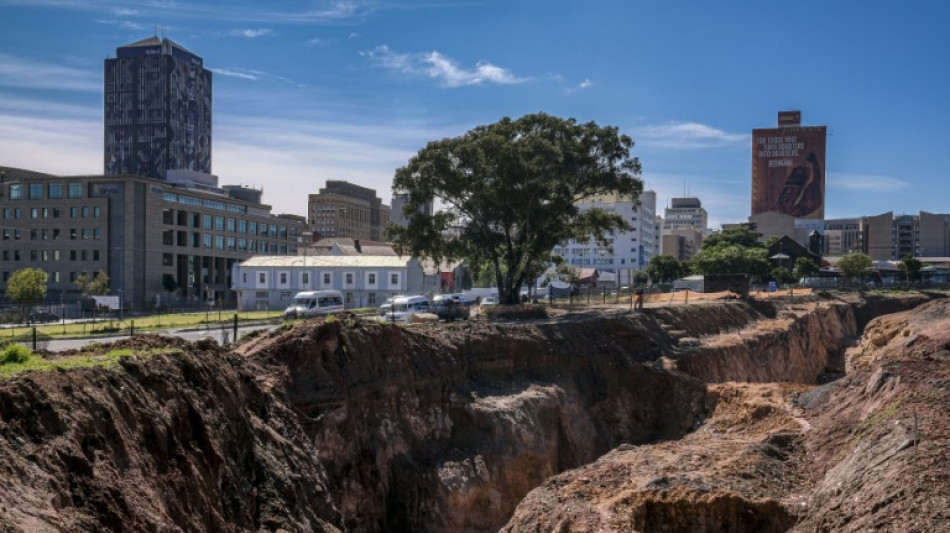
Off Johannesburg's main highway, surrounded by skyscrapers, heavy machinery has unearthed one of the city's original wounds -- a deep gash left by the 1880s gold rush.
The entire city centre is built over tunnels dug by generations of miners who extracted gold from the richest deposits the world has ever discovered.
The city of around six million grew around cavernous pits and mountainous dumps, which eventually became the physical barriers of racial segregation.
Now the rather poetic challenge of healing wounds both social and geological has fallen to property developers, who are turning this symbol of division into a bus terminal, connecting the city and the region.
"This is a gateway site," said Richard Bennett, marketing director for iProp, the company tasked with rehabilitating the site.
"It will allow the South African populace in Johannesburg and surrounds to gain easy access to public or effective transport."
- Connections -
In the 1880s, the mine was one of the first places where prospectors dug with pickaxes, and eventually dynamite, hauling the gold 40 metres (130 feet) back up to the ground.
After the easiest finds were depleted, this crevice -- which looks like a canyon in the middle of the city -- was simply filled with sand and used as a parking lot.
The sand has now been hauled off, readying the pit to be refilled with a cement-like material that is to support the construction of a new, large bus terminal.
The gold once mined there fuelled both fabulous wealth and deep social divides that persist to this day.
But the future of the city depends on connecting people with better transport and more walkable streets, said David van Niekerk, CEO of the Johannesburg Inner City Partnership, a group working to revive the city centre after decades of official neglect.
"Mixing is an important concept for the future of this city, and mixing in the widest possible sense," van Niekerk said.
"The vision that I certainly have for this city is to turn it into a walkable city," he added.
"A city that's walkable is a city that works for everyone, and I'm talking about from the homeless person to the major international corporate investor, and everyone in between."
It's a big challenge in a starkly divided country.
A World Bank study last year found that the top one percent of South Africans own 55 percent of the nation's wealth.
The wealth of the poorest half of the country is actually negative -- their debts outweigh their assets.
The top 0.01 percent, or about 3,500 people, own more than the bottom 90 percent, representing 32 million people.
- Miners' suffering -
Much of that inequality stems from the early days of mining, which took a tremendous and largely uncounted toll on the mostly black miners, while a few owners -- wealthy whites -- pocketed most of the profits.
"Those early mines were done very chaotically and very hastily. There were no proper plans, and a lot of people died... in rockfalls and such," said author Fred Khumalo.
His novel "The Longest March" centred on black mine workers in early Johannesburg who lived in compounds where "the conditions were really appalling," he said.
"People slept on cement blocks. There were no cushions, no mattress whatsoever. The blankets they provided were flimsy, and Johannesburg winters can be cold. People fell sick, and some of them died from exposure."
As the city braced for war between British and white Afrikaners settlers in 1899, the mines shut down and food supplies were cut off, leading to riots.
- Segregation -
In later decades, black mine workers who built homes nearby were forcibly removed as the gold digging expanded.
When apartheid fully took hold, blacks were pushed to designated areas to the outskirts of the city with poor access to transport -- and needed a "pass book" to access the city at all.
Almost three decades after the end of white rule, transport links remain patchy and residents of black townships who can afford it drive cars into the city, clogging its roads.
A new transit hub could help ease some of that traffic, as thousands of commuters would replace the migrant workers who once toiled there.
"In a way, it's a philosophical level, paying tribute to how those spaces were created in the first place," Khumalo said.
"The prosperity of this country owes a lot to what happened back then."
A.Williams--AT