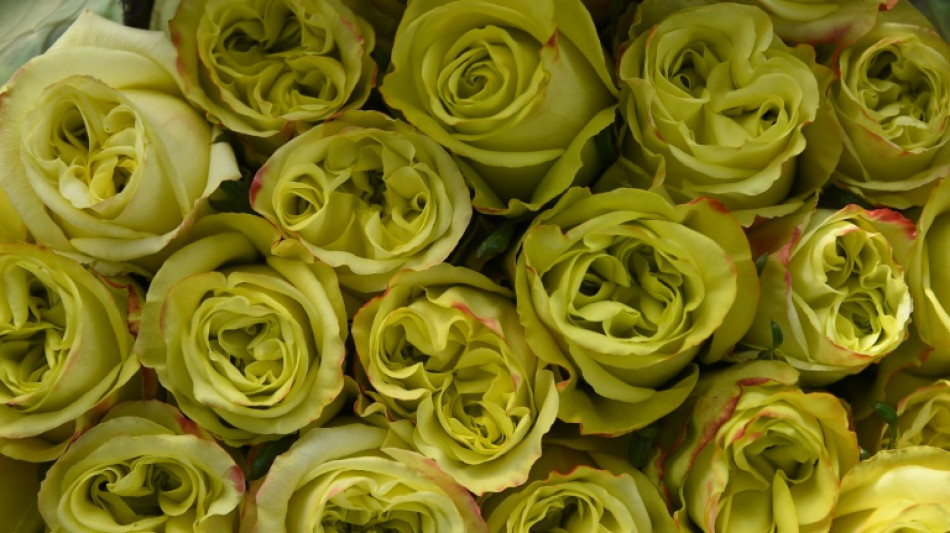
No bed of roses for Ecuador's flower industry / Photo: Rodrigo BUENDIA - AFP

 Stocks sink, yields at multi-decade highs and oil spikes on Mideast flare-up

 US defends Trump Venezuela oil deal as energy secretary lands in Caracas

 Jubilant Monfils celebrates birthday with US Open win
 The Japanese idealist behind the last deradicalisation NGO in Somalia

 Rybakina, Gauff advance as Zverev launches US Open campaign

 Macron in Britain to help unveil tapestry, hold Burnham talks
 China's Xi to hold talks with Sisi in rare visit to Egypt

 Confident Gauff reaches US Open 2nd round with straight-set win
 US postal whistleblower warns ballot system could disrupt midterms

 John Ternus takes over as Apple enters era of AI, foldable phones

 Second-ranked Rybakina eases into US Open 2nd round

 Man City sign Fernandez, Ndiaye as Premier League clubs set new spending record

 Alcaraz aims to step it up in round two of US Open title defense

 Honduran judge drops corruption charges against ex-leader Hernandez

 Mudryk joins Spurs on loan from Chelsea after doping ban ends

 What's next after judge strikes down New York's landmark climate fund law

 Cobolli claws out five-set victory at rain-hit US Open
 Ndiaye seizes 'chance of a lifetime' in Man City move

 Global bond sell-off, surging oil prices send markets into the red
 Zuckerberg, Musk make plea at G20 for more AI data centers

 'Discomfort' at G20 finance talks as US hosts Russian minister

 Man City set to sign Fernandez for record fee, Ndiaye on deadline day

 Back-to-school in Cuba a grim day with shortages of everything
 Canadian minister says Russia's G20 presence sparked 'discomfort'

 IMF reaches agreement with Senegal on new $2.2 bn loan programme
The pandemic, the war on Ukraine, and more than two weeks of ruinous protests over soaring living costs -- Ecuador's flower industry has recently had to surmount one obstacle after another.
The country's fourth-largest income-generator in terms of sales, roses alone earned nearly a billion US dollars in 2021 -- a record haul of $927 million to be exact.
With hundreds of companies growing 450 rose varieties, Ecuador is the world's third-biggest flower exporter after the Netherlands and Colombia.
But this year's prognosis is unclear after 18 days of sometimes-violent mass protests against rising fuel prices that included burning roadblocks and arson, and resulted in six deaths.
"The protests meant much larger losses than all that was lost during two years of pandemic," said Marcelo Echeverria, Ecuador commercial representative for the Dummen Orange international flower firm.
"That has slowed down a lot of things that were planned, a lot of projects that were planned for the second half of the year."
The protests, led by a powerful Indigenous people's group, saw cut flowers among the export products targeted by arsonists.
"They are BURNING our flowers," the Expoflores association of producers and exporters exclaimed on Twitter as the contents of delivery trucks were being set on fire last month.
"They are burning our income and that of our families."
Expoflores said other flowers rotted as they could not be harvested and moved for export, and ended up in "the garbage."
The government estimated the cost of the uprising at about $1 billion -- some two-thirds of it borne by the private sector, including the flower industry.
"There were innumerable losses in terms of flowers that could not be exported (and) damage to private property," said Socorro Martinez, Ecuador's Dummen Orange boss.
"It was a very sad issue because... it widened the gap between some producers and ordinary people who were part of the community, people who we considered very close to us."
- Necessity -
But those who are part of it say the industry is a resilient one, with flowers never going out of fashion, whether it be for happy events or sad ones.
"We have experienced many local and international crises. We live in crisis, but we know how to manage them," said Eduardo Letort, manager of the firm Hoja Verde, which produces about 35 million stems of 120 rose varieties each year.
"It’s been a tough few years, but... we have managed to adapt" by looking for new markets or making better use of dwindling fertilizer stocks as shortages bit during the pandemic and more recently with the war in Ukraine, he told AFP on his farm in the Andean town of Cayambe.
In 2020, Ecuador's flower industry recorded sales of $827 million -- a smaller decline than had been expected from pre-pandemic 2019 when it was $880 million.
"We saw that flowers... became a product of necessity. People wanted to have colors, scents in their homes" during lockdown, said Letort.
There was also a sharp rise in demand for flowers for pandemic funeral wreaths.
- More complicated -
Between January and May this year, flower exports brought in $432 million, compared to $417 million in the same period of 2021.
The rest of the year "had looked very good despite Russia (and its war on Ukraine) with forecasts for a dip followed by a recovery by year end," said Expoflores president Alejandro Martinez.
"But with the protests, things now seem more complicated," he added.
Russia was Ecuador's second-biggest country client for flowers in 2021, behind the United States.
Since the start of the war, Russia's share of the market fell from 20 percent to 10 percent, said Letort, who is also president of Expoflores in Cayambe.
"The flower business is already complicated, it does not need protests, pandemics or wars to make it complicated," said Marco Penaherrera, who sends about 120,000 roses to the United States every week.
"It is good business, but it is complicated."
O.Brown--AT