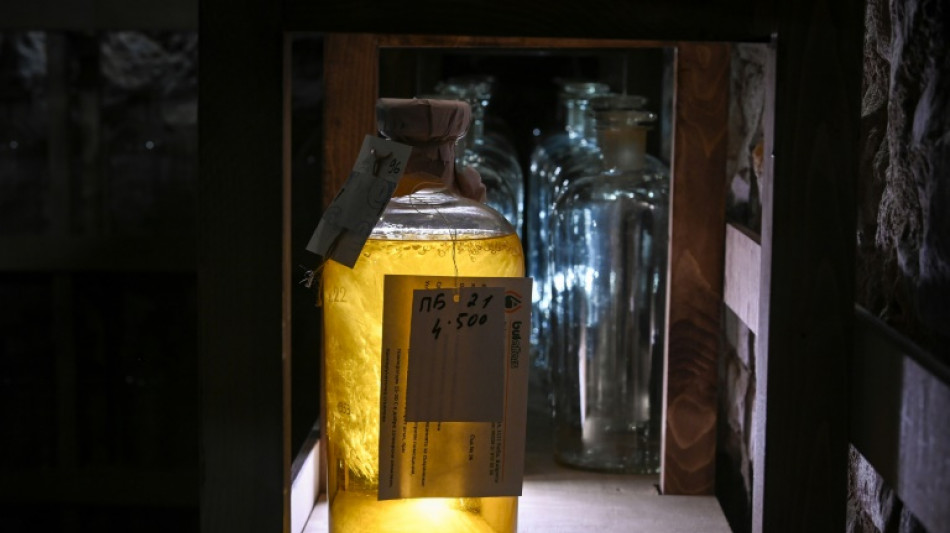
Inflation a thorn in the side of Bulgaria rose oil makers / Photo: Nikolay DOYCHINOV - AFP

 China's Xi arrives in Egypt as US sanctions threat looms over Iran links
 Car bomb at Colombian police station kills one, injures 11

 Rain delays start of play on US Open

 Man City agree blockbuster deal to sign Chelsea star Fernandez: reports

 Alkemya Metacore Secures $50M via Tokenised Equity to Scale Nickel Energy and Security Tech

 Man City chase Fernandez, Arsenal sell Jesus on deadline day

 EU says Russian 'hybrid attacks' won't halt aid to Ukraine

 Explosives used in sabotage attack on German power lines

 Nepali families hold symbolic funerals for missing after floods

 Newcastle sign Lille forward Fernandez-Pardo

 Even at Elysee, phones are handed in, Macron tells French pupils

 Chelsea agree to sign Atalanta's Ahanor, with Palace loan for this season

 Chelsea sign Atalanta's Ahanor and loan him to Palace

 UK chalks up hottest summer on record for second year running

 China's Xi visits Egypt as US sanctions threat looms over Iran links

 RISE Robotics Awarded $100,000 MassVentures Grant to Accelerate Commercialization of Beltdraulic Technology

 Global bond sell-off deepens on inflation concerns

 Germany's far-right AfD promises 'boom' but economists fear worst

 Former England captain Stokes signs for Adelaide Strikers

 Pakistan selector and ex-captain Misbah resigns after coach sacked
 Shein flattens on Hong Kong debut facing global headwinds

 Eurozone inflation hits three-year high at 3.3% in August
 Man City chase Fernandez, Arsenal eye Alvarez on deadline day

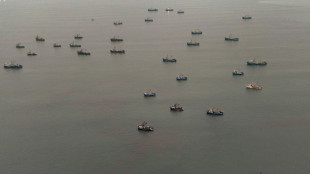 El Nino hammering Peru anchovy fishing: industry officials

 Mass Russian barrage kills 12 in Kyiv

Business is not a bed of roses for Bulgaria's rose oil makers these days.
Made from Damask roses grown in the aptly named Rose Valley, the oil is a vital ingredient in the perfumes made by the world's top luxury brands such as Christian Dior, Estee Lauder and Chanel.
But a heatwave has slashed this year's harvest of rose petals, labour is hard to find and the global surge in energy prices has increased costs for a product so precious that it is dubbed "liquid gold".
This year's oil will be "considerably more expensive," Plamen Stankovski, a partner at rose oil producer and exporter Bulattars, told AFP in his distillery near Pavel Banya, in Bulgaria's famed Rose Valley.
Production costs for one kilogram of rose oil stood at around 6,000 euros ($6,300) in 2021, but they have surged by as much as 40 percent this year.
The price of petals alone doubled since last year, according to producers.
This means that a 4.5-kilo glass jar filled with the thick, golden-yellow oil could sell for more than 45,000 euros this year.
Bulgaria is the world's top rose oil maker along with Turkey and the distilleries to make the precious substance run on natural gas, diesel and fuel oil -- commodities whose prices soared after Russia invaded Ukraine in late February.
"The price of fuel has gone up two or even three times," Stankovski said.
- 'Not all roses' -
Small amounts of rose oil are used in almost every high-quality perfume -- not for its aroma, but because its fixative qualities help blend other ingredients and prolong the scent on the skin.
To produce it, huge amounts of petals are boiled in massive metal vats. The vapours are then distilled to separate the oil in a process nearly unchanged since the days of the Ottoman empire in the 17th century.
On his family's rose fields near Pavel Banya, Dimitar Dimitrov laments that a chronic labour shortage has plagued the sector for years.
"Picking is the most expensive as it is done solely by hand. If you don't pick the open roses today, tomorrow they're gone," said the 40-year-old, who plucked petals with his father and brother-in-law.
Fertiliser, fuel, ploughing and pruning have all become more expensive, he said.
With petal prices almost doubling, he said he hoped "this will cover at least our production costs so we don't end up in the red".
To make things worse, a heatwave scorched rose buds before they could open, slashing yields and reducing the picking season by half.
The flowers that survived excrete less oil. To extract one kilo of rose oil, 4,000 kilograms of petals are now needed, 15 percent more than usual.
"We are worried by the increased cost of our production," said exporter Filip Lissicharov, CEO of the Enio Bonchev Production company in the nearby village of Tarnichane.
"The picture is not all roses," he added.
More fuel is now needed to sustain production, which is interrupted by irregular petal deliveries, but the industry association's calls for fuel subsidies have thus far gone unanswered by the government.
Rose oil production is expected to drop below its usual annual haul of 2.5 tonnes.
- Certified as 'pure' -
Nearly 100 percent of the oil produced in Bulgaria is exported to places such as France, Germany, Switzerland, the United States, China, Japan, South Korea and Taiwan.
Lissicharov is anxious about how the market will react to higher prices.
"There's interest (from buyers)," he said. "But whether this interest will turn into deals depends on the price."
To prevent counterfeit products from entering the market, the oil is certified by a few designated labs, such as the state Bulgarska Rosa Laboratory in Sofia.
The product leaves the lab in hermetically-sealed aluminium flasks with a label that guarantees "100-percent pure and natural genuine Bulgarian rose oil".
Cutting corners, Stankovski said, is not an option: "Regardless of our troubles, we will preserve the high quality of the rose oil."
P.Smith--AT