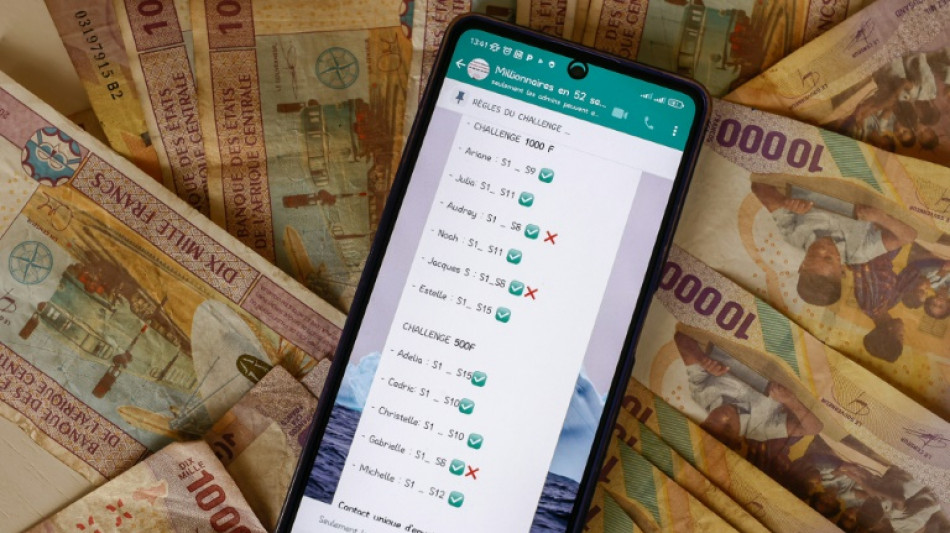
Ancient community banking enters digital age in Cameroon / Photo: Daniel BELOUMOU OLOMO - AFP

 Klopp poised to replace Nagelsmann as Germany coach: reports

 More than 400 dead in DR Congo's spreading Ebola outbreak

 Hot spell roasts eastern US as holiday weekend approaches

 Superb Swiatek storms into Wimbledon last 32, Zverev waits

 Russian strikes kill 21 in biggest ever attack on Kyiv, mayor says

 Swiatek sees off Pliskova to race into Wimbledon third round

 Dollar down, stocks shine after disappointing US jobs data

 US job growth slows, posing questions for Trump before midterms

 Chanel eyes menswear with Charvet shirtmaker takeover

 Chanel eyes menswear with Charvet shirtmaker takevoer

 'I grabbed my child': Kyiv residents face devastation of biggest Russian barrage of war

 Former top jockey Dettori breaks ribs in car crash

 Rees-Zammit returns to wing as Wales face Fiji

 Renovations on historic Paris Opera house extended by three years

 Thailand denies viral claim Macron knelt before king

 Spain, Portugal eye World Cup last 16

 Russian strikes kill 17 in biggest ever attack on Kyiv, mayor says

 Uruguay veteran Cavani quits Boca Juniors

 West Ham's Fernandes joins Spurs

 Bones of contention: More research needed on 'd'Artagnan corpse'

 Coffee with a view: tourists flock to Starbucks overlooking North Korea

 German coalition agrees on reform package in key breakthrough

 France recall record try scorer Penaud for All Blacks Test

 Seoul's Kospi tanks as Asia tech firms suffer another blow

 'Outstanding' Love to start at fly-half for All Blacks against France

Joseph Ngono's face lights up with a smile as he looks at his smartphone, where a payment worth $830 has just appeared in his digital wallet.
Like many Cameroonians, the computer scientist pays in each week to a shared savings fund known as a "tontine" -- an ancient system that start-ups are now bringing into the digital age.
This week it has paid out 500,000 Central African francs to Ngono, who will use it to cover the final instalment of his children's school fees.
"Without it, they wouldn't go to school," he said.
Shunned by banks, many people in Cameroon turn to their communities for help in the form of tontines, such as the one Ngono uses via the smartphone app Djangui.
In its most common form, members pay money into a common fund and take turns collecting it after an agreed period -- interest free.
Every week Ngono, along with colleagues and strangers whom they sponsor, contributes 10,000 FCFA ($16) each on Djangui.
It gives crucial access to ready cash for Ngono -- he only occasionally receives his monthly salary of 150,000 FCFA ($250) because his employer is "experiencing some cash-flow difficulties."
- Digital savings schemes -
The system of "pooling savings... between people united by connections of family, friendship, profession, clan" existed "long before the introduction of money," said a 2020 report published by the Global Development Research Center.
It lists at least 30 African countries where tontines are used and 14 in Asia.
Launched in 2016 by Guilain Kenfack, Djangui was one of the first tontine apps in the country.
"The idea came to me because I was in a traditional tontine and it was becoming very difficult. We weren't sure if some people had paid or not," he said.
Since its creation, Kenfack said the app has gained 50,000 users.
A number of imitators of Djangui have sprung up and now there are several apps offering tontines online in Cameroon.
- 'Replace the bank' -
As in other countries in Africa, many Cameroonians struggle to get loans from mainstream banks.
The African World Institute wrote in a 2019 report that 85 percent of people on the continent are "excluded from the banking system".
In Cameroon and elsewhere the average interest rate for loans to individuals was 10 percent in 2022, according to the Bank of Central African States (BEAC).
It can exceed 20 percent elsewhere in Africa.
Banks also rarely give credit to those on small and medium sized incomes.
The tontine "replaces the bank" and allows "informal economic players" to make essential expenditures or investments, said Omer Zang, the founder of Social Brokers -- a Cameroonian NGO that supports tontines.
The digitised saving systems have attracted the interest of large banking corporations including Cameroon's Afriland First Bank which offers customers the chance "to tontine."
- Online fraud risk -
However, even online tontines can be risky as people can register under false identities.
"I lost over one million Central African francs ($1,700) that I had saved for a year" in an online tontine, said Paul Kemayou, a 48-year-old civil servant.
"When it came to receiving the money, the administrator was unable to tell me where the money had gone."
This is why some Cameroonians keep to the traditional tontines.
"I prefer the tontines where people meet in person," said Emmanuel Talla, a shopkeeper in Yaounde, who is a member of several tontines in the capital.
"We know each other, the old and the young get together," he said. "The relationships are about more than just money."
R.Garcia--AT