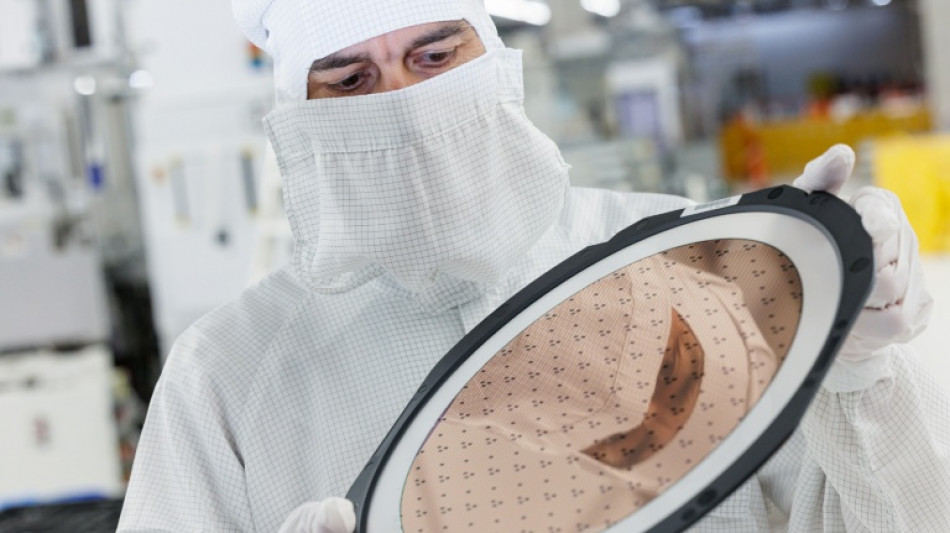
Germany's Infineon opens major chip plant as EU seeks tech autonomy / Photo: Jens SCHLÜTER - AFP

 NAND Prices Set to Fall in Early 2027 as DRAM Remains Elevated

 NSE and BSE Restrict Algorithmic Trading to Tech-Savvy Investors with Static IP

 Report Finds Large UK Fishing Fleet Violates Rules Two-Thirds of Time

 COP31 Negotiations Collapse as Youth Climate Demands Clash with Fossil Fuel Lobbying

 Craig Reucassel’s Ultra-Processed Food Experiment Reveals Brain Changes

 Seattle U Defeats Loyola Chicago 76-63 to Win Acrisure Series Title
German semiconductor giant Infineon opened a five-billion-euro ($5.7 billion) microchip plant Thursday, at a time Europe seeks to bolster its high-tech autonomy.
The "Smart Power Fab" in the eastern city of Dresden, completed three months ahead of schedule, has been hailed as a symbol of an EU push to reduce dependency for crucial parts on Asia and the United States.
The factory will produce chips for intelligent power management that are used in everything from electric vehicles, wind turbines and solar panels to data centres crucial for artificial intelligence.
The facility was backed by the EU's Chips Act with one billion euros in subsidies, part of a broader policy aimed at doubling the EU's share of global semiconductor production from 10 to 20 percent by 2030.
Work on the new plant began in May 2023, and represents both the largest single investment in Infineon's history and a major strategic pivot for the technology firm based outside of Munich.
The company has moved away from being primarily a supplier to the automotive industry and instead sought to capitalise on the massive AI investment boom.
The plant is located in the heart of Germany's "Silicon Saxony", which boasts one of Europe's most dynamic clusters for the microchip industry.
Dresden, home to nine universities, has a large number of trained engineers who are sought after by the roughly 2,500 companies in the sector operating in the area.
While constructing the "Smart Power Fab" came at a high cost, the subsequent unit production cost of the microchips will be minimal, say experts.
"The chip industry is a business driven by extreme economies of scale," Wolfgang Weber, head of the German electronics association ZVEI, told AFP.
"The first chip is incredibly expensive because you have to build a factory first -— an investment that can run into the billions of euros. Once production is up and running, unit costs drop sharply."
H.Romero--AT