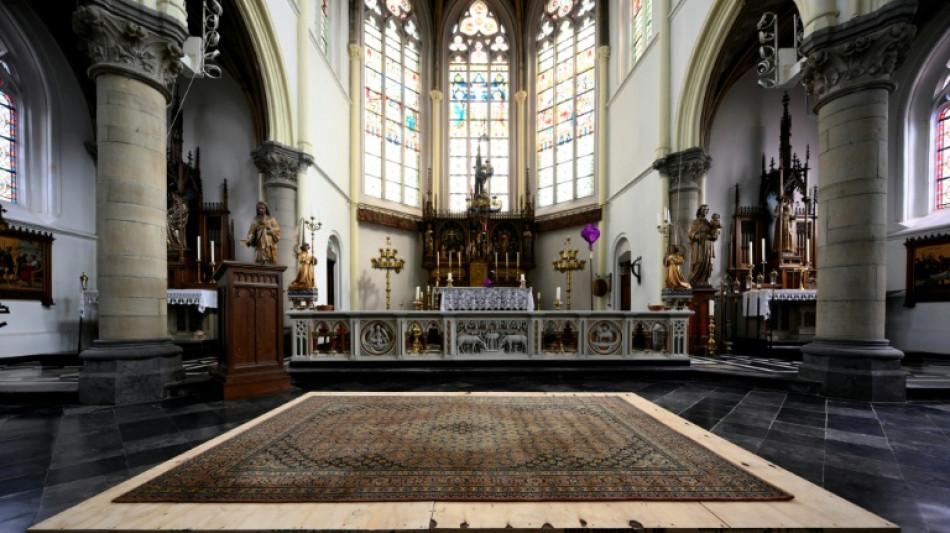
Bones of contention: More research needed on 'd'Artagnan corpse' / Photo: JOHN THYS - AFP

 NAND Prices Set to Fall in Early 2027 as DRAM Remains Elevated

 NSE and BSE Restrict Algorithmic Trading to Tech-Savvy Investors with Static IP

 Report Finds Large UK Fishing Fleet Violates Rules Two-Thirds of Time

 COP31 Negotiations Collapse as Youth Climate Demands Clash with Fossil Fuel Lobbying

 Craig Reucassel’s Ultra-Processed Food Experiment Reveals Brain Changes

 Seattle U Defeats Loyola Chicago 76-63 to Win Acrisure Series Title
More research is needed to determine whether bones buried beneath a Dutch church belong to d'Artagnan, the swashbuckling French soldier who inspired the novel The Three Musketeers, officials said Thursday.
After months of speculation and media reports of bungled investigations, the city hall of Maastricht said in a statement that the jury was still out.
"Based on the current research findings, it cannot be established that the skeleton found is that of d'Artagnan," said the authorities.
"The characteristics of the skeleton are consistent with what is known historically about d'Artagnan, but they are not specific enough to allow a definitive identification. Further research is therefore needed."
The skeleton's discovery -- in the nave of a modern church whose origins date back to at least the 13th century -- sparked global media interest in March.
D'Artagnan was killed during the siege of Maastricht in 1673. His final resting place has remained a mystery ever since.
The Gascon nobleman Charles de Batz de Castelmore inspired Alexandre Dumas's hero in The Three Musketeers in the 19th century, a character now known worldwide thanks to the novel and numerous film adaptations.
But according to local media L1, mistakes were made during an initial excavation, meaning valuable information was lost.
The city hall took over with an "emergency excavation" but admitted that the investigation had suffered.
"Because no archaeological documentation was prepared in accordance with the usual standards before the emergency excavation, part of the archaeological context has been lost," said the statement.
"The loss of information limits the possibilities for fully interpreting the grave and the skeleton," the statement added.
Authorities said they needed to conduct further archaeological, historical and genetic research to determine whether the bones once belonged to the famous swashbuckler.
Until then, all options are open, said the authorities.
"The current research findings do not confirm the identification, but they do not rule it out either," they concluded.
F.Ramirez--AT