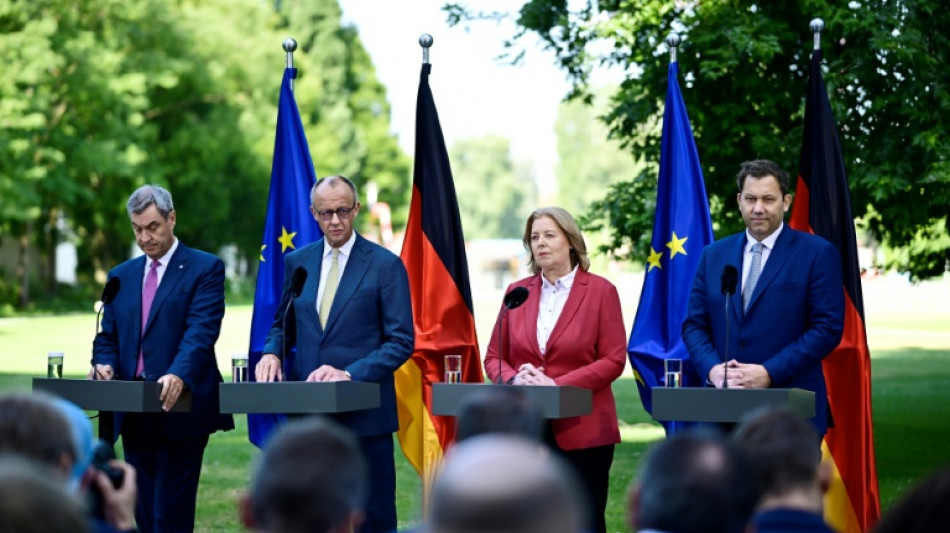
German ruling coalition agrees on major reform package / Photo: Tobias SCHWARZ - AFP

 Energy costs spark inflation surges in France, Italy

 South Korea break China hearts to reach Asian Games football final

 Eala storms into Asian Games semi-finals to thrill adoring fans

 Turkey freezes ex-minister's assets as fund crisis grows

 What we know about the North Korean POW dispute

 Most equities rise after oil price plunge, US data in focus
 Polar oceans transformed as warming melts ice habitats: research

 Lost shark becomes viral star in South Korea

 Dangote to launch $16bn refinery in Kenya

 North Korean leader 'extremely obese': Seoul spy agency
 Yankees and pope-backed White Sox start MLB playoffs with wins

 Malaysia's ex-PM Mahathir in hospital for observation

 'No limits': Marathon world record holder Sawe chasing history

 Countdown begins to biggest-ever Rugby World Cup

 Bangladesh women lose ground after quota reform

 Vietnam admits 'differing opinions' on Hanoi development

 Stocks temper gains as oil pares heavy losses, US data in focus

 New Zealand denies breaching climate commitments to EU

 Albert becomes youngest US scorer in 4-2 win over Chile

 Pirate island's plunging population shows Greece's demographic decline

 With elections ahead, Latvia's Russian-speakers reject Moscow's help

 Brazil football clubs face massive sponsorship blow from betting ban

 ChatGPT maker wants to be the App Store for AI as safety concerns grow

 Women fight fires and sexism in Indonesian Borneo

 Forsling's OT blast lifts Florida over Carolina in NHL opener

Germany's ruling coalition has agreed on sweeping tax, labour and pension reforms, Chancellor Friedrich Merz said Thursday, a breakthrough aimed at reviving the struggling economy and countering the rise of the far right.
"We are working to increase the flexibility of our businesses," Merz told a Berlin press conference after lengthy talks between his centre-right CDU/CSU alliance and their coalition partners the centre-left SPD.
"We are working to cut red tape. We are working to protect our welfare state, and we are working to ease the burden on employees and companies by lowering taxes," said Merz, who had promised a "great leap forward" for German growth.
The package includes income tax cuts worth 10 billion euros ($11.4bn), to be financed by higher taxes on those earning more than 250,000 euros a year. And changes to the pension system will eventually see the retirement age rise past 67.
"The highest earners in this country will take on a larger share" of the tax burden, said Finance Minister and Vice Chancellor Lars Klingbeil of the SPD. "That is fair, so that our country can move forward."
The tax relief would mean an average family is about 600 euros better off per year, the parties said.
The coalition also agreed to reduce corporate reporting obligations that companies see as burdensome, and to scrap the right of employees to get a sick note by telephone with the aim of reducing worker absentee days in Germany.
It will also be possible to employ people on temporary contracts for up to four years.
Business organisations welcomed the plans, but trade union IG Metall said the labour reforms were "an attack on workers' rights".
- 'Under pressure' -
The coalition parties -- in power since May last year in Europe's biggest economy -- had been struggling for months to agree on a series of thorny issues.
The government is also keen to show it can get to grips with the country's problems and to diminish the appeal of the far-right Alternative for Germany (AfD), which has been topping national opinion polls for months.
Key regional elections will be held in September in formerly communist eastern Germany, which could produce the first-ever AfD-led state government. That would be unprecedented in post-war Germany and would underline Merz's dire approval ratings.
"We are doing everything we can to overcome our country's structural weakness when it comes to economic growth," Merz said, admitting that "we are under pressure from many sides".
Germany's export-led industry was long the engine of its economic success but has been hit hard by rising energy and labour costs. Tough Chinese competition and US President Donald Trump's erratic tariff blitz have only heightened the pressure.
In a part of the package which was seen as aimed at China, the coalition said the government would press for tougher action at the EU level against "unfair competition" as well as stricter rules on foreign investment in "strategic sectors and critical infrastructure".
Marion Muehlberger, senior economist at Deutsche Bank, said Thursday's announcement represented "one of (Germany's) biggest reform packages in decades" and showed the government's "ability to agree on important structural reforms".
She said that the package "should bode well for sentiment and dovetails with our forecast that growth will pick up in the second half of the year".
Holger Schmieding from Berenberg cautioned that "none of the many reforms... will be ground-breaking on its own".
"But on top of the major pension reform proposal which the government had already endorsed ten days ago, the reform deal can make a real difference," he said. "If implemented, Germany can become a better place to invest and create jobs again."
Marcel Fratzscher, president of the DIW institute, offered a more downbeat assessment, telling the Rheinische Post daily that the reforms did not represent "a great success but rather a symbolic package".
M.White--AT