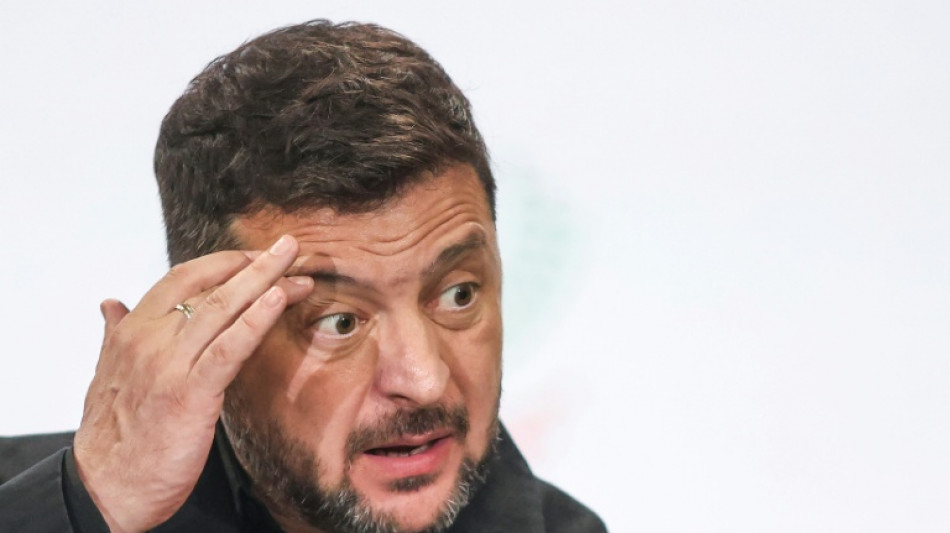
Ukrainian state ordered Nord Stream sabotage: German prosecutors / Photo: Paul Faith - AFP

 Bishop Museum Races to Save Rare Megamouth Shark Specimen

 Zach Hickerson Recounts Hayden Panettiere's Final Moments in New Interview

 Luxembourg Housing Petition Passes Threshold for Parliamentary Consideration

 Raheem Sterling Receives Suspended Sentence After Lamborghini Crash

 Audience to Choose the Set List at Luxembourg's First FAMIL Jukebox Night

 Luxembourg Pay Rise Delayed as Regional and World Headlines Develop

 Chennai Urbanist Sashna Develops 'Anniki' Card Game to Gamify Tamil Nadu History

 Transport Minister Defends Land Seizure Powers for Toronto-Quebec City High-Speed Rail

German prosecutors said Thursday that the Ukrainian state ordered a 2022 bomb attack on the Nord Stream gas pipelines, complicating relations between Kyiv and its key military backer Berlin.
The sabotage, never claimed by any actor, destroyed three of the four Baltic seafloor pipelines of the major energy link from Russia to Germany and released huge amounts of methane into the atmosphere.
The Ukrainian government has always denied ordering the destruction of the pipelines, which had in earlier times allowed Russia to earn billions through gas sales to Germany and beyond.
News broke Wednesday that German prosecutors had now levelled charges against the Ukrainian suspect Serhii Kuznetsov, who is alleged to have led a team of divers in the high-stakes operation.
He was arrested while on holiday in Italy last summer and extradited to Germany in November.
In a statement Thursday detailing the charges, including the alleged war crime of targeting civilian infrastructure, German prosecutors said that he was "an officer in the Ukrainian army" and that he and other military personnel had acted "on the orders of state authorities in Ukraine".
Following Russia's February 2022 full-scale invasion of Ukraine, "he and other members of the military... developed a plan to destroy" the pipelines in order to deprive Russia of gas revenues, they said.
The case is awkward for Germany and Ukraine at a time when Germany, Europe's leading economy, has emerged as the biggest military backer of Ukraine in its war against Russia.
Ukrainian President Volodymyr Zelensky, asked about the charges on Wednesday, told reporters that "we have not officially received all the details, at least I have not seen them ... For now, it is too early to speak."
- 'Context of armed conflict' -
The German prosecutors said that Kuznetsov led a team "consisting of several professional divers, a skipper, and an explosives expert" who chartered a yacht in the German port of Rostock using forged identity documents.
"Using this vessel, the accused and his accomplices transported large quantities of high-performance explosives suitable for military use through international waters to an area near the Danish island of Bornholm," prosecutors say.
The explosives were then allegedly attached to the pipelines, together with timed detonators, and the blasts took place four days later.
Kuznetsov is now reportedly in detention in Hamburg, where he will face trial.
German media reported that the evidence against him is described as "overwhelming", as he had allegedly incriminated himself during phone calls he made while in custody in Italy.
The ARD broadcaster said that investigators had found traces of military explosives on the yacht and that a total of seven suspects had been identified in the case, one of whom had since died fighting Russia.
Last year a Polish court refused a German extradition request for another Ukrainian suspect in the Nord Stream case.
Kuznetsov's Italian defence lawyer, Nicola Canestrini, on Thursday dismissed "the fragile theses of the prosecution" and argued that a conviction was "out of the question".
The lawyer also said that German authorities had sought the extradition from Italy on lesser charges including sabotage and only later added the more serious war crime allegation.
Canestrini added that "with the charge of a war crime, the prosecuting authority acknowledges for the first time that the conduct alleged took place in the context of an armed conflict -- that is, in the framework of a war".
O.Ortiz--AT


