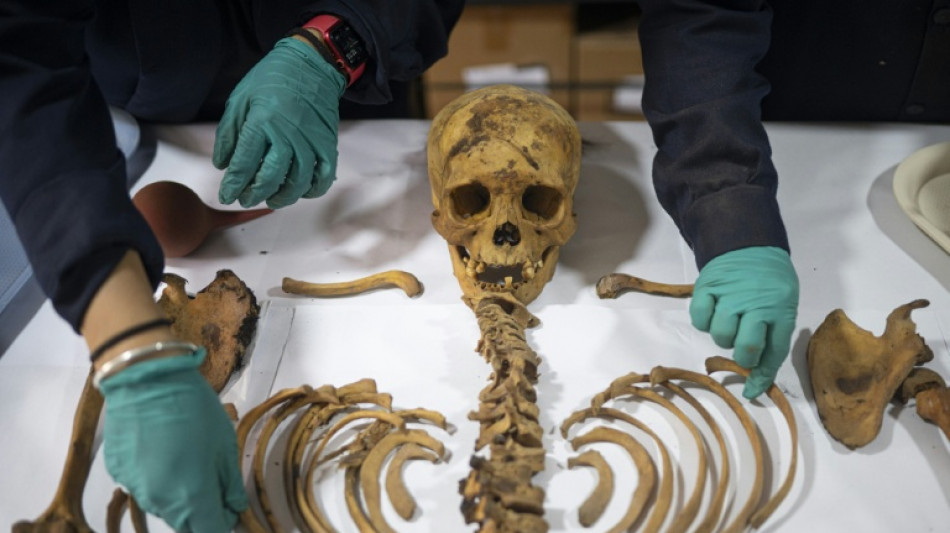
Peru gas workers find thousand-year-old mummy / Photo: Ernesto BENAVIDES - AFP

 India's Wholesale Inflation Jumps to 12.29% as Fuel Costs Surge

 China's October Activity Data Reveal a Weak Start to the Fourth Quarter

 Philippines Urges ASEAN and China to Accelerate South China Sea Code of Conduct

 Mbeki Claims No Progress Since 2018; Author Cites Infrastructure and Economic Gains

 Qatar's Amir and Venezuelan Acting President Discuss Energy Cooperation

 Blue Chip Capital Group Announces Quotation of its Common Stock on the OTCID and Updates Status of Initial Regulatory Compliance
 OBI Pharma Signs Collaboration and License Agreement with Novartis

 Strategic Metals Reports Promising Results From the Rusty and Ranch Projects
 Big Mamma Founder Tigrane Seydoux Brings Italian Restaurant Group to Florida

Peruvian gas workers this week found a thousand-year-old mummy while installing pipes in Lima, their company said, confirming the latest discovery of a pre-Hispanic tomb in the capital.
The workers found the trunk of a huarango tree (a species native to coastal Peru), "which served as a tomb marker in the past," at a depth of 50 centimeters (20 inches), archaeologist Jesus Bahamonde, scientific coordinator of Calidda gas company, told reporters.
The mummy of a boy aged between 10 and 15, was found at a depth of 1.2 meters, he added.
"The burial and the objects correspond to a style that developed between 1000 and 1200," he said.
The remains discovered on Monday were found "in a sitting position, with the arms and legs bent," according to Bahamonde.
They were found in a shroud which also contained calabash gourds.
Ceramic objects, including plates, bottles and jugs decorated with geometric figures and figures of fishermen, were found next to the mummy.
The tomb and artifacts belong to the pre-Inca Chancay culture, which lived in the Lima area between the 11th and 15th centuries.
They were discovered while gas workers were removing earth from an avenue in the Puente Piedra district of northern Lima.
In Peru, utility companies must hire archaeologists when drilling the earth, because of the possibility of hitting upon heritage sites.
Calidda has made more than 2,200 archaeological finds since 2004.
Lima is home to over 500 archaeological sites, including dozens of "huacas" as ancient cemeteries are known in the Indigenous Quechua language.
H.Romero--AT