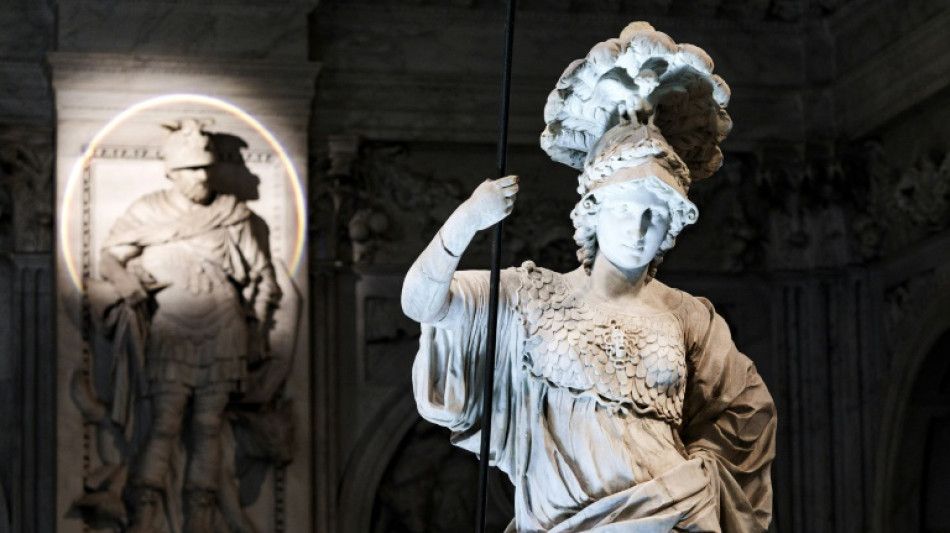
Amsterdam honours its own Golden Age sculpture master / Photo: Ramon van Flymen - ANP/AFP

 Philippines Urges ASEAN and China to Accelerate South China Sea Code of Conduct

 Mbeki Claims No Progress Since 2018; Author Cites Infrastructure and Economic Gains

 Qatar's Amir and Venezuelan Acting President Discuss Energy Cooperation
 InterContinental Hotels Group PLC Announces Transaction in Own Shares - November 16

 Hawai‘i Falls to North Dakota State, Bowl Hopes Dashed

 Park Jin-young Denies Cult Allegations Against Firstfruits Group

Imposing but delicate marble sculptures of Graeco-Roman-style figures grace the vaulted corridors of a huge palace. But this isn't Florence or Rome. This is Amsterdam.
As part of celebrations to mark 750 years since the founding of the Dutch capital, the city is unveiling from Wednesday an exhibition dedicated to Artus Quellinus, the 17th century "sculptor of Amsterdam."
Virtually unknown outside Flanders in present-day Belgium where he made his name, the city has Quellinus to thank for the decorations on the Royal Palace that dominates the city's iconic Dam Square.
Quellinus "lifted our sculpture to a new level" with a fresh style, Dutch art historian Bieke van der Mark told AFP.
Born in Antwerp in 1606, Quellinus sculpted with marble, as well as ivory and clay.
His style, heavily influenced by Flemish baroque painter Reubens, was a complete novelty for the Protestant Netherlands, used to a more sober style at the time.
His subjects -- mythological figures, chubby angels, and animals -- are perhaps a nod to the great masters he would have seen while an apprentice in Rome.
"Like (17th century Italian master Gian Lorenzo) Bernini, he masters the way the flesh looks, and hands," said Van der Mark.
"It's really fantastic," said the 46-year-old, pointing to a statue of the God Saturn devouring his son, whom he holds in his huge veiny hands.
Organised by the Amsterdam Royal Palace and the Rijksmuseum, this is the first-ever retrospective devoted to Quellinus, displaying more than 100 of his works from national and international collections.
"We spent quite some time to select and to collect, to bring together all these very special works... to show Quellinus at his best," said curator Liesbeth van Noortwijk.
"Because I think he's an artist that deserves that."
"We dare to call him the Bernini of the North... And I think this is no exaggeration," she told AFP.
The decorations of Amsterdam's Royal Palace, built as a town hall between 1648 and 1665, remains Quellinus's statement work, with an iconic figure on the roof of Atlas bearing the world on his shoulders.
Now, nearly 400 years on, the city hopes the show will raise awareness of the hitherto unrecognised "sculptor of Amsterdam."
N.Walker--AT