
Tweed's youthful makeover resurrects symbol of Scottish heritage / Photo: ANDY BUCHANAN - AFP

 Indonesia doing 'everything' but still struggling to curb fires
 Once decried as 'human cockfighting', MMA wants Olympic spot
 China's Yu, 13, great for swimming says multiple Olympic medallist
 Putin's party set to retain power after Russia vote hit by cyberattacks, drones
 Germany's Merz under pressure after bruising state election losses

 Messi, Miami frustrated in 2-2 draw with San Diego

 Thousands march in France against 'licence to kill' draft law

 Best Gold IRA Accounts 2026 Rankings Released: Top Precious Metals IRA Companies Compared in New Guide

 Braves clinch division title as Red Sox reach MLB playoffs

 Bordeaux-Begles hammer Stade Francais despite Jalibert injury

 Milan and Juventus end blips with home wins

 Bridgeman wins PGA Biltmore title with sizzling 61

 Williams injured as Bears shut down by Vikings

 US warns of rapid escalation in Middle East war

 Germany's far-right AfD celebrates another state election win

 Russia vows revenge for election-day attacks as poll shows ruling party win

 Spaun late shows snatches PGA Championship win

 Conceicao strikes as Juventus beat Atalanta

 Britain, Zverev-inspired Germany, Spain complete Davis Cup finals

 Man Utd salvage Fulham draw as pressure mounts on Carrick

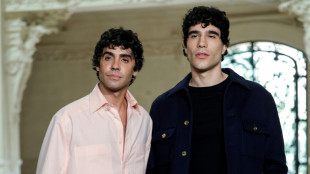 Spanish civil war drama 'The Black Ball' wins at Toronto festival

 Germany's Merz shaken by far-right and far-left gains in state votes

 Macron welcomes Canada's Carney to French Atlantic territory

 Fiorentina frustrate Napoli with Serie A draw, Como upset

 Five-star Man City top Premier League after Sunderland thriller

"When you see tweed on the runway, you don't expect it to come from here," joked 38-year-old former banker Alexander MacLeod as he set up his loom in a converted barn on the shores of a Scottish loch.
MacLeod became a weaver two years ago, joining residents on the islands of Lewis and Harris, off Scotland's northwest coast, in helping to rejuvenate the tweed industry after a significant period of decline.
"It's a good thing to keep the tradition going," he told AFP.
Tweed is a symbol of Scottish heritage and has "always been part of the culture" on the Outer Hebrides, added Macleod, who hails from the island of Scalpay, which is connected to Harris by a bridge.
It's now "an attractive sector to be in", he explained.
He left the Hebrides for seven years to work in banking but the pull of his roots proved too strong.
During the day, McLeod now works for a small local cosmetics company. In the evenings, he puts on a podcast, usually about espionage, and patiently begins to weave.
Only the steady hum of his machine disturbs the calm of the old stone barn.
Harris tweed, traditionally made from 100 percent wool, is the only fabric protected by a 1993 Act of Parliament.
It must be "handwoven by the islanders at their homes in the Outer Hebrides, finished in the Outer Hebrides, and made from pure virgin wool dyed and spun in the Outer Hebrides".
- 'Resurgence' -
The weaver spoke of his "satisfaction" once the tweed is finished.
The fabric, once associated with the British aristocracy, then goes to the spinning mill for a quality control check, where the slightest flaw is flagged up.
Finally, it receives the precious "Harris Tweed" stamp -- a globe topped with a cross -- certifying the fabric's provenance and authenticity, issued by the Harris Tweed Authority (HTA).
The tweed then leaves the island to be purchased by discerning companies abroad, including luxury brands such as Christian Dior, Chanel, and Gucci.
Several sneaker brands such as Nike, New Balance, and Converse have also used it for limited edition products.
The traditional staples are jackets, caps, and bags, but the fabric can also used for furniture.
There are 140 weavers, according to the HTA, which launched a recruitment campaign in 2023 and offered workshops to learn the trade following a wave of retirements.
This know-how, often passed down from generation to generation, is now being nurtured by a different profile of weaver.
"It's nice to see younger people coming in," said Kelly MacDonald, director of operations at the HTA.
"When I joined the industry 22 years ago, there was a severe period of decline. I was wondering: 'is there going to be an industry anymore?'"
But the industry is now enjoying a "resurgence" and "significant growth", with more than 580,000 metres of tweed produced in 2024.
"We are always looking at new markets," she explained, and tweed is now exported to Korea, Japan, Germany, France and other countries.
It is no longer dependent on the US market, as it once was, and should be largely shielded from the tariffs imposed by President Donald Trump.
- Slow fashion -
Tweed has "modernised", said Cameron MacArthur, who works at Carloway Mill, one of the three spinning mills in the west of the Isle of Lewis.
He is only 29, but has already worked there for 12 years.
The mill, with its large machines, looks as if it hasn't changed for decades. But MacArthur has seen it evolve to embrace a younger workforce and newer fabrics, meaning it is no longer just the ultra-classic Prince of Wales check or dark colours that are on offer.
"Nowadays, we're allowed to make up our own colours... and we're just doing different things with it, modernising it, making it brighter," he said, showing off rolls of turquoise blue and fuchsia pink.
"We're so busy... it never used to be like that," he said, adding that he was "proud" to be working with the local product.
MacDonald also noted that tweed was an antidote to environmentally unfriendly "fast fashion."
"How nice to own a product where you can actually look on a map to a tiny island and say, that's where my jacket was made. That's so rare now, and I think people really engaged with that," he said.
"Every stage of the production has to happen here, but from start to finish, it is a really long process. We are the epitome of slow fashion."
H.Romero--AT

