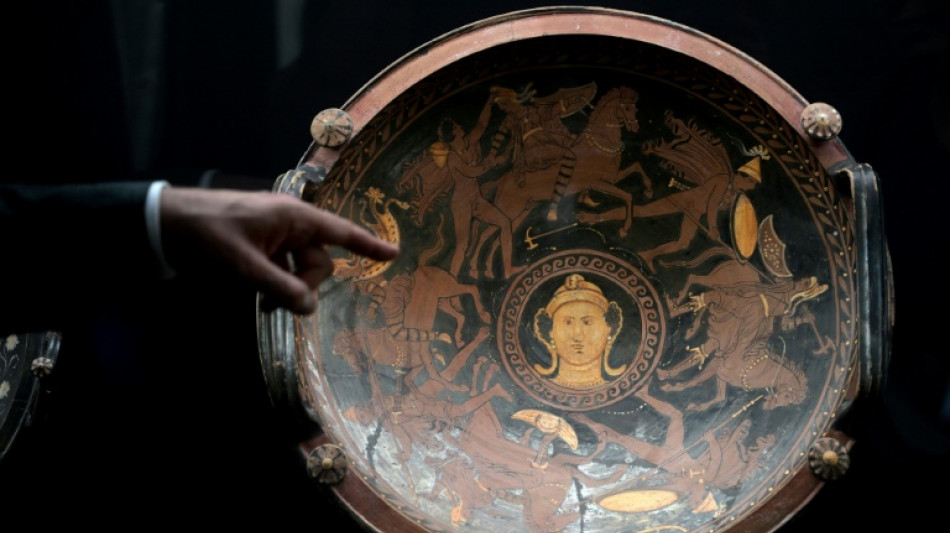
Rome museum gives stolen artefacts their due / Photo: Tiziana FABI - AFP/File

 Memoir by Diana's brother goes on sale after rocking UK monarchy

 Newcomers South Korea face holders Italy in Davis Cup finals

 Japan's Kojima sounds Marchand warning with Asian Games gold

 England rugby star Pollock signs new Northampton deal

 STARTRADER Expands Its Chinese Equity CFD Range with CXMT and Unitree Robotics

 MEXC Expands Opportunity Compass with Stock Trading Handbook to Help Crypto Users Build Investment Knowledge

 England paceman Wood retires from international cricket

 Magnificent Mandhana's 79 helps India to Asian Games cricket gold

 Marchand 'stressed' about racing Japanese rivals at LA Olympics

 Mobile boat clinics bring healthcare to India's remote islands

 Former India paceman Zaheer Khan named Chennai coach in IPL

 Six-year-old Chinese girl sets world record with Rubik's Cube
 Swimming prodigy Yu, 13, says 'interviews way harder than racing'

 Star coaches make their bows as Nations League returns

 Rams bounce back as Giants reel from Dart injury

 In Bangladesh, Pakistan's Jinnah photo stirs anger

 Two New Zealand naval ships transit Taiwan Strait

 Zidane gets down to work as France start new era

 Inside the Venezuelan prison meant to 'drive you insane'

 UK king braces as memoir by Diana's brother goes on sale

 Silver X Increases Measured and Indicated Resources 173% to 10.4 Mt at 213 g/t AgEq (70.8 Moz AgEq) and Inferred Resources 43% to 21.6 Mt at 252 g/t AgEq (180.9 Moz AgEq)

 SLAM Uncovers Antimony, Gold and Silver on Its Moose Lake Trenching Program

 Arrive AI to Demonstrate Autonomous Delivery Infrastructure at Investor Showcase

 Amber Book Expands California Supplemental Exam Prep with New Practice Tools Designed for How Architects Learn
 Jaguar Mining Commences New Underground Drilling Program Targeting Untested High-Grade Zones at Turmalina Mine, Brazil
Antiquities recovered after being looted in Italy and sold on the global black market have found their sanctuary in the heart of Rome.
The "Museum for Rescued Art" is housed in a spectacular hall within the majestic Diocletian Baths, ancient Rome's largest bath complex.
Currently holding dozens of amphorae, coins and busts, the museum stages rotating exhibits aimed not just at showcasing the art, but recounting how it was rescued.
Some of the antiquities were looted during illegal excavations of Etruscan necropolises north of Rome or from secret digs in the southern region of Puglia.
Many were smuggled out of Italy via a network of antique dealers and sold to foreign collectors.
Some of the objects highlighted were "resold or donated to major American museums" in the past, said museum director Stephane Verger, a French archaeologist.
Italy has waged legal and diplomatic battles lasting years as it seeks to recover its stolen artworks and plundered archaeological artefacts.
Two years ago it scored a major success.
The prestigious Getty Museum in Los Angeles agreed to return to Italy a group of three life-size terracotta statues known as "Orpheus and the Sirens" dating from the fourth century B.C., acknowledging they had been illegally excavated.
They, too, made their way to the Museum for Rescued Art, part of a thematic exhibit on Italian terracotta.
"We don't want to be like those big museums and simply show beautiful works," Verger told AFP.
"It is an educational museum which shows all the dangers of international trafficking."
But the works do not stay here.
"After being exhibited for some time, they are repatriated to other Italian museums", Verger said -- precisely where they should have been all along had they not been smuggled out of the country.
- Grave robbers -
Illegal excavations, such as when ancient burial sites are targeted by "tombaroli", or grave robbers, are damaging in two key ways.
Archaeologists are deprived of the looted objects themselves, but also key information on how, where and when they were found.
"Clandestine excavations have a very negative impact on our knowledge of ancient cultures," Verger said.
He added: "These days in archaeological work, context is about half the scientific value of the work."
The museum, which opened two years ago, is temporarily closed due to construction works ahead of the 2025 Jubilee Year, in which millions of Catholic pilgrims are expected to visit Rome.
But when it re-opens, could it welcome "The Athlete of Fano", a splendid ancient Greek statue in bronze that has been at the Getty for nearly 50 years?
The European Court of Human Rights ruled earlier this month in favour of Italy's request to take back the statue, known in the United States as "Victorious Youth".
But Getty contests the decision and the case could be referred to the court's Grand Chamber for further examination.
Discovered 60 years ago by Italian fishermen off the Adriatic coast of Fano in central Italy, the statue is believed to have been immediately sold, changing hands several times before resurfacing on the art market in 1974.
The statue, which depicts a nude athlete with a wreath atop his head, was acquired from a German dealer by the J. Paul Getty Museum for nearly $4 million.
As to whether the athlete will make a stopover to Rome's museum, Verger said that "nothing is certain".
W.Nelson--AT